Why Park Hyatt Chicago matters.
Park Hyatt Chicago is a refined hotel where the Gold Coast's architectural prestige meets the Pritzker family's hometown expression of Park Hyatt, combining limestone architecture, residential-scale interiors and a major contemporary art program beside Chicago's historic Water Tower.
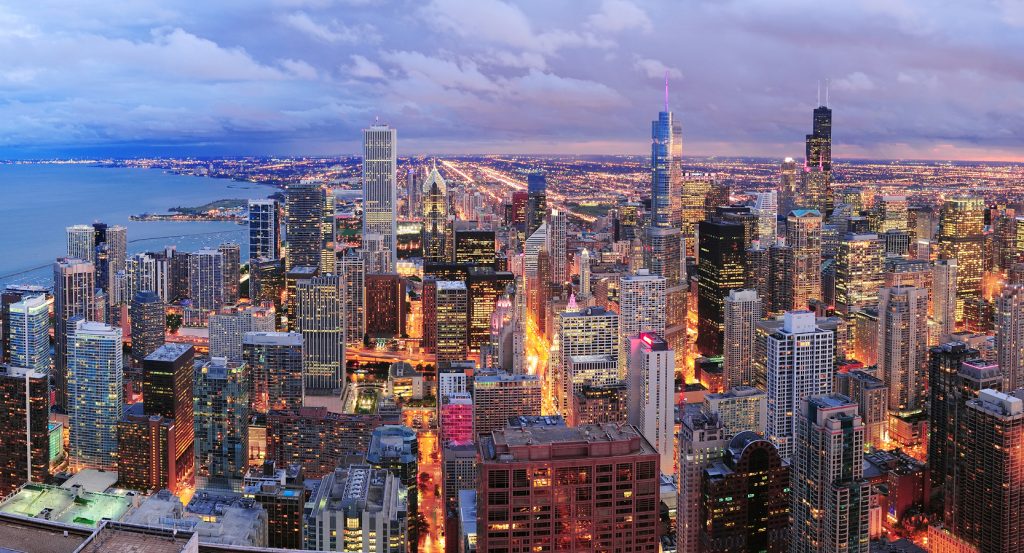
Set along North Michigan Avenue near East Chicago Avenue and just steps from Loyola University Chicago's Water Tower Campus, the hotel occupies the Gold Coast's southeastern threshold between Michigan Avenue's retail corridor, Chicago Avenue's east-west junction and residential towers extending north toward Oak Street. Lucien Lagrange Architects composed the tower with limestone, glass and strongly defined vertical proportions, creating a contemporary building whose restrained exterior relates closely to the masonry architecture surrounding the northern Grand Mile. Upper hotel floors command broad perspectives across the Water Tower district, with Lake Michigan appearing beyond the dense high-rises east of the avenue. Arrival shifts from the commercial intensity of Michigan Avenue into quieter interiors organized around stone, wood, artwork and carefully framed views of the surrounding city. The result is a hotel whose limestone architecture, residential scale and immediate relationship with Chicago's historic northern skyline give Hyatt's flagship luxury brand an unusually strong connection to its hometown.
What defines Park Hyatt Chicago.
Park Hyatt Chicago is best known for opening in 2000 as a purpose-built flagship for the luxury brand created by Chicago's Pritzker family. Hyatt's history began in 1957 when Jay Pritzker purchased the Hyatt House motel near Los Angeles International Airport from entrepreneur Hyatt von Dehn, initiating the hospitality company that subsequently expanded across the United States and internationally. Park Hyatt emerged decades later as the company's most rarefied brand, and its Chicago property brought that concept directly into the city where the Pritzker family had built its business empire. The project rose at the northern end of the Grand Mile on a site occupied by an earlier Park Tower building, creating a new hotel and residential tower beside the surviving nineteenth-century Water Tower. Lucien Lagrange Architects designed the development, extending the architect's extensive body of residential and hospitality work across Chicago. The tower reaches 67 stories, with hotel functions concentrated in its lower portion and private residences occupying the floors above. Hyatt opened the hotel in November 2000, establishing a Park Hyatt property within blocks of the company's longtime Chicago corporate base. Hyatt Hotels Corporation subsequently became a publicly traded company in 2009, placing the Chicago hotel within a global portfolio whose origins remained directly tied to the Pritzker family. The property closed in 2020 for an extensive reconstruction that extended for nearly two years, representing the first comprehensive reinvention of the hotel since its debut. Park Hyatt Chicago reopened in July 2022 after the project transformed principal interiors while preserving the building's original architectural structure. The reopening returned one of Hyatt's signature properties to the city where the company itself had been built, linking the Park Hyatt brand's international expansion with the Pritzker family's enduring Chicago business history.
Jouin Manku directed the 2022 interior transformation, developing a residential composition around natural materials, custom furnishings and an expanded relationship between artwork and architecture. Limestone, oak, wool, leather and pale textiles establish a subdued material palette that shifts attention toward craftsmanship and the city views framed throughout the property. Chicago artist Nick Cave's Soundsuit 2011 stands within the lobby collection, bringing one of the city's most internationally recognized contemporary artists into the principal arrival sequence. Paintings, sculpture and works on paper extend throughout the public and private interiors, continuing an art program that has been central to the property since its original opening. Gerhard Richter's Domplatz, Mailand became particularly associated with the hotel after the Pritzker family sold the painting at Sotheby's in 2013 for $37.1 million, then a record auction price for a living artist. NoMI was reconstructed across the seventh floor as three interconnected components, NoMI Kitchen, NoMI Lounge and NoMI Garden, each developed around a distinct relationship with the skyline and Water Tower below. Jouin Manku used sculptural woodwork, stone surfaces and softly curved furnishings across the dining interiors, reducing visual boundaries between circulation areas and places intended for longer occupation. NoMI Garden extends the composition outdoors above Michigan Avenue, positioning trees, planting and seating against views of the surrounding towers. The hotel's renewed art collection and tactile material program carry the private character of Park Hyatt into spaces shaped by significant works of contemporary art and close visual contact with Chicago architecture. Park Hyatt Chicago emerged from its 2022 transformation with a design language built around natural materials, significant contemporary art and the elevated urban perspectives inherent to Lucien Lagrange's tower.
How Park Hyatt Chicago fits.
Park Hyatt Chicago works as the anchor for an outing connecting a Roman Catholic cathedral shaped by Chicago's nineteenth-century growth, a historic house that became a center for architectural scholarship and an institution devoted to preserving the history and culture of Polish America.
Begin at Holy Name Cathedral, whose present building opened in 1875 after the Great Chicago Fire destroyed its predecessor and dramatically altered the surrounding Catholic community. Patrick Charles Keely designed the Gothic Revival church with a steeply pitched roof, pointed arches and a soaring interior organized around clustered columns and extensive woodwork. The cathedral became the seat of the Archdiocese of Chicago, placing the building at the institutional center of one of the country's largest Catholic populations. Its exterior also bears a physical trace of the 1926 killing of North Side Gang figure Hymie Weiss, embedding a notorious Prohibition-era episode into the fabric of the religious complex. Continue to Charnley-Persky House Museum, commissioned by James and Helen Charnley and constructed in 1891 and 1892 under Adler & Sullivan. Louis Sullivan developed the residence with Frank Lloyd Wright contributing during his period in Sullivan's office, producing a remarkably restrained brick exterior and a symmetrical interior organized around a soaring central atrium. Skidmore, Owings & Merrill acquired and restored the house during the 1980s, and Seymour Persky subsequently transferred it to the Society of Architectural Historians. The building became the organization's international headquarters, joining an important early modern residence with an institution devoted to studying the built environment. Conclude at Polish Museum of America, founded in 1935 by the Polish Roman Catholic Union of America and opened to the public in 1937. Its collections preserve art, military artifacts, manuscripts, folk material and objects documenting Polish immigration and Polish American civic life. A major gallery is devoted to pianist and statesman Ignacy Jan Paderewski, incorporating possessions from his final residence and material connected with his extraordinary careers in music and Polish politics. The institution also preserves objects from the Polish Pavilion at the 1939 New York World's Fair, extending its scope beyond immigration history into twentieth-century Polish cultural representation abroad. The progression moves from Holy Name Cathedral's nineteenth-century ecclesiastical authority through Charnley-Persky House Museum's pivotal architectural experimentation and culminates at Polish Museum of America, where art, migration, music and political history converge within one of the country's oldest ethnic museums.
Where your story begins.
Foresyte Travel reveals places that feel extraordinary long before you arrive.
Enjoy editorial crafted for luxury travelers.
Foresyte may earn a commission when you book.