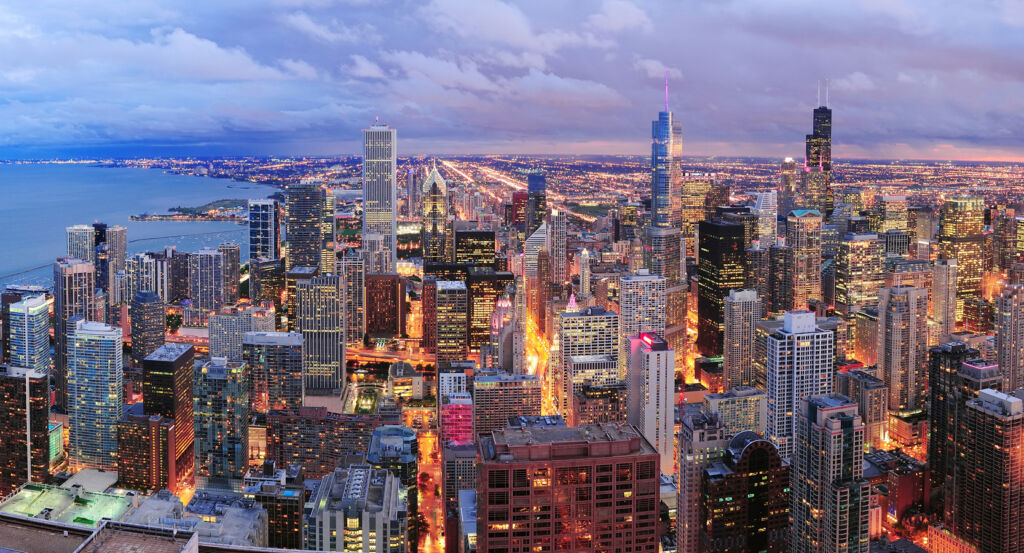
Why you should experience Peoria Street in Chicago, Illinois.
Peoria Street is an enterprising corridor where West Loop's industrial legacy, architectural reinvention, entrepreneurial spirit, and Chicago's continuing evolution as a center of innovation unfold across one of the Near West Side's defining streets.
Running through the West Loop between Fulton Market and University Village, Peoria Street passes former warehouse districts, restored loft buildings, contemporary offices, research facilities, neighborhood institutions, and historic masonry streetscapes that demonstrate more than a century of urban transformation. The corridor reveals how manufacturing, wholesale commerce, and adaptive reinvestment reshaped an industrial landscape into one of Chicago's most economically dynamic districts while preserving its historic structure. Historic brick architecture and contemporary development coexist naturally, creating a streetscape where successive eras of growth remain clearly legible. The result is a corridor distinguished by architectural continuity, commercial vitality, and one of Chicago's most compelling examples of urban reinvention.
What you should know about Peoria Street.
Peoria Street is best known for extending through the West Loop, where rapid industrial expansion followed construction of the Union Stock Yard in 1865, the growth of the Chicago & North Western Railway freight network, and the establishment of the Fulton Market Produce District during the late nineteenth century. Development surrounding the corridor accelerated between the 1880s and the 1930s as wholesale food markets, cold-storage warehouses, food processing plants, freight houses, and multi-story loft buildings established the neighborhood as one of the Midwest's principal centers of food distribution and light manufacturing. Much of the corridor falls within the Fulton-Randolph Market Historic District, designated a Chicago Landmark in 2015, preserving one of the city's largest concentrations of late nineteenth- and early twentieth-century industrial architecture while recognizing the district's longstanding commercial significance. Peoria Street also developed alongside the former headquarters and manufacturing facilities of internationally recognized companies including Harpo Studios and McDonald's corporate campus, reflecting the district's continuing evolution from industrial production to corporate investment, technology, and creative enterprise.
Preservation policy has guided much of Peoria Street's recent evolution as landmark protections encouraged adaptive reuse of timber-loft buildings, heavy masonry warehouses, and former industrial facilities. Developers working within the Fulton-Randolph Market Historic District retained original brick façades, exposed structural timber, cast-iron columns, and oversized warehouse windows while introducing contemporary offices, laboratories, and commercial interiors compatible with historic design standards. Economic investment expanded further as life sciences, technology firms, and corporate headquarters established major operations along the corridor, reinforcing a development pattern that continued building upon the district's industrial structure. Together, these preservation strategies, architectural adaptations, and long-term private investment demonstrate how Peoria Street continues expressing the West Loop's evolution through sustained reinvention grounded in its historic built environment.
How to fold Peoria Street into your trip.
Peoria Street works as an exploration of the West Loop's industrial heritage, contemporary design, and culinary culture.
Begin at Fulton Market District, where preserved warehouse architecture introduces the commercial foundations that shaped the surrounding neighborhood before following Peoria Street through the West Loop. Continue to Mary Bartelme Park, whose contemporary landscape architecture provides a striking contrast to the historic masonry streetscape while illustrating the district's continuing residential evolution. Conclude at Chicago French Market, where regional food vendors and locally produced specialties provide a fitting finale celebrating the commercial traditions that have long defined this part of the city. The progression moves naturally from wholesale commerce to contemporary public space before concluding within a market that reflects the neighborhood's continuing role as one of Chicago's foremost destinations for food and entrepreneurship.
Where your story begins.
Foresyte Travel reveals places that feel extraordinary long before you arrive.
Experience premium editorial crafted for luxury travelers.