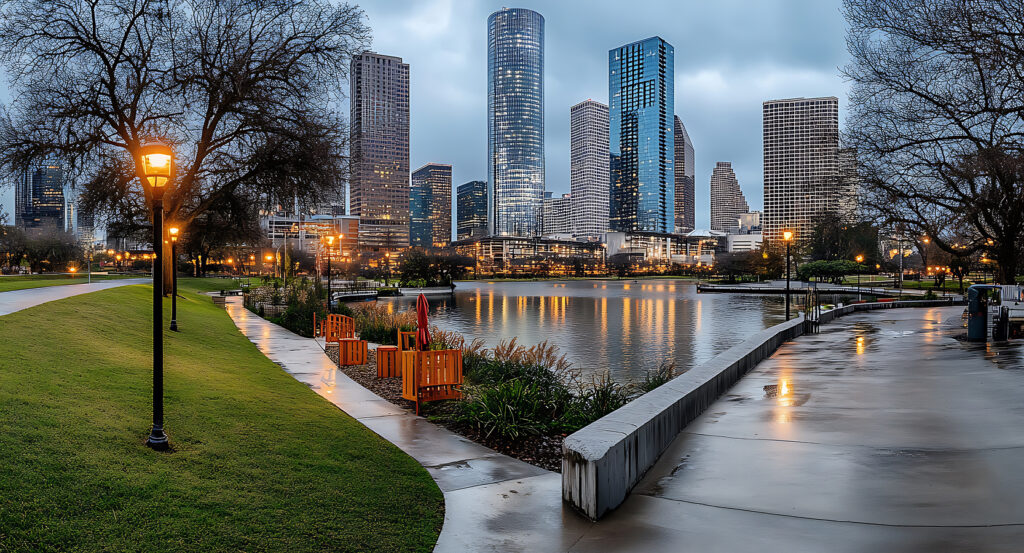
Why you should experience Ranchester Drive in Houston, Texas.
Ranchester Drive is a tranquil corridor where Spring Branch's postwar heritage, neighborhood continuity, cultural diversity, and enduring residential character converge along one of West Houston's defining community streets.
Running through Spring Branch between Memorial and Spring Branch West, the corridor connects established residential neighborhoods, longstanding congregations, commercial corridors, and community green spaces that collectively reflect Houston's remarkable suburban expansion during the second half of the twentieth century. Broad setbacks, mature live oaks, mid-century homes, and carefully maintained neighborhood landscapes create a streetscape where generations of community investment remain readily apparent. Continued reinvestment has strengthened the corridor while preserving the residential structure established during Spring Branch's formative decades. The result is an experience defined by architectural continuity, cultural richness, and one of Spring Branch's most enduring corridors.
What you should know about Ranchester Drive.
Ranchester Drive is best known for extending through Spring Branch, an area settled during the nineteenth century by German immigrant farming families before rapid suburban expansion followed World War II, transforming dairy farms, rice fields, and open prairie into one of Houston's largest residential districts. Residential construction surrounding the corridor accelerated between the 1950s and the 1970s, producing extensive collections of Ranch, Mid-Century Modern, Traditional, and Contemporary homes distinguished by low-pitched rooflines, brick veneer, attached garages, generous setbacks, and mature tree canopies that continue defining the neighborhood's architectural character. Successive German, Korean, Vietnamese, Hispanic, and Middle Eastern communities established churches, neighborhood businesses, cultural organizations, and locally owned enterprises that contributed to Spring Branch's exceptional cultural diversity while reinforcing the corridor's longstanding community identity. Nearby commercial districts expanded alongside the growth of Houston's energy economy, allowing Ranchester Drive to remain closely connected to one of West Houston's principal residential centers. Collectively, the corridor's agricultural origins, architectural evolution, demographic diversity, commercial development, and residential continuity establish Ranchester Drive as one of Spring Branch's defining historic corridors.
Along the corridor, St. Cecilia Catholic Church, established in 1952, expanded with Spring Branch's earliest postwar neighborhoods and became an enduring center of religious, charitable, and cultural life serving successive generations of residents. That tradition of neighborhood stewardship continues through nearby Agnes Moffitt Park, whose 52 acres preserve mature woodland, athletic fields, walking trails, and Brays Bayou floodplain landscapes that reinforce the natural setting surrounding Ranchester Drive. The nearby Houston Arboretum & Nature Center, founded in 1967, protects 155 acres of native forest, prairie, wetland, and savanna habitats, illustrating the ecological communities that once extended across much of western Harris County before suburban development reached Spring Branch. Together, these longstanding institutions, preserved landscapes, and enduring ecological resources demonstrate how Ranchester Drive developed within a corridor where neighborhood history, environmental continuity, and community traditions remain closely interconnected.
How to fold Ranchester Drive into your trip.
Ranchester Drive works as an exploration of West Houston's natural landscapes, architectural heritage, and artistic traditions.
Begin at Memorial Park, where extensive woodland trails, restored native habitats, and expansive green spaces introduce the ecological character that historically defined western Houston. Continue to Bayou Bend Collection and Gardens, where American decorative arts, historic architecture, and formal gardens broaden the experience through one of Houston's finest historic estates. Conclude at The Menil Collection, where internationally renowned works spanning centuries provide the historical payoff by illustrating Houston's enduring commitment to art, scholarship, and cultural excellence. The progression moves naturally from preserved natural landscapes through architectural heritage before culminating in one of the city's foremost cultural institutions.
Where your story begins.
Foresyte Travel reveals places that feel extraordinary long before you arrive.
Experience premium editorial crafted for luxury travelers.