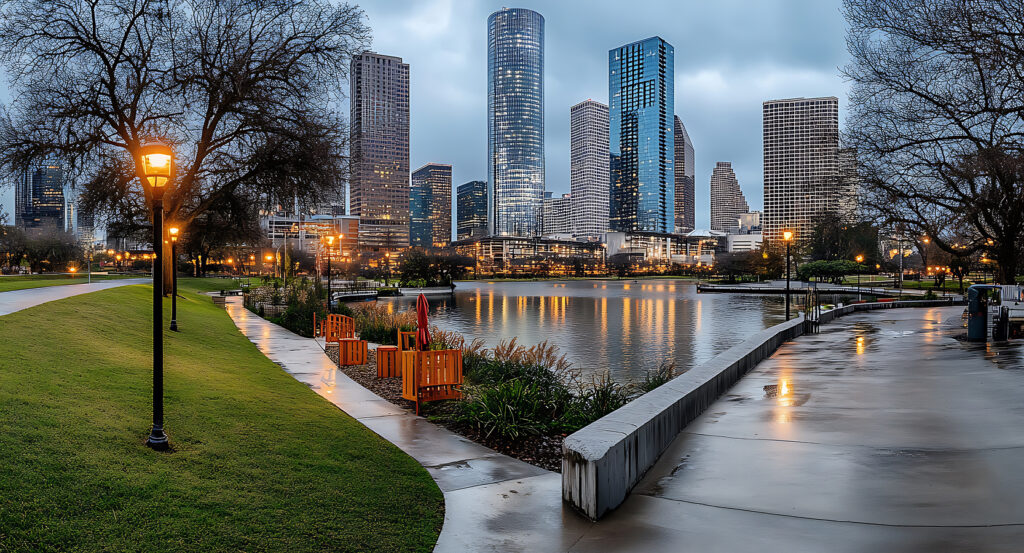
Why you should experience Revere Street in Houston, Texas.
Revere Street is a refined corridor where River Oaks' architectural distinction, residential heritage, cultural sophistication, and enduring civic character converge along one of Houston's most elegant neighborhood streets.
Running through River Oaks between Upper Kirby and Montrose, the corridor connects distinguished residences, landscaped boulevards, neighborhood institutions, and cultural destinations that collectively reflect one of the nation's most influential twentieth-century planned communities. Mature live oaks, generous setbacks, ornamental landscaping, and architecturally significant homes create a streetscape where nearly a century of careful stewardship remains immediately apparent. Longstanding preservation of the neighborhood's original planning principles has enabled the corridor to retain the residential character established during River Oaks' formative decades. The result is an experience defined by architectural refinement, historical continuity, and one of River Oaks' most distinguished corridors.
What you should know about Revere Street.
Revere Street is best known for extending through River Oaks, a master-planned community established in 1924 by developers Will Hogg and Michael Hogg in partnership with attorney Hugh Potter, introducing one of the nation's earliest comprehensively planned suburban neighborhoods. Development followed a landscape plan prepared by Hare & Hare, whose curvilinear streets, deed restrictions, broad parkways, and coordinated open-space design established planning principles that later influenced residential communities throughout the United States. Residential construction accelerated throughout the 1920s, 1930s, and 1940s, producing an exceptional collection of Colonial Revival, Georgian Revival, Tudor Revival, Mediterranean Revival, and International Style residences designed by architects including John F. Staub, Birdsall P. Briscoe, Harry D. Payne, and MacKie & Kamrath. The River Oaks Garden Club, founded in 1927, shaped the neighborhood's horticultural character through coordinated tree planting, boulevard landscaping, and civic beautification, while the River Oaks Property Owners, Inc. has maintained the original deed restrictions and planning structure for generations. Collectively, the corridor's planned origins, landscape architecture, architectural diversity, institutional continuity, and residential heritage establish Revere Street as one of Houston's defining historic corridors.
Along the corridor, St. John's School, founded in 1946, occupies a campus whose collegiate-inspired architecture and longstanding educational presence reflect the neighborhood institutions that developed alongside River Oaks' residential growth. That tradition of architectural excellence continues at St. Martin's Episcopal Church, established in 1952, where expansive Gothic-inspired buildings, limestone construction, and finely crafted interiors demonstrate the continued evolution of distinguished institutional architecture surrounding Revere Street. Nearby River Oaks Park, acquired by the City of Houston in 1929, preserves mature live oaks, recreational landscapes, and the original relationship between neighborhood green space and residential planning envisioned by the community's founders. Together, these enduring institutions, carefully preserved public landscapes, and architecturally significant buildings demonstrate how Revere Street developed within a corridor where thoughtful planning, institutional continuity, and architectural excellence remain closely connected.
How to fold Revere Street into your trip.
Revere Street works as an exploration of Houston's residential architecture, decorative arts, and cultural heritage.
Begin at Bayou Bend Collection and Gardens, where American decorative arts, formal gardens, and the former Ima Hogg estate establish the historical foundation for understanding River Oaks' architectural legacy. Continue to The Menil Collection, where internationally renowned artworks broaden the experience through one of Houston's most respected cultural institutions. Conclude at Museum of Fine Arts, Houston, where encyclopedic collections spanning thousands of years provide the historical payoff by illustrating the artistic traditions that complement River Oaks' architectural refinement. The progression moves naturally from Houston's finest historic residence through world-renowned artistic expression before culminating in one of the nation's premier art museums.
Where your story begins.
Foresyte Travel reveals places that feel extraordinary long before you arrive.
Experience premium editorial crafted for luxury travelers.