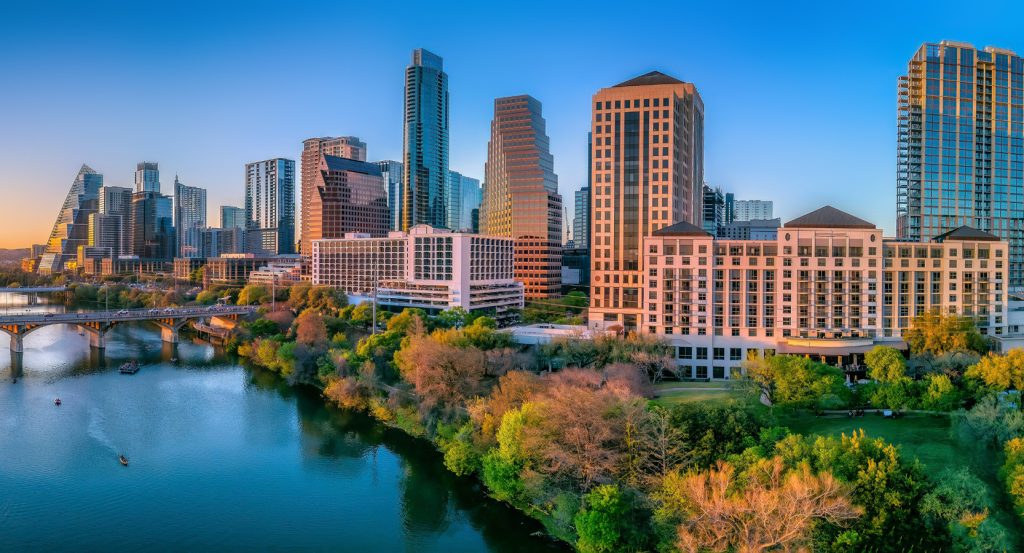
Why you should experience Robert Dedman Drive in Austin, Texas.
Robert Dedman Drive is a distinguished corridor where East Cesar Chavez's civic ambition, educational tradition, athletic legacy, and cultural vitality create one of Austin's most recognizable streets.
Running through East Cesar Chavez between Downtown and Holly, the corridor connects major athletic venues, educational institutions, public parks, museums, and the Colorado River corridor that reflect generations of civic investment and urban growth. Each successive stretch reveals stadium architecture, mature pecan trees, landscaped plazas, academic buildings, and riverfront vistas that reinforce the street's unmistakable identity. The defining moment arrives as Robert Dedman Drive demonstrates how higher education, public investment, and athletic achievement continue shaping one of Central Austin's defining corridors. The result is an experience defined by institutional significance, civic energy, and one of East Cesar Chavez's most rewarding streets.
What you should know about Robert Dedman Drive.
Robert Dedman Drive is best known for serving as the principal approach to the University of Texas at Austin's eastern athletic campus, where the university has expanded intercollegiate athletics and institutional facilities since the early twentieth century. The corridor fronts Darrell K Royal-Texas Memorial Stadium, originally completed in 1924 as War Memorial Stadium with 27,000 seats, before successive expansions increased capacity to more than 100,000 spectators, making it among the largest collegiate football stadiums in the United States. Nearby athletic facilities include the Frank C. Erwin Jr. Center, which operated from 1977 until 2022, the Moody Center, opened in 2022 as the university's new multipurpose arena, and Disch-Falk Field, whose origins date to 1949 before a comprehensive reconstruction completed in 2009 created one of collegiate baseball's premier venues. The corridor also borders the Lyndon Baines Johnson Presidential Library, dedicated in 1971 and designed by architect Gordon Bunshaft of Skidmore, Owings & Merrill, preserving more than 45 million pages of historical documents, 650,000 photographs, and extensive audiovisual collections documenting the Johnson administration. Broad sidewalks, native limestone, landscaped medians, live oaks, cedar elms, and multimodal transportation improvements reinforce the corridor's civic setting while linking the university with the Colorado River and Downtown. Collectively, the corridor's educational institutions, athletic facilities, architectural landmarks, presidential archives, and transportation infrastructure establish Robert Dedman Drive as one of Austin's defining institutional corridors.
Adjacent to the corridor, the Mike A. Myers Stadium, completed in 1999, serves as the home of Texas track and field while hosting NCAA Championships, Big 12 Championships, and international athletics competitions. Nearby, the Texas Memorial Museum, opened in 1939, continues advancing geological, paleontological, archaeological, and biodiversity research through one of Texas's most significant natural history collections. The nearby Waller Creek Conservancy, established in 2011, has guided ecological restoration, flood-control integration, and public open-space improvements that strengthen the environmental character surrounding the university district. Together, these athletic venues, scientific institutions, and environmental initiatives demonstrate how Robert Dedman Drive reflects a corridor where education, research, and civic investment continue reinforcing one another.
How to fold Robert Dedman Drive into your trip.
Robert Dedman Drive works as an exploration of Austin's educational legacy, athletic tradition, and presidential history.
Begin at Darrell K Royal-Texas Memorial Stadium, where nearly a century of collegiate football, grand stadium architecture, and university tradition establish the defining character surrounding Robert Dedman Drive. Continue to Moody Center, where contemporary arena design, concerts, and collegiate athletics deepen the experience before guiding the journey toward its historical conclusion. Conclude at Lyndon Baines Johnson Presidential Library, where presidential archives, immersive exhibitions, and nationally significant historical collections provide the historical payoff by illuminating one of the most consequential presidencies in modern American history. The progression moves naturally from athletic tradition to contemporary civic entertainment before culminating in one of the nation's foremost presidential libraries.
Where your story begins.
Foresyte Travel reveals places that feel extraordinary long before you arrive.
Experience premium editorial crafted for luxury travelers.