Why Sofitel Chicago Grand Mile matters.
Sofitel Chicago Grand Mile is a sculptural hotel where Gold Coast's architectural sophistication meets Jean-Paul Viguier's French modernism, a dramatically cantilevered glass prism and Pierre-Yves Rochon interiors conceived as a distinctly Parisian contribution to Chicago's skyscraper tradition.
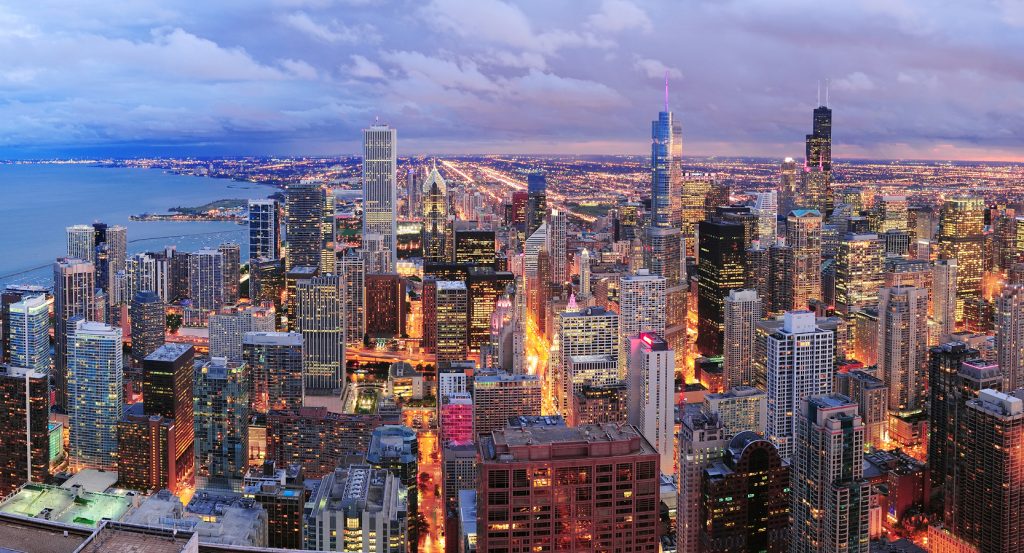
Set along East Chestnut Street near North Wabash Avenue and just steps from Mariano Park, the hotel occupies an angular downtown parcel where Rush Street's diagonal geometry opens the surrounding blocks and gives the tower an unusually exposed position among the Gold Coast's dense high-rises. Jean-Paul Viguier shaped the building as a white-glass wedge rising from a dark curving base, with the southern edge leaning outward as the tower narrows and eventually projecting 33 feet beyond the sidewalk below. Opaque white glass dominates the principal elevations, and a contrasting band of dark glazing sweeps across the lower structure before climbing the tower as a narrow vertical plane. Floor-to-ceiling windows exploit the building's angled geometry through broad exposures toward Lake Michigan and the surrounding skyline, turning Viguier's unconventional massing into a direct component of the interior setting. The result is a hotel whose cantilevered edge, contrasting glass surfaces and carefully exposed urban position give a French architect's geometric modernism unusual prominence within Chicago's celebrated high-rise landscape.
What defines Sofitel Chicago Grand Mile.
Sofitel Chicago Grand Mile is best known for Jean-Paul Viguier's 2002 tower, an audacious purpose-built project that gave Accor's French luxury brand one of its most architecturally consequential North American properties. Construction began in 2000 as Sofitel pursued a substantial international development campaign that would place new properties in cities including Washington, Montreal, London, Marrakech, Bangkok, Buenos Aires, Venice, Budapest and Shanghai. Viguier approached Chicago as an architectural city demanding an assertive original building, developing a prism whose acute southern edge projects 33 feet beyond its footprint at the upper levels. Teng & Associates worked with the Paris architect on engineering, resolving the structural demands created by the outward-leaning southern portion and the constrained urban parcel. The completed tower reaches 347 feet and uses its triangular geometry to create two principal façades oriented toward different portions of the city. Sofitel Chicago Water Tower opened in May 2002, establishing a permanent downtown showcase for a brand founded in France in 1964. AIA Chicago subsequently selected Viguier's project as the best new Chicago building of the preceding decade, recognition determined through voting by hundreds of local architects. The building also entered the American Institute of Architects' national list of 150 favorite works of American architecture and received a MIPIM award in the Hotels and Tourism Resorts category. Ashford Hospitality Prime acquired the property for $153 million in February 2014, placing a substantial financial value on the hotel twelve years after its debut. The Sofitel Chicago Grand Mile name later replaced Sofitel Chicago Water Tower, tying the property more explicitly to the North Michigan Avenue district while leaving Viguier's architecture as its defining physical asset. Sofitel Chicago Grand Mile occupies an uncommon position in Chicago hospitality as a purpose-built luxury hotel whose architectural authorship, engineering and international recognition carry significance independent of its hotel brand.
Where your story begins.
Foresyte Travel reveals places that feel extraordinary long before you arrive.
Enjoy editorial crafted for luxury travelers.