
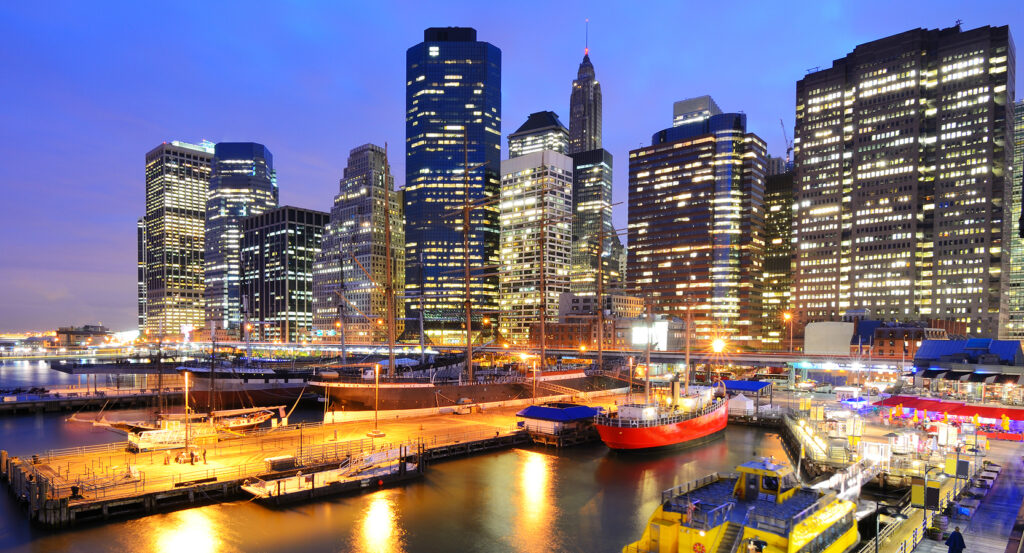
Why South Street matters.
South Street is a historic Seaport corridor where the Financial District's maritime heritage, commercial ambition, preserved architecture, and waterfront character create one of Lower Manhattan's most storied streets.
Running along the East River through the The Seaport Historic District between Whitehall Street and Fulton Street, this remarkable waterfront corridor invites visitors to explore restored nineteenth-century warehouses, cobblestone streets, historic sailing ships, museums, restaurants, and riverfront promenades that preserve the atmosphere of New York's original working harbor. Brick mercantile buildings, sweeping harbor views, and centuries of maritime history create an environment where the city's global rise as a port remains vividly apparent. Every block reflects the enduring relationship between commerce and the waterfront. The result is an experience defined by historic authenticity, architectural preservation, and one of New York's most significant waterfront corridors.
What defines South Street.
South Street is best known for developing during the late eighteenth and nineteenth centuries as the commercial spine of the Port of New York, when the East River waterfront became one of the busiest maritime districts in the world and the principal gateway for international trade serving the rapidly expanding United States. Constructed immediately beside the city's original shoreline before successive waves of landfill extended Lower Manhattan eastward, the corridor became lined with counting houses, chandlers, sailmakers, ship outfitters, warehouses, merchant offices, and wholesale markets supporting thousands of oceangoing vessels arriving from Europe, the Caribbean, South America, and Asia. The surviving The Seaport Historic District, designated in 1977, preserves one of the nation's largest concentrations of early nineteenth-century commercial architecture, including Federal and Greek Revival mercantile buildings that demonstrate New York's transformation into America's leading port city. The street also anchors the The Seaport Museum, whose internationally significant collection includes the 1885 tall ship Wavertree, historic vessels, maritime archives, and exhibitions documenting centuries of New York's shipping history. Extensive revitalization efforts completed during the twenty-first century have restored historic buildings, expanded waterfront public spaces, strengthened flood resilience following Hurricane Sandy in 2012, and reestablished South Street as one of Lower Manhattan's premier cultural and recreational destinations while preserving its extraordinary maritime character.
Beyond its remarkable architectural heritage, South Street demonstrates how historic waterfront infrastructure can successfully evolve into a spirited mixed-use district. Carefully restored warehouses now accommodate museums, restaurants, galleries, specialty retailers, and cultural venues while preserving the scale, materials, and street pattern that once served one of the world's busiest working harbors. The corridor's direct relationship with the East River, Brooklyn Bridge, Pier 17, and historic ships creates an immersive urban landscape where visitors can experience the physical setting that powered New York's emergence as a global commercial capital. Maritime preservation, adaptive reuse, waterfront revitalization, and urban continuity combine to create one of America's most influential historic streets.
How South Street fits.
South Street works as the historic waterfront centerpiece of an exploration through the The Seaport.
Begin at the The Seaport Museum, where remarkable maritime collections introduce the extraordinary history surrounding South Street. Continue to Pier 17, whose contemporary waterfront promenade extends the corridor's relationship with the East River. Conclude at the Brooklyn Bridge, where one of the world's most celebrated engineering landmarks provides a memorable finale celebrating the remarkable relationship between commerce, transportation, and maritime heritage that defines Lower Manhattan. The progression moves naturally from maritime history to historic waterfront corridor before concluding through two defining New York landmarks, revealing why South Street remains one of the city's essential historic experiences.
Where your story begins.
Foresyte Travel reveals places that feel extraordinary long before you arrive.
Enjoy editorial crafted for luxury travelers.
Foresyte may earn a commission when you book.







































































































