Why St. Louis Cemetery No. 1 matters.
St. Louis Cemetery No. 1 is the living mythology of New Orleans etched in stone and sunlight.
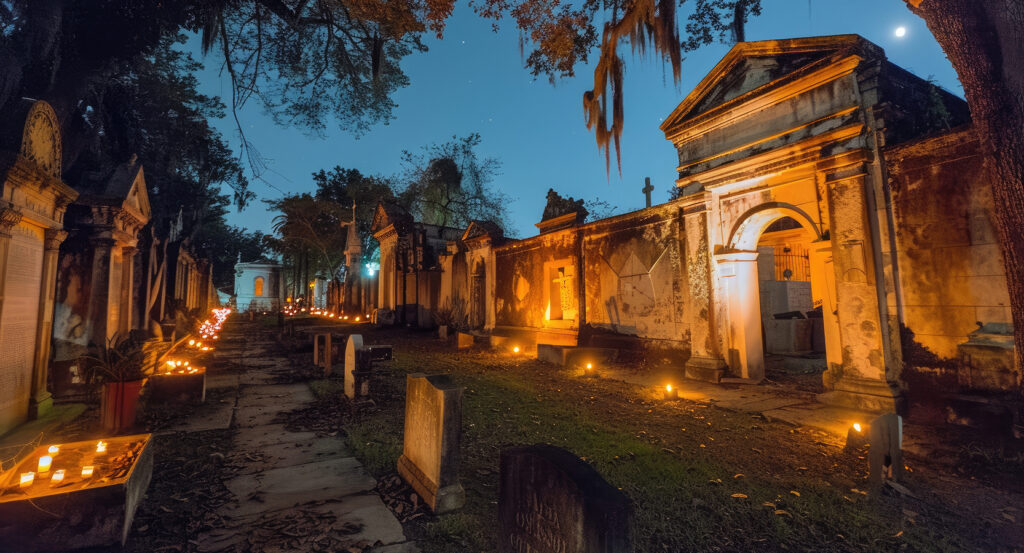
Founded in 1789, this compact, one-block necropolis is the oldest and most storied of the city's “cities of the dead.” Above-ground tombs rise shoulder-to-shoulder in a maze of white plaster and gray marble, their weathered façades glowing under the Louisiana sun. The tight, winding aisles feel more like narrow streets than graveyard paths, and as you wander them, you sense the pulse of the city that built this place, Catholic, Creole, African, French, Spanish, and unmistakably New Orleans. The air hums with cicadas, the scent of magnolia mingles with moss and dust, and the sound of distant brass bands seems to drift in from another life. This is where saints and sinners, politicians and poets, soldiers and storytellers all share the same eternal address. St. Louis Cemetery No. 1 isn't morbid; it's lyrical, a place where life and death blur into something profoundly, rebelliously alive.
What defines St. Louis Cemetery No. 1.
Behind its cracked plaster and wrought-iron gates lies a layered tale of invention, resilience, and faith that mirrors the city itself.
Built to combat the city's swampy ground and frequent flooding, the above-ground vaults were inspired by Mediterranean and Caribbean traditions, blending necessity with artistry. Families share tombs over generations, each burial chamber designed to reopen once remains have returned to ash in the subtropical heat, a cycle that keeps space and memory intertwined. Among its most famous residents is Marie Laveau, the renowned Voodoo Queen whose tomb draws visitors from around the world, leaving offerings, flowers, and quiet prayers. Nearby rest Étienne de Boré, the city's first mayor, and Homer Plessy, whose defiance in Plessy v. Ferguson reshaped American law. The cemetery itself is a lesson in endurance: despite fires, floods, and neglect, it continues to stand, safeguarded by preservation groups and descendants who treat it as both sacred ground and ancestral gallery. Every tomb here is a chapter, every crack a line of poetry written by time.
How St. Louis Cemetery No. 1 fits.
To experience St. Louis Cemetery No. 1 with the reverence it deserves, enter it as a guest of memory, not a tourist.
Access is limited to guided tours, a rule that protects both the fragile vaults and the stories they hold. Begin at the Basin Street Visitor Center, where you can learn about the cemetery's layered history before stepping through its arched gates. Let a local guide lead you through the labyrinth of tombs, pausing at Marie Laveau's resting place, the pyramidal future tomb of actor Nicolas Cage, and family vaults bearing names that built and rebuilt New Orleans over three centuries. Move slowly, this is a place best felt, not rushed. Visit in early morning when the sun gilds the plaster in gold, or at dusk when long shadows stretch like memory itself. As you leave, turn back once more toward the clustered mausoleums gleaming against the skyline. St. Louis Cemetery No. 1 isn't just where New Orleans buries its dead, it's where it keeps its soul.
Where your story begins.
Foresyte Travel reveals places that feel extraordinary long before you arrive.
Enjoy editorial crafted for luxury travelers.
Foresyte may earn a commission when you book.