
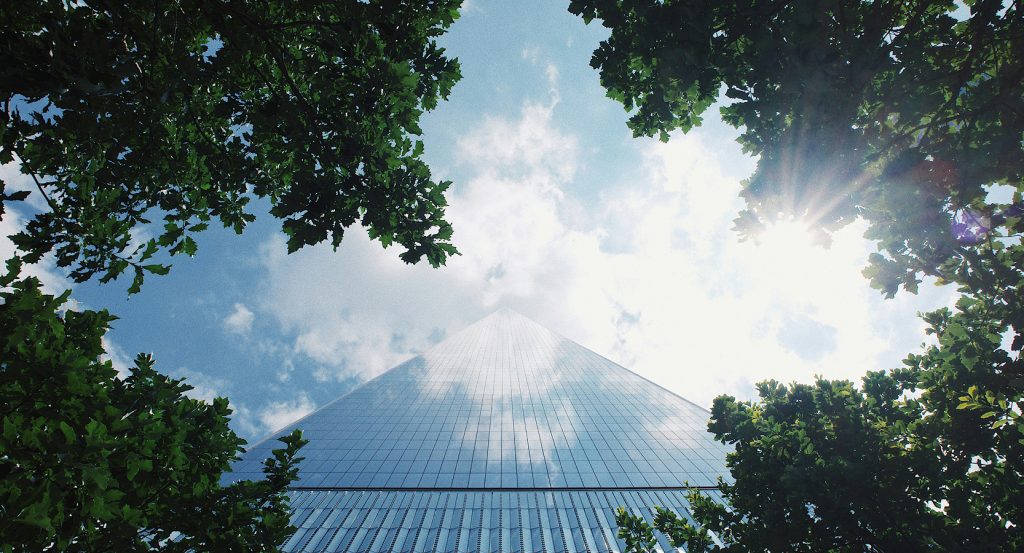
Why St. Nicholas National Shrine matters.
St. Nicholas National Shrine is a luminous Byzantine-inspired sanctuary where the World Trade Center's culture of remembrance meets Santiago Calatrava's sacred architecture, Greek Orthodox tradition and the rebirth of the only house of worship destroyed on September 11, 2001.
Set atop Liberty Park near Greenwich Street and just steps from the 9/11 Memorial Glade, the shrine occupies an elevated position 25 feet above street level, lifting its compact sacred volume above the surrounding memorial landscape. Four stone-clad corner towers define a square around a circular drum and dome, with alternating bands of white and gray marble recalling Byzantine masonry and giving the compact exterior a pronounced geometric order. Thin stone-and-glass laminated panels divide the dome into 40 facets corresponding to the 40 windows of Hagia Sophia, allowing concealed illumination to pass through the translucent envelope after dark. A sheltered porticus leads through the exonarthex and narthex toward the nave, iconostasis and sanctuary, compressing the architectural sequence into a building whose modest footprint carries an unusually elaborate liturgical organization. The result is a compact sacred building whose elevated position, marble geometry, translucent dome and carefully ordered interior place Byzantine architectural references directly within the rebuilt World Trade Center.
What defines St. Nicholas National Shrine.
St. Nicholas National Shrine is best known for resurrecting the Greek Orthodox parish destroyed by the collapse of the World Trade Center's South Tower on September 11, 2001, carrying a Lower Manhattan immigrant church founded in 1916 into a new national shrine conceived for the reconstructed site. Greek immigrants had purchased the original Cedar Street row house in 1892 as a community home before converting the former tavern into Saint Nicholas Greek Orthodox Church, giving newcomers arriving through Ellis Island a religious foothold near the southern end of Manhattan. The parish remained at 155 Cedar Street as the original World Trade Center rose around it during the 1960s and resisted efforts to sell its increasingly isolated property. The South Tower's collapse completely destroyed the church on September 11, leaving only a small number of sacred objects recovered during the subsequent search of the site. Reconstruction became a prolonged institutional undertaking as the Greek Orthodox Archdiocese of America negotiated the church's position within the redesigned World Trade Center with the Port Authority of New York and New Jersey. A settlement mediated during Governor Andrew Cuomo's administration secured a new site at 130 Liberty Street, placing the rebuilt church a short distance from its original parcel and integrating it with the elevated Liberty Park. Santiago Calatrava received the architectural commission and developed the new shrine through direct study of Byzantine precedents, drawing its central dome from Hagia Sophia and the banded exterior towers from the Church of the Holy Savior in Chora. Calatrava translated those precedents through Pentelic marble, the same Greek stone associated with the Parthenon, and a contemporary translucent wall assembly engineered to transform the exterior after sunset. The rebuilding encountered another major interruption when construction stopped in 2017 amid financial difficulties, prompting creation of the Friends of Saint Nicholas in December 2019 to raise and disburse the money required for completion. Work resumed in 2020, carrying a project born from the destruction of 2001 through nearly two decades of negotiation, architectural development and fundraising toward completion.
Ecumenical Patriarch Bartholomew gave the unfinished shrine a major ceremonial milestone on November 2, 2021, blessing the building and participating in the elevation of the cross atop its marble dome during the thirtieth anniversary year of his enthronement. The shrine had displayed its signature nighttime illumination weeks earlier during the twentieth-anniversary remembrance of September 11, activating a lighting concept developed by Calatrava with DLR Group to make the stone envelope glow internally. Archbishop Elpidophoros of America subsequently presided over the consecration on July 4, 2022, placing the building into Greek Orthodox liturgical life on American Independence Day. The consecrated building carries a dual role as an active parish and a National Shrine open to people beyond the Greek Orthodox community, expanding the purpose of the former Cedar Street church into a place devoted to prayer, mourning and remembrance at the World Trade Center. Twenty prophets occupy the dome between its 40 ribs, joining Orthodox sacred imagery to the architectural geometry derived from Hagia Sophia. The interior iconographic program extends through the iconostasis and sanctuary, embedding the rebuilt church within a Byzantine artistic tradition that reaches far beyond its twenty-first-century structure. Calatrava's architecture joins Bartholomew's 2021 blessing, Elpidophoros's 2022 consecration and the shrine's Orthodox imagery within a single post-September 11 chapter, turning physical reconstruction into the restoration of a living religious institution at the World Trade Center.
How St. Nicholas National Shrine fits.
St. Nicholas National Shrine works as the anchor for a daytime Lower Manhattan sequence connecting colonial worship, the architectural ambition of early skyscraper New York and the rediscovery of an African sacred ground beneath the modern city.
Begin at St. Paul's Chapel, completed in 1766 as an auxiliary chapel of Trinity Church and now Manhattan's oldest public building in continuous use, giving Lower Manhattan a surviving religious structure that predates American independence. The Georgian chapel endured the Great Fire of 1776, and George Washington proceeded there with members of the new federal government for a religious service after his April 30, 1789 inauguration as the first president of the United States. Its historical arc acquired another chapter after September 11, 2001, when the chapel escaped structural destruction beside the World Trade Center and became a center of care for rescue and recovery workers, joining eighteenth-century national history to Lower Manhattan's twenty-first-century catastrophe. Continue to Woolworth Building, where retail magnate Frank W. Woolworth commissioned Cass Gilbert in 1910 to turn a corporate headquarters into the world's tallest building. Gilbert and structural engineer Gunvald Aus carried the tower to 792 feet, sinking 69 pneumatic caissons 100 to 120 feet to bedrock beneath a steel frame clad by the Atlantic Terra Cotta Company; the building held the world height title after its 1913 completion until 1930. President Woodrow Wilson activated its illumination remotely from Washington during the April 24, 1913 opening, and the vaulted lobby joined mosaics, stained glass, marble and caricature sculptures of Woolworth, Gilbert and other project figures within a skyscraper celebrated as the “Cathedral of Commerce.”  Conclude at African Burial Ground National Monument, where excavation for a federal office building in 1991 exposed a colonial cemetery that had disappeared beneath Lower Manhattan after closing in the 1790s. The burial ground had covered 6.6 acres and received 15,000 Africans and people of African descent, enslaved and free, during the seventeenth and eighteenth centuries; excavation removed the remains of 419 individuals from a portion of the site. Community action halted excavation in 1992, the remains went to Howard University for extensive examination, and the 2003 Rites of Ancestral Return carried them from Washington through several cities before reinterment in Ghanaian-carved mahogany coffins lined with Kente cloth. President George W. Bush proclaimed the site a national monument in 2006, completing a modern sequence of rediscovery, community intervention, ancestral return and permanent memorialization. The progression moves from St. Paul's survival across the Revolutionary and September 11 eras through Gilbert and Woolworth's skyscraper ambition into the recovered African Burial Ground, revealing Lower Manhattan as a place where sacred memory, architectural reinvention and buried histories repeatedly reshape the meaning of the city.
Where your story begins.
Foresyte Travel reveals places that feel extraordinary long before you arrive.
Enjoy editorial crafted for luxury travelers.
Foresyte may earn a commission when you book.







































































































