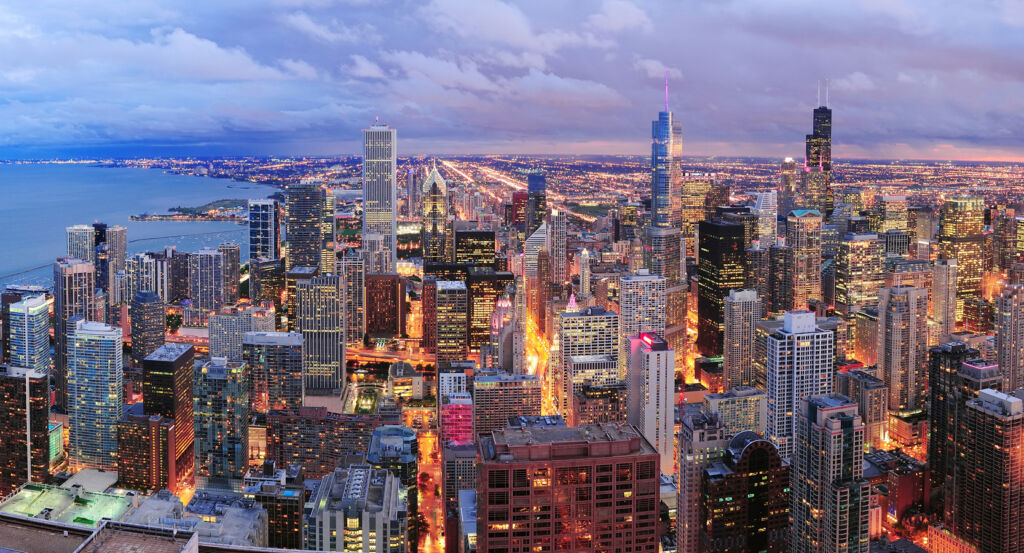
Why Stony Island Avenue matters.
Stony Island Avenue is a distinguished corridor where South Shore's lakefront legacy, Chicago's cultural heritage, and the South Side's architectural ambition converge along one of the city's most influential boulevards.
Running through South Shore between Hyde Park and South Chicago, the corridor connects nationally significant museums, historic apartment buildings, neighborhood commercial districts, expansive churches, and Jackson Park while tracing more than a century of civic and residential development. Broad medians, mature trees, masonry high-rises, and institutional architecture preserve a streetscape shaped by the World's Columbian Exposition, expanding streetcar networks, and the growth of Chicago's lakefront communities. Walking along Stony Island Avenue reveals how transportation, culture, and neighborhood investment combined to create one of the South Side's defining urban corridors. The result is a corridor whose enduring character continues to embody the character of South Shore.
What defines Stony Island Avenue.
Stony Island Avenue is best known for evolving from an early regional roadway into one of Chicago's principal South Side boulevards following the World's Columbian Exposition of 1893, whose transformation of nearby Jackson Park accelerated residential and commercial development throughout the surrounding neighborhoods. Expansion of electric streetcar service during the late nineteenth and early twentieth centuries, followed by improvements associated with the South Shore Line and the Chicago Surface Lines, established the avenue as a major transportation spine linking Hyde Park, South Shore, and South Chicago. Between the 1900s and the 1940s, architects and developers introduced substantial apartment hotels, Art Deco residential towers, neighborhood shopping districts, and institutional buildings that reflected the corridor's growing prominence within Chicago's expanding lakefront. Continued preservation efforts, streetscape improvements, and institutional investment have retained Stony Island Avenue as one of the South Side's most historically significant civic corridors.
In 1936, the George Washington Carver Military Academy established an enduring educational presence that reflected the corridor's expanding civic role while serving generations of South Side students through evolving academic and leadership programs. The opening of the South Shore Cultural Center as a public facility in 1975, following its earlier life as the South Shore Country Club, reinforced Stony Island Avenue's importance by preserving one of Marshall & Fox's finest Mediterranean Revival designs as a center for arts, recreation, and community life. Successive revitalization initiatives led by organizations including the Quad Communities Development Corporation and the Chicago Department of Transportation have modernized commercial intersections, pedestrian infrastructure, and public spaces while preserving the boulevard's historic scale and architectural continuity. Together, these educational institutions, civic investments, and preservation initiatives demonstrate how Stony Island Avenue continues to evolve while maintaining the physical and cultural structure that defines South Shore.
How Stony Island Avenue fits.
Stony Island Avenue is best experienced through an exploration of South Shore's cultural heritage, architectural legacy, and lakefront landscape.
Begin at Museum of Science and Industry, where the only major surviving building from the 1893 World's Columbian Exposition establishes the historical foundation for understanding the expansive civic development that shaped Stony Island Avenue and its surrounding neighborhoods. Continue to South Shore Cultural Center, whose preserved Mediterranean Revival architecture and lakefront setting deepen the story by illustrating how elite recreation evolved into one of Chicago's most beloved public cultural destinations. Conclude at Jackson Park, where Olmsted and Vaux's celebrated landscape, the legacy of the World's Columbian Exposition, and today's revitalized public spaces provide the historical and resonant payoff, revealing how Stony Island Avenue unites Chicago's ambitions in landscape design, culture, education, and community into one enduring South Side narrative.
Where your story begins.
Foresyte Travel reveals places that feel extraordinary long before you arrive.
Enjoy editorial crafted for luxury travelers.
Foresyte may earn a commission when you book.