
Why Strahov Library matters.
Strahov Library in Prague is more than a collection of ancient books, it's a cathedral of knowledge, where time seems to pause and the air hums with centuries of thought.
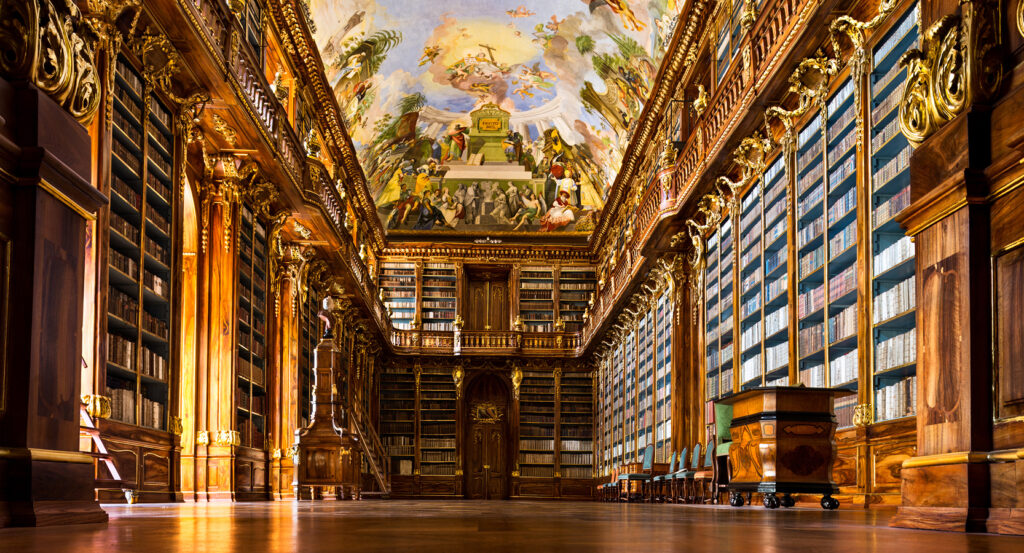
Perched within the Strahov Monastery atop Petřín Hill, this 12th-century library stands as one of the most breathtaking intellectual sanctuaries in Europe. Sunlight filters through high arched windows, glinting off gilded woodwork and frescoed ceilings that depict the triumph of wisdom over ignorance. Every corner feels reverent, not only for faith, but for human curiosity itself. The Theological Hall, with its gleaming walnut shelves and globes scattered across polished floors, captures harmony between science and spirituality. The Philosophical Hall, grander still, stretches upward into a vault painted with allegories of enlightenment, its scent of old parchment and beeswax heavy in the air. Strahov Library isn't just a visual wonder; it's a living tribute to the pursuit of truth, a reminder that before knowledge was digital, it was sacred. In a world rushing forward, stepping into this library feels like opening a door back into eternity.
What defines Strahov Library.
Strahov Library's splendor is matched only by the richness of its history, a story shaped by faith, resilience, and the love of learning.
Founded in 1143 as part of the Premonstratensian monastery, the library grew over centuries into one of Europe's most significant centers of scholarship. Its earliest volumes date to the Middle Ages, painstakingly copied by monks who saw writing as a form of prayer. Many of those manuscripts remain preserved in the Theological Hall, built in the 17th century by architect Giovanni Domenico Orsi. The room's frescoes, painted by Siard Nosecký, demonstrate divine wisdom guiding humanity, scenes filled with angels, scrolls, and glowing orbs of light. A century later, the Philosophical Hall was added, its neoclassical grandeur designed by Jan Ignác Palliardi and frescoed by Franz Anton Maulbertsch, whose sweeping murals celebrate human reason as a gift of God. Together, the two halls contain more than 200,000 volumes, from illuminated medieval texts and Jesuit theology to first editions of Galileo and Newton. During the 20th century, when the Communist regime seized the monastery, the library narrowly escaped destruction. Its priceless manuscripts were secretly catalogued and hidden, protected by those who understood that these works were not mere relics, but vessels of national memory. After the Velvet Revolution, the Premonstratensian order reclaimed and restored the site, reviving its original harmony. Beyond the great halls, the Cabinet of Curiosities displays seashells, fossils, and scientific instruments that reflect humanity's boundless fascination with the natural world, the Renaissance spirit distilled into a single room. Each shelf, each globe, each manuscript captures centuries of questions whispered into parchment and ink.
How Strahov Library fits.
Visiting Strahov Library is best approached as a quiet pilgrimage, a journey into the heart of wisdom itself.
Begin by making your way up Petřín Hill, where Prague unfurls in spires and red rooftops beneath you. The monastery complex appears serene and unassuming from the outside, its white façades concealing the grandeur within. Step through the entrance and pause, the hush is immediate, the kind of silence that seems to listen back. Start with the Theological Hall, where sunlight catches on gold-leaf inscriptions and ancient globes gleam in the dim light. Let your eyes travel along the shelves stacked with manuscripts that once shaped entire civilizations. Move next to the Philosophical Hall, where Maulbertsch's fresco, a sweeping vision of humanity's enlightenment, expands above like the sky itself. When the scent of old paper and beeswax fills your senses, you'll realize that this place is alive; every book hums softly with memory. Explore the adjoining Cabinet of Curiosities to see the intersection of art and science that once defined the early modern world. Afterward, stroll through the monastery gardens for a view of Prague Castle and the Vltava River flowing below, and if time allows, stop by the Strahov Brewery, where monks have brewed beer since the 13th century. Visit near golden hour, when amber light spills through the library's arched windows, igniting the frescoes in warm fire. Standing there, surrounded by six centuries of wisdom, you understand that Strahov Library is more than a place, it's a tribute to humankind's eternal longing to know, to create, and to remember.
Where your story begins.
Foresyte Travel reveals places that feel extraordinary long before you arrive.
Enjoy editorial crafted for luxury travelers.
Foresyte may earn a commission when you book.





































































































