Why Swissôtel Chicago matters.
Swissotel Chicago is a sculptural hotel where The Loop's riverfront character meets Harry Weese's triangular modernism, an all-glass tower conceived around three directional panoramas and a Swiss hospitality brand expanding internationally during the late twentieth century.
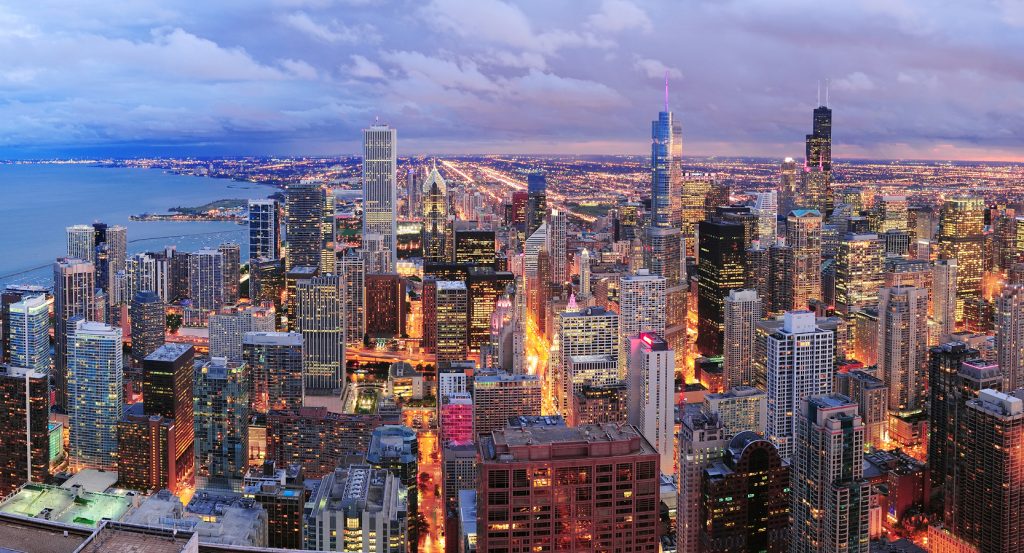
Set along East Wacker Drive near North Columbus Drive and just steps from the landscaped terraces of Lakeshore East, the hotel occupies a narrow riverfront parcel where elevated roadways, high-rise residential architecture and the open water of the Chicago River create an unusually layered downtown setting. Harry Weese Associates shaped the tower as a slender equilateral triangle, allowing its three glass elevations to address different portions of the surrounding city and water while giving the building a sharply recognizable profile. Continuous glazing wraps the concrete structure, and the acute corners terminate in narrow vertical edges that heighten the tower's apparent slenderness from the river and adjoining streets. Upper floors rise above much of the immediate built environment, creating long sightlines across the river corridor, downtown towers and lakefront from the building's three principal orientations. The result is a hotel whose triangular geometry, uninterrupted glass skin and river-edge position transform an unconventional downtown parcel into one of Harry Weese's clearest late-career high-rise compositions.
What defines Swissôtel Chicago.
Swissotel Chicago is best known for Harry Weese Associates' distinctive triangular tower, conceived during the first decade of Swissôtel's international expansion and opened on August 1, 1988 as the Swiss Grand Hotel Chicago. Swissair and Nestlé had formed Swissôtel in 1980, initially building the company around properties in Bern, Zurich, Geneva and New York before extending the network into additional international cities. Chicago became one of the brand's significant purpose-built American projects after construction began in 1986. Weese gave the building an equilateral-triangle cross section, turning geometry into the central architectural decision governing its relationship with the Chicago River, Lake Michigan and downtown skyline. The 457-foot tower rises 45 stories and carries an all-glass curtain wall across 180,000 square feet of façade. Morse Diesel International served as general contractor, and Enclos participated in development of the exterior enclosure. The project joined a body of Weese work that ranged from Washington Metro stations and Washington's Arena Stage to Chicago's Metropolitan Correctional Center, Time & Life Building and restoration of Louis Sullivan and Dankmar Adler's Auditorium Building. Swiss Grand Hotel opened during a period when the Swissair and Nestlé hospitality venture was pushing beyond its original European base into cities including Chicago, Seoul, Beijing, Istanbul and Singapore. Nestlé subsequently relinquished its Swissôtel interest, leaving Swissair in control of the hotel company as the brand continued expanding during the 1990s. Raffles Holdings acquired Swissôtel in 2001 after Swissair encountered severe financial difficulties, beginning a succession of corporate changes that eventually placed the brand alongside Fairmont and Raffles. Accor acquired the Fairmont, Raffles and Swissôtel parent company in 2015, bringing the Chicago property into one of the world's largest hospitality groups. Swissotel Chicago links a major work by one of Chicago's most individual postwar architects with the corporate history of a Swiss hotel brand that passed from an airline and food-company partnership through Raffles and Fairmont before entering Accor.
Gettys Group directed a $10 million reconstruction completed in 2012 that treated Harry Weese's architecture as the conceptual basis for a new lobby, bar and meeting interiors. Natural finishes and earth tones established the principal palette, connecting the redesign with the property's Swiss origins through an understated material program. Thousands of suspended glass bubbles form a rainstorm-inspired lighting installation overhead, turning illumination into one of the lobby's dominant decorative elements. Backlit glass panels etched with the Chicago skyline establish a second site-specific component behind the reception area. German artist Jork André Dieter created Swiss Circle near Amuse, using changing colored light to produce a continually shifting installation within the public interior. Streamlined individual check-in pods replaced the conventional continuous reception counter, materially changing the organization of the arrival area during the same campaign. Digney York Associates undertook another large reconstruction beginning in 2018, extending the design renewal through private interiors and corridors during the property's thirtieth-anniversary year. Summit Design + Build simultaneously reconstructed 13,200 square feet across the uppermost hospitality levels, working with Design One Studio and Gettys Group on a new ballroom, meeting areas and relocated fitness facilities. A 150-foot chandelier became the principal decorative intervention inside the new ballroom, giving the upper tower a lighting installation comparable in ambition to Gettys Group's earlier glass composition in the lobby. The 2018 work also introduced new specialty interiors, including the brand's second Vitality Suite worldwide, extending Swissôtel's wellness program into a property-specific design commission. Swissotel Chicago uses successive Gettys-led interventions, commissioned light art and Swiss-derived material references to reinterpret Weese's late-modern tower while preserving its triangular architecture as the dominant element of the property.
How Swissôtel Chicago fits.
Swissotel Chicago works as the anchor for an outing connecting a pioneering American music institution, a purpose-built theater beneath a major urban park and an architectural remnant preserving Chicago's nineteenth-century bridge engineering.
Begin at American Writers Museum, created after Irish writer Malcolm O'Hagan proposed a national institution devoted to American literature and assembled an advisory council that included scholars, publishers and cultural leaders. The museum opened in Chicago in May 2017 as the first national institution devoted to celebrating American writers and their influence on the country's history and culture. Ralph Appelbaum Associates developed the permanent exhibitions, using interactive installations to connect writers across periods, genres and regions instead of organizing the institution around a single author or collection. The Nation of Writers gallery establishes a chronological wall of significant literary figures, and the museum has developed dedicated exhibitions around subjects ranging from Frederick Douglass to Ray Bradbury. Continue to Harris Theater for Music and Dance, created through a philanthropic campaign to provide a permanent performance home for Chicago's midsized music and dance organizations. Hammond Beeby Rupert Ainge designed the theater largely below grade at the northern end of Millennium Park, solving the difficult problem of placing a substantial performance venue within a park whose surface was already constrained by rail infrastructure and parking. The theater opened in November 2003 and became home to organizations including Music of the Baroque and Hubbard Street Dance Chicago, consolidating multiple independent performing-arts groups within a purpose-built downtown venue. Its steeply descending auditorium and subterranean organization make the building an architectural counterpart to the public park directly overhead. Conclude at DuSable Bridge, the double-deck bascule crossing opened in 1920 to carry Michigan Avenue across the Chicago River and complete a major element of Daniel Burnham and Edward Bennett's vision for a unified boulevard north of the river. Hugh E. Young developed the bridge engineering, and Edward H. Bennett shaped the architectural treatment of its limestone bridgehouses. Four sculptural reliefs installed in 1928 portray episodes associated with exploration, settlement and the development of Chicago, integrating civic history into the bridge's massive pylons. The bridge's two roadway levels also accommodated the unusual vertical organization of Wacker Drive and the riverfront transportation system surrounding it. The progression moves from American Writers Museum's national interpretation of literary culture through Harris Theater for Music and Dance's subterranean home for Chicago performing arts and culminates at DuSable Bridge, where engineering, sculpture and city planning converge in the movable structure that transformed Michigan Avenue into a continuous downtown axis.
Where your story begins.
Foresyte Travel reveals places that feel extraordinary long before you arrive.
Enjoy editorial crafted for luxury travelers.
Foresyte may earn a commission when you book.