Why The Movie Menu matters.
The Movie Menu is a cinematic supper club where Bridgeport's independent creative character meets film-specific cooking, synchronized courses and screenings built around eating what appears on screen.
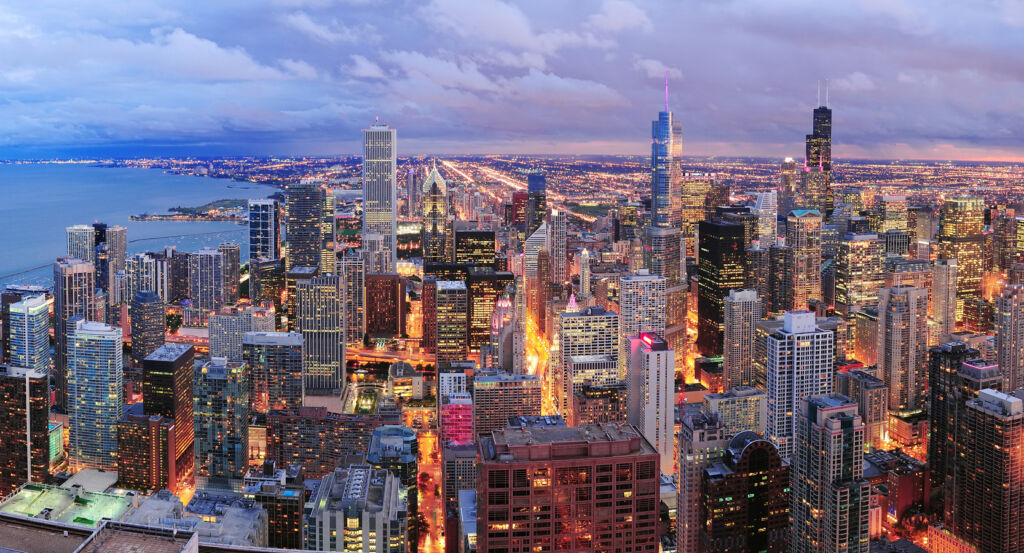
Set along South Throop Street near West 29th Street and just west of South Archer Avenue, the restaurant occupies a residential pocket of Bridgeport between the Halsted Street commercial spine, the South Branch of the Chicago River and the industrial corridor extending toward Bubbly Creek, with Chinatown unfolding northeast beyond the Stevenson Expressway and the Central Chicago skyline rising farther north. Movie posters, themed decorations and screening equipment transform the intimate dining room according to the title occupying the program. Tables face the projected film so dishes arrive against the scenes that inspired them, placing the screen and plate inside the same sequence. Coordinated decorations and party favors extend selected screenings beyond the food, changing the room alongside the rotating movie selection. The result is a small Bridgeport supper club whose synchronized film screenings, changing décor and scene-specific food turn a conventional dinner-and-movie pairing into a single tightly controlled event.
What defines The Movie Menu.
The Movie Menu is best known for building entire multi-course dinners around individual films, with the featured title and accompanying menu changing as the program rotates. Its central conceit depends on synchronization: food connected with a scene reaches the table as the corresponding moment unfolds on screen. The restaurant formalizes repeat attendance through a blue Movie Menu passport, which receives another stamp when a diner returns for a subsequent screening. Film changes also trigger menu changes, preventing the kitchen from operating around one permanent collection of signature dishes. Private events push the concept further through coordinated food, decorations and party favors assembled around the selected celebration. Reservations structure attendance within a room whose limited scale keeps the screening and meal concentrated around a small group of tables. Friday through Sunday service currently runs from early afternoon into the evening, giving the concept a scheduled event pattern distinct from continuous daily restaurant service. The Movie Menu operates less around a fixed culinary repertoire than an expanding catalogue of film dinners, with repeat visits organized around the next title and another stamp in the passport.
The kitchen takes its instructions directly from the featured film, translating recognizable on-screen food into courses timed to the relevant sequence. One documented screening moved through golden fried pieces with green salad, croutons, sliced strawberries and green apple before another serving paired fried bites with a creamy orange sauce and parsley. Dessert shifted into a clear cup layered with whipped cream, caramel and fresh strawberries, finished with a shiner as the later portion of the screening unfolded. Branded Movie Menu boxes make the service itself part of the presentation, carrying individual components to the table in containers tied directly to the concept. The changing-film structure frees subsequent programs to abandon those preparations entirely when another title takes over, forcing ingredients, presentation and course order to follow a different set of screen references. Tickets have started $70 for documented programs, bundling the screening with the succession of corresponding food. Food functions as a timed physical counterpart to specific cinematic moments, with the kitchen changing its preparations as radically as the films themselves.
How The Movie Menu fits.
The Movie Menu works as the evening anchor for a Bridgeport outing connecting a limestone quarry converted into ecological parkland, an industrial warehouse reclaimed for contemporary artists and a Chinese-American painting partnership that turned a former commercial building into an international arts center.
Begin at Palmisano Park, where land formed from a Silurian coral reef became a source of dolomite after Illinois Stone and Lime Company acquired the site in the late 1830s. Marcus Cicero Stearns took control of the quarry, whose excavation eventually descended 380 feet below street level during more than 130 years of mining before extraction ended in 1970. Construction debris subsequently filled portions of the void until dumping ceased, and Site Design Group later converted the damaged industrial terrain into a 26.6-acre park opened in 2009, retaining quarry walls while routing water through terraced wetlands toward a pond inside the former excavation. Continue to Bridgeport Art Center, whose 500,000-square-foot building began in 1911 as a manufacturing and warehouse complex for Albert Pick & Co. Architect A. S. Alschuler designed the Classical Revival structure, which expanded in 1922 and 1928 before Spiegel Catalog occupied it and Goodwill Industries acquired the property in 1978. Paul Levy and Tony Augustine purchased the five-acre complex in 1999, restoring heavy timber posts, wood plank floors and skylights as the building became Bridgeport Art Center in 2001; more than 120 artists now work alongside three galleries and the Fashion Design Center inside the former industrial plant. Conclude at Zhou B Art Center, founded in 2004 by brothers ShanZuo and DaHuang Zhou after their collaborative painting practice carried them from China to Chicago. The brothers had created their first joint work in 1973, gained national attention through the Huashan mural series and reached Chicago for an exhibition in 1986 before establishing their practice in Bridgeport. Their center grew into galleries and studios supporting 50 resident artists, extending the brothers' own movement between Chinese and American contemporary art into a permanent institution for international exchange. The progression moves from a 380-foot quarry reclaimed through ecological design through a manufacturing complex converted for hundreds of creative workers and culminates inside the institution created by two Chinese brothers whose collaborative practice made Bridgeport a base for international contemporary art.
Where your story begins.
Foresyte Travel reveals places that feel extraordinary long before you arrive.
Enjoy editorial crafted for luxury travelers.
Foresyte may earn a commission when you book.