
Why Vessel matters.
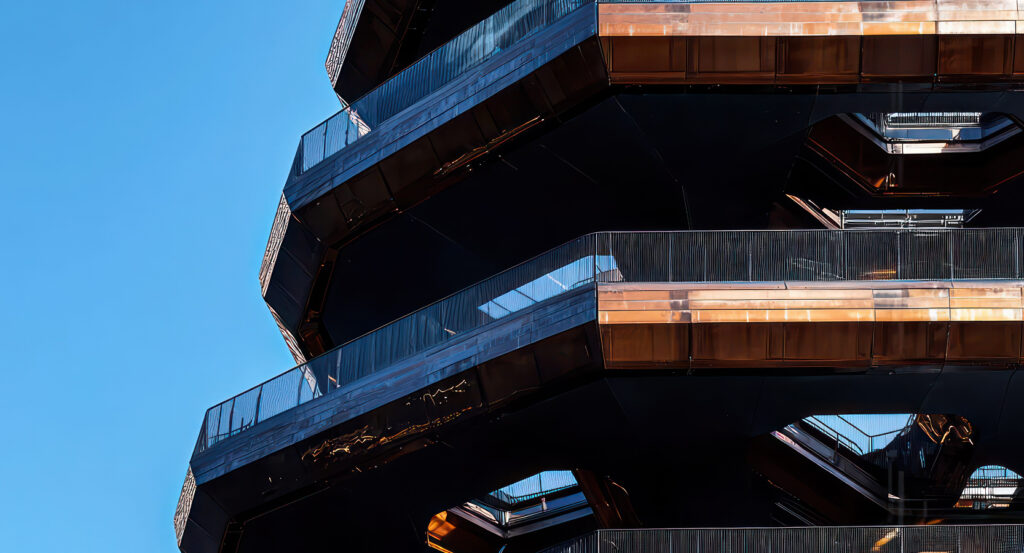
Vessel is a kinetic sculptural staircase where Hudson Yards' vertical ambition meets Thomas Heatherwick's inhabitable geometry of climbing routes, elevated perspectives and shifting reflections.
Set along Hudson Boulevard near West 33rd Street and just steps from The Shops at Hudson Yards, the sculptural structure occupies the center of a broad public square framed by glass towers, planted gardens and the dense vertical architecture of Manhattan's redeveloped West Side. Polished copper-colored undersides multiply fragments of the surrounding skyline across an open lattice whose repeated stair forms widen as they rise. Climbing establishes the primary encounter, sending movement upward through changing directions and elevations as the city repeatedly disappears behind the structure and returns through its openings. Elevated platforms introduce a second spatial mechanism through inward views across opposing stairways and outward sightlines toward the Hudson River, turning people elsewhere in the structure into moving elements of the composition. The result is an inhabitable sculpture whose shifting geometry becomes legible through ascent, giving Hudson Yards a public centerpiece experienced through physical movement as much as visual form.
What defines Vessel.
Vessel is best known for Thomas Heatherwick's conversion of the repeating geometry of Rajasthan's ancient stepwells into a 150-foot vertical structure containing 154 flights, 2,500 steps and 80 landings. Related Companies chairman Stephen M. Ross had sought a major centerpiece for Hudson Yards, and Heatherwick Studio pursued an object that people would physically enter and explore. Indian stepwells supplied the decisive conceptual reference, with their descending flights inverted into an ascending network that expands from a 50-foot base to a 150-foot upper diameter across 16 storeys. Heatherwick Studio developed the project for Related Companies and Oxford Properties Group with collaborators including AKT II, Arup, Kohn Pedersen Fox, Permasteelisa and Thornton Tomasetti. Italian steel specialist Cimolai fabricated the structure as 75 interlocking primary pieces at its Monfalcone facility, requiring components to be partially assembled before their journey to New York. The first ten pieces crossed the Atlantic during a fifteen-day voyage, passed through Port Newark and completed a five-hour barge journey across the Hudson River before erection began in April 2017. Eight months of assembly brought the final structural piece into position in December 2017, and Vessel opened to the public on March 15, 2019. Ross's commission, Heatherwick's stepwell concept, the expanding geometry and Cimolai's transatlantic fabrication joined an ancient architectural reference to one of the most technically intricate structures created for the Hudson Yards development.
Structural engineer Eli Gottlieb and Thornton Tomasetti developed another consequential chapter through the challenge of stabilizing a public structure composed principally of stairs, voids and repeated cantilevered forms. The completed assembly uses 96 steel members, including 75 primary dog-bone components, ten special base pieces, five pedestal pieces and six pieces forming the angled southern spine. Engineers modeled severe unbalanced loading scenarios in which occupants concentrated on one side and tested rhythmic movement capable of producing structural vibration. RWDI recreated anticipated motion and visual conditions at its St. John's, Newfoundland facility, allowing members of the design and ownership teams to experience simulated accelerations before completion. Ten tuned mass dampers averaging 12,000 kilograms apiece were designed and fabricated by German engineering company GERB to control movement, adapting technology associated with far taller structures to the unusual stair lattice. The reflective skin demanded separate technical development, with investigations into bonded bimetallic products and cupronickel alloys preceding selection of polished stainless steel treated with a copper-colored deposition coating engineered to retain its reflectivity beside the Hudson. Thornton Tomasetti, RWDI and GERB turned vibration, crowd loading and exposed metal performance into an engineering system supporting Heatherwick's unusual concept of lifting public circulation vertically through open space.
How Vessel fits.
Vessel works as the anchor for a daytime sequence through three West Side institutions that connect ambitious civic architecture, the industrial Hudson waterfront and twentieth-century transportation history.
Begin at Jacob K. Javits Convention Center, where lead designer James Ingo Freed of I. M. Pei & Partners conceived a convention complex around a 1,000-foot public concourse and 15-storey Crystal Palace, opening in 1986 and earning the American Institute of Architects' National Honor Award in 1988. A five-year, $463 million intervention completed in 2014 introduced a 6.75-acre green roof and replaced the exterior with 3,722 high-performance glass panels, followed by a 1.2-million-square-foot expansion completed in 2021 that substantially enlarged the institution created along Manhattan's western edge. Continue to Pier 76, where nineteenth-century waterfront industrialization eventually gave way to United States Lines operations before a 1964 reconstruction produced Manhattan's second-largest Hudson River pier. The site became Manhattan's municipal impound lot in 1977, remained a tow pound for more than four decades and entered a new chapter in 2021 when the former building was removed and 245,000 square feet opened as public space after an 81-day conversion; a 73,000-pound propeller from the S.S. United States preserves a physical connection to the transatlantic shipping era that preceded the tow pound. Conclude at Intrepid Museum, centered on the Essex-class aircraft carrier commissioned in 1943 that survived five kamikaze attacks and a torpedo strike during World War II before serving through the Cold War, three Vietnam deployments and NASA recovery missions. Real-estate developer and philanthropist Zachary Fisher led the campaign that saved USS Intrepid from scrapping after its 1974 decommissioning, bringing the carrier to New York as the centerpiece of a museum opened in 1982; the collection now extends that technological chronology through the submarine Growler, British Airways Concorde Alpha Delta G-BOAD and Enterprise, NASA's prototype space-shuttle orbiter. The progression moves from James Ingo Freed's glass convention architecture through a Hudson pier shaped by shipping, municipal reuse and waterfront conversion into an aircraft carrier spanning World War II, the Cold War, Vietnam and the Space Race, revealing the successive engineering ambitions that have shaped Manhattan's far West Side.
Where your story begins.
Foresyte Travel reveals places that feel extraordinary long before you arrive.
Enjoy editorial crafted for luxury travelers.
Foresyte may earn a commission when you book.







































































































