Why The Westin Cincinnati matters.
The Westin Cincinnati is a downtown hotel where Central Business District's commercial heritage meets late twentieth-century urban redevelopment, modernist architecture, and the evolution of Cincinnati's convention and hospitality industries.
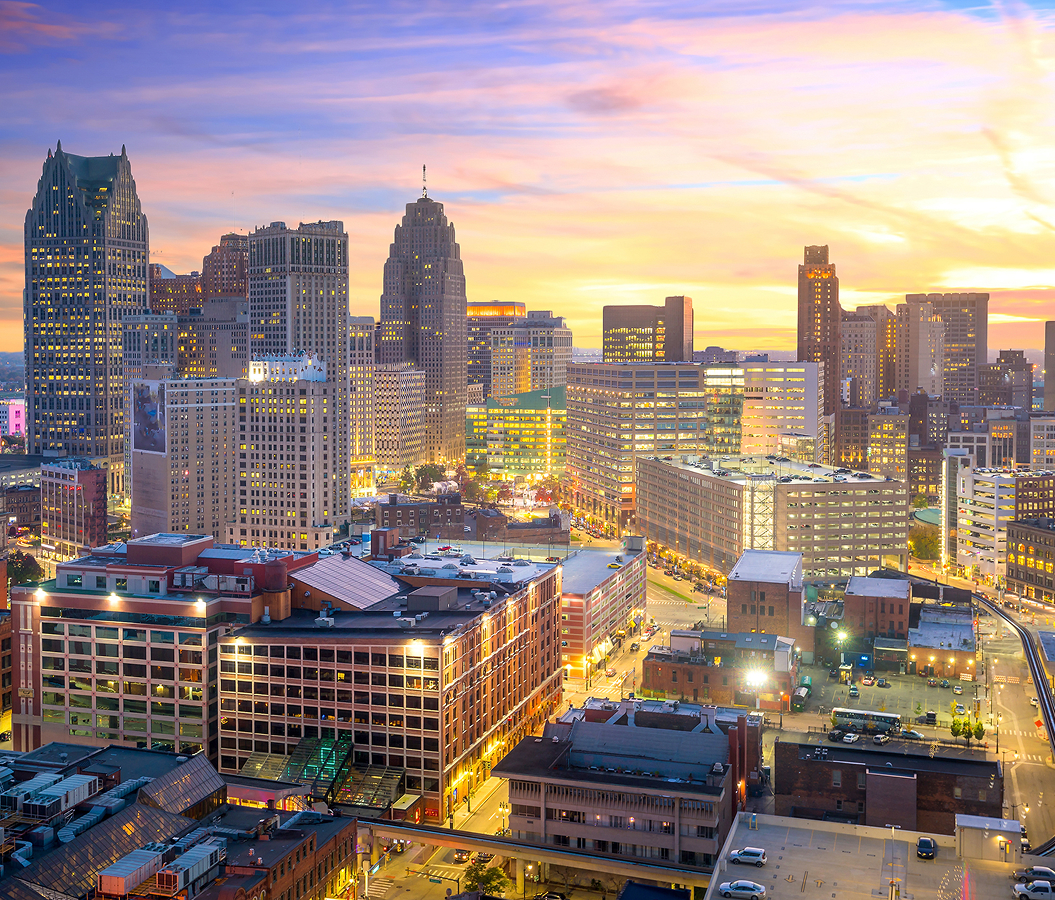
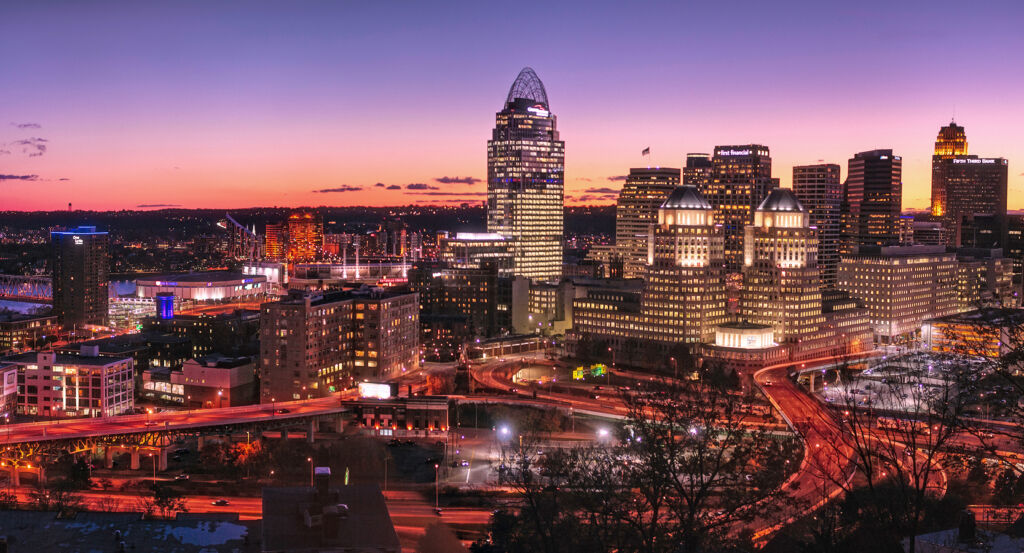
Occupying the southern frontage of the city's principal civic plaza, the hotel stands between 5th Street's commercial towers and the office buildings extending toward the Ohio River. Its modernist structure combines a broad glazed podium with a rectangular high-rise, forming part of a larger commercial complex whose architecture dates to Cincinnati's major downtown redevelopment campaigns. The entrance leads into a multilevel interior where escalators and broad circulation areas connect the principal reception spaces with adjoining commercial facilities. Floor-to-ceiling windows provide a second encounter with the surrounding city, framing the historic building façades, office towers, and public spaces that distinguish the central business district. The result is a metropolitan hotel whose architectural arrangement preserves a consequential chapter in Cincinnati's effort to rebuild its commercial center around convention travel and major civic investment.
What defines The Westin Cincinnati.
The Westin Cincinnati is best known for its origins as the Western International hotel within Fountain Square South, a major redevelopment completed in 1981 during Cincinnati's campaign to strengthen its downtown convention industry. The undertaking emerged from growing concern that the city's convention facilities and hotel capacity were insufficient to compete with larger Midwestern destinations. Cincinnati's convention bureau had advocated expansion of the existing convention center, whose original capacity constrained the city's ability to attract major gatherings. Municipal officials subsequently pursued additional hotel construction through development incentives and federal urban assistance, seeking to strengthen the relationship between convention activity and downtown commercial investment. Fountain Square South became a central component of this strategy, combining hotel accommodation, office development, and retail facilities along the southern boundary of the city's principal public square. The original development proposal, introduced in 1978, envisioned a glass-enclosed public living room extending the square's civic character into the hotel complex. That proposal underwent substantial revision before construction, and the final arrangement incorporated a more conventional commercial concourse. The change revealed a tension within the redevelopment campaign between creating public gathering spaces and accommodating the operating priorities of an international hotel. Abramovitz, Harris & Kingsland designed the complex, bringing a New York architectural practice associated with major commercial developments into the Cincinnati project. Turner Construction Company served as general contractor, completing a 26-story structure that combined hotel and office functions. The building opened in 1981, adding a substantial modernist development to a downtown district undergoing changes in its commercial geography. Its original Western International affiliation subsequently evolved into the Westin brand, preserving the property's relationship with an international hospitality organization whose origins date to the formation of Western Hotels in 1930. The complex also became associated with successive banking institutions, carrying names including Star Bank Center and Firstar Bank Tower as Cincinnati's financial industry underwent consolidation. A significant renovation followed in 2009, renewing the hotel during another period of downtown reinvestment. Host Hotels & Resorts subsequently commissioned an additional $11 million improvement program, with Becker Frondorf managing the undertaking and Blackdog Studio contributing architectural services. The investment demonstrated the continued commercial importance of the property more than three decades after its original construction. Its history connects Cincinnati's federally supported redevelopment, the expansion of international hotel operations, and successive efforts to sustain the downtown convention economy.
How The Westin Cincinnati fits.
The Westin Cincinnati works as the starting point for a walk from the city's historic civic square through a major commission in contemporary museum architecture and south toward an institution devoted to the history of American slavery and the Underground Railroad.
Begin at Fountain Square, immediately across 5th Street from the hotel, where the Tyler Davidson Fountain has served as a focal point of Cincinnati's public life since the nineteenth century. Businessman Henry Probasco commissioned the fountain in memory of his brother-in-law and business partner Tyler Davidson, selecting the Munich foundry of Ferdinand von Miller for its execution. Dedicated on October 6, 1871, the bronze and granite composition centers on the Genius of Water, surrounded by figures representing the practical and recreational importance of water. The square underwent major alterations in 1970, followed by a comprehensive redesign completed in 2006 that restored the fountain to a prominent position within an expanded pedestrian setting. Continue north and east to the Contemporary Arts Center, where Cincinnati's longstanding commitment to experimental visual art culminated in an internationally significant architectural commission. The institution originated in 1939 as the Modern Art Society, founded by Betty Pollak Rauh, Peggy Frank Crawford, and Rita Rentschler Cushman. Its development included decades of exhibitions across successive locations before the organization commissioned Zaha Hadid to design its first independent building. The Rosenthal Center for Contemporary Art opened in May 2003, becoming Hadid's first completed American project and a major achievement in the development of contemporary museum architecture. Her design incorporates an urban carpet extending from the sidewalk into the building, with interlocking galleries arranged above a multilevel public interior. Conclude by walking south toward the Ohio River to the National Underground Railroad Freedom Center, whose position near the waterfront connects the institution with Cincinnati's historical role along the boundary between free and slave states. The museum originated from a proposal advanced in 1994 and became an incorporated nonprofit organization the following year. Its development culminated in a groundbreaking attended by 14,000 people in 2002 and a public opening in 2004. The permanent exhibitions include an early nineteenth-century slave pen recovered from Kentucky, preserving a physical structure associated with the domestic slave trade. Its educational program examines abolitionism, resistance to enslavement, and the continuing struggle against human trafficking. The progression moves from Cincinnati's nineteenth-century civic investment through Hadid's advances in contemporary museum architecture and culminates in the Freedom Center's examination of the Ohio River's historical significance, connecting public space, artistic institutions, and American history.
Where your story begins.
Foresyte Travel reveals places that feel extraordinary long before you arrive.
Enjoy editorial crafted for luxury travelers.