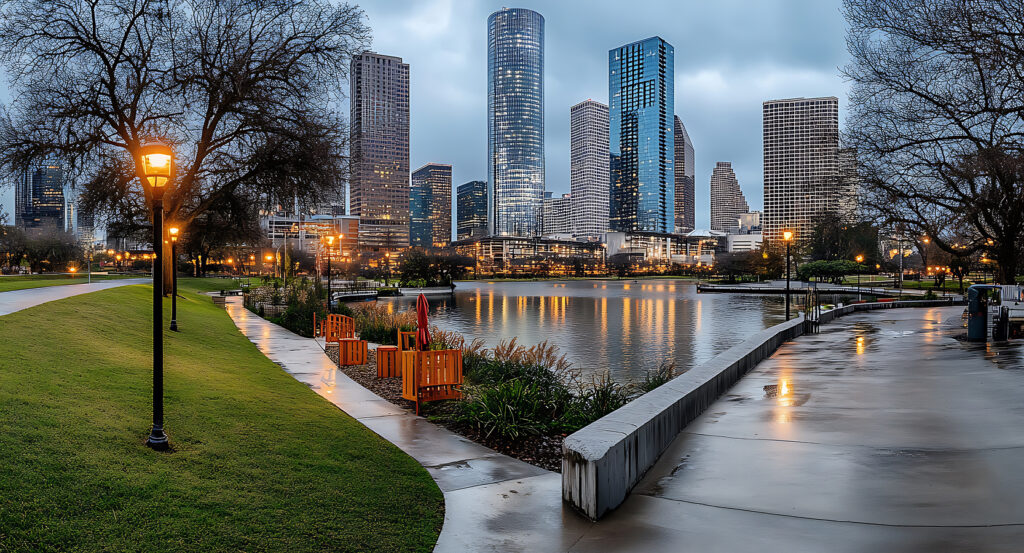
Why Wayside Drive matters.
Wayside Drive is an energetic corridor where Greater Eastwood's industrial heritage, neighborhood resilience, cultural diversity, and enduring east-side character converge along one of Houston's defining north-south streets.
Running through Greater Eastwood between Second Ward and Pleasantville, the corridor connects established neighborhoods, community institutions, industrial districts, and longstanding commercial centers that collectively reflect Houston's evolution as a Gulf Coast manufacturing and transportation hub. Broad rights-of-way, mature tree canopies, postwar neighborhoods, and longstanding commercial corridors create a streetscape where generations of working families and local enterprise remain closely connected. Continued reinvestment has strengthened the corridor while preserving the multicultural character that distinguishes Houston's historic east side. The result is an experience defined by neighborhood continuity, economic heritage, and one of Greater Eastwood's most recognizable corridors.
What defines Wayside Drive.
Wayside Drive is best known for connecting Houston's historic east-side communities, whose modern development accelerated during the first half of the twentieth century as the Houston Ship Channel, opened in 1914, attracted manufacturing, petrochemical industries, rail facilities, and residential subdivisions supporting a rapidly expanding workforce. The corridor matured alongside nearby districts including Pleasantville, established in 1948 by developer Jesse H. Jones as one of the first master-planned communities in the United States specifically developed for African American homeownership during the segregation era. Surrounding neighborhoods preserve representative examples of Minimal Traditional, Ranch, Craftsman, and Mid-Century Modern architecture that document successive periods of industrial expansion and postwar residential growth. The corridor also reflects Houston's longstanding multicultural character through Latino, African American, and immigrant communities whose churches, civic organizations, neighborhood businesses, and cultural traditions have shaped the east side for generations. Collectively, the corridor's industrial heritage, residential development, architectural diversity, community continuity, and cultural significance establish Wayside Drive as one of Houston's defining historic corridors.
The Brays Bayou watershed influenced development across Houston's east side through coastal prairie soils, riparian ecosystems, and natural drainage corridors that guided subdivision planning throughout the twentieth century. The Greater East End Management District, established in 1999, continues supporting economic development, neighborhood revitalization, public art, mobility improvements, and preservation initiatives that reinforce the area's long-term vitality. Archaeological investigations across eastern Houston have documented Indigenous occupation together with nineteenth-century settlement evidence that continues expanding scholarly understanding of human activity across the Upper Texas Gulf Coast. Together, these environmental systems, civic organizations, and archaeological discoveries demonstrate how Wayside Drive reflects a corridor where neighborhood history, environmental history, and cultural stewardship remain closely interconnected.
How Wayside Drive fits.
Wayside Drive works as an exploration of Houston's industrial heritage, cultural diversity, and community history.
Begin at Smither Park, where artist-built mosaics and community collaboration introduce the creative spirit that continues redefining Houston's east side through public art and neighborhood participation. Continue to The Orange Show Monument, where Jeff McKissack's visionary folk-art environment expands the experience through one of Houston's most celebrated examples of self-taught artistic expression. Conclude at 1940 Air Terminal Museum, where the restored Houston Municipal Airport terminal provides the historical payoff by illustrating the city's emergence as a national aviation center during the twentieth century. The progression moves naturally from neighborhood creativity to visionary public art before culminating in a defining chapter of Houston's transportation history.
Where your story begins.
Foresyte Travel reveals places that feel extraordinary long before you arrive.
Enjoy editorial crafted for luxury travelers.
Foresyte may earn a commission when you book.