Why Willis Tower matters.
Willis Tower is a commanding skyscraper where Chicago Loop's architectural ambition meets the structural innovations of Fazlur Rahman Khan, the corporate history of Sears, Roebuck and Co. and the engineering achievement that transformed the international skyline.
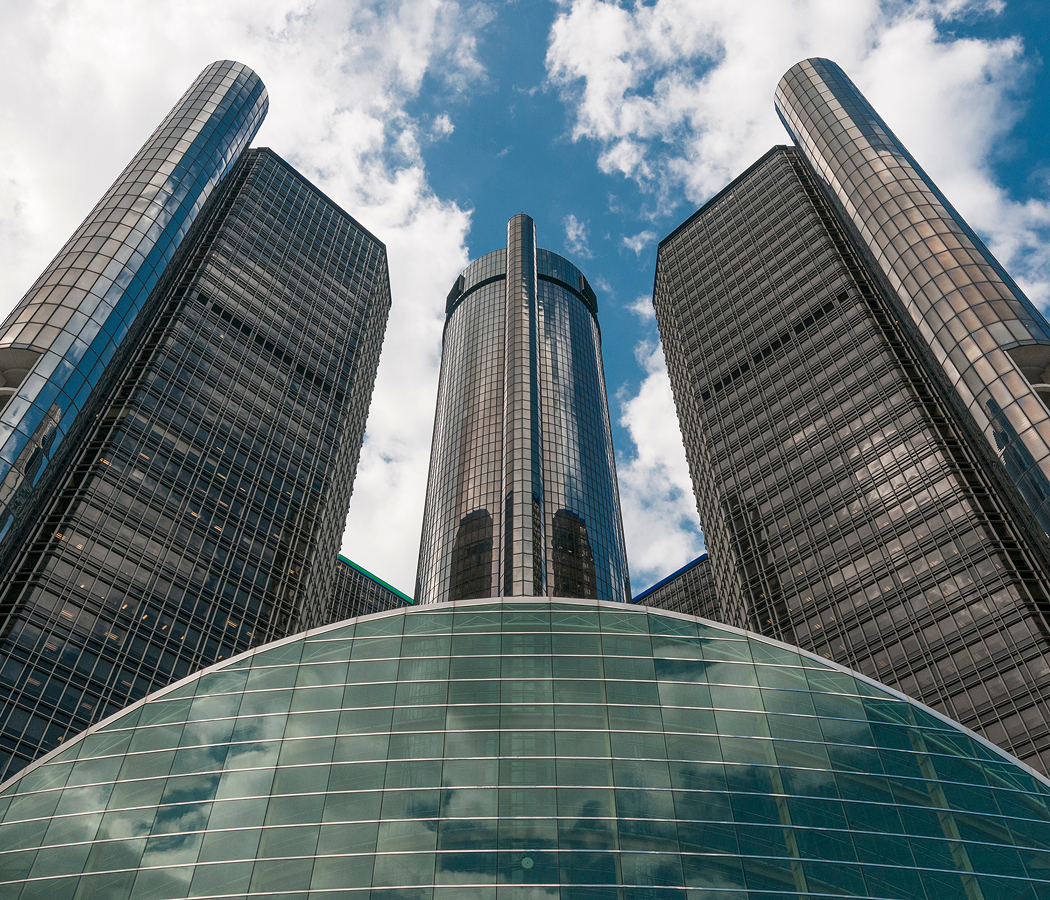
Set along South Wacker Drive near West Adams Street and just steps from the Chicago River, the 110-story skyscraper occupies an entire downtown block bounded by Wacker Drive, Franklin Street, Adams Street and Jackson Boulevard. Nine square structural tubes rise together from the building's broad base, terminating at different heights to create a distinctive stepped silhouette that culminates in two slender rooftop antennas. Bronze-tinted glazing and black aluminum spandrels give the exterior its characteristic dark appearance, emphasizing the tower's rigorous vertical geometry against the surrounding skyline. The western frontage establishes a commanding presence above the river corridor, with the surrounding plaza and street-level entrances connecting the immense office building to the dense commercial fabric of the Loop. The result is a skyscraper whose bundled-tube structure, expansive proportions and unmistakable silhouette express Chicago's enduring leadership in the engineering and architectural development of the modern high-rise.
What defines Willis Tower.
Willis Tower is best known for becoming the world's tallest building upon its completion in 1973 and introducing a revolutionary structural system that changed the engineering possibilities of skyscraper construction. Sears, Roebuck and Co., then the world's largest retailer, commissioned the project to consolidate thousands of employees from offices scattered across metropolitan Chicago into a single corporate headquarters. Chairman Gordon Metcalf and company executives pursued a building capable of accommodating substantial immediate office requirements alongside the company's anticipated expansion. Architects Bruce Graham and Fazlur Rahman Khan of Skidmore, Owings & Merrill developed a design that reconciled these requirements through an innovative bundled-tube structural system. Khan's engineering solution joined nine square tubes into a rigid structural assembly, distributing wind loads through interconnected steel columns and permitting the building's extraordinary height with exceptional structural efficiency. The tubes terminated at successive elevations, creating setbacks that reduced the building's upper-floor dimensions and produced the distinctive stepped form. Construction began in 1970 under general contractor Diesel Construction Company, with the project ultimately requiring 76,000 tons of steel and incorporating a foundation system extending deep into Chicago's underlying bedrock. The building reached its full structural height in 1973, surpassing the World Trade Center in New York and becoming the tallest building in the world at 1,450 feet to its roof. The completed tower contained 4.5 million square feet of gross floor area, establishing an unprecedented scale for a corporate office building. Its bundled-tube engineering became a major influence on subsequent skyscraper design, demonstrating how structural innovation could reconcile extreme height, large floor plates and changing commercial requirements. Sears retained its headquarters in the building until relocating to suburban Hoffman Estates during the early 1990s, marking the end of the tower's original role as the operational center of the American retail corporation. London-based insurance broker Willis Group Holdings secured naming rights in 2009, formally changing the building's name from Sears Tower to Willis Tower. The skyscraper's original character nevertheless remained deeply embedded in Chicago's architectural history, reflecting the scale of Sears' former commercial empire and the engineering ambition of the city's late twentieth-century development.
The Skydeck observation facility established the building as one of Chicago's most consequential public architectural destinations, opening in 1974 on the tower's 103rd floor. The observation level stands 1,353 feet above the city, creating an extraordinary vantage point over the Chicago River, Lake Michigan and the metropolitan landscape extending across Illinois and neighboring states. High-speed elevators connect the ground-level visitor entrance to the observation floor, carrying passengers through the building's immense vertical structure in one minute. The attraction underwent a major transformation in 2009 when architect Ross Wimer of Skidmore, Owings & Merrill designed The Ledge, a series of retractable glass balconies projecting four feet beyond the western façade. The transparent floors, walls and ceilings create a direct visual relationship with the streets more than a thousand feet below, turning the engineering achievement of the skyscraper into a striking physical encounter with extreme height. A subsequent redevelopment led by Blackstone, which acquired the tower in 2015, introduced a $500 million modernization program intended to reconnect the property with the surrounding downtown neighborhood. Gensler directed the architectural transformation, introducing Catalog, a multilevel retail and dining environment that expanded the building's public-facing commercial spaces. The project also created a substantial outdoor terrace and reconfigured the tower's entrances, strengthening pedestrian connections between the office complex and the surrounding Loop streets. The redesigned Skydeck visitor journey introduced immersive exhibitions exploring Chicago's neighborhoods, cultural institutions and architectural history before the ascent to the observation floor. The tower's combination of structural innovation, public observation facilities and renewed street-level activity preserves its significance as both an expansive engineering achievement and a continuously evolving center of Chicago's downtown life.
How Willis Tower fits.
Willis Tower works as the architectural centerpiece for an outing connecting Chicago's pioneering commercial skyscrapers, the development of modern structural engineering and the civic architecture that established the Loop as an internationally influential center of American urban design.
Begin at Rookery Building, the celebrated commercial skyscraper designed by Daniel Burnham and John Wellborn Root and completed in 1888. The building's massive masonry exterior, iron structural elements and extraordinary central light court express the transitional engineering methods that characterized Chicago's earliest generation of skyscrapers. Root developed an innovative foundation system to support the structure on the city's challenging soil conditions, contributing to the technical experimentation that made Chicago a center of high-rise construction. Frank Lloyd Wright redesigned the interior light court in 1905, introducing white marble, gilded ornamentation and refined geometric details that transformed the building's central public space. Continue to Monadnock Building, the expansive commercial structure whose two construction phases reveal the transition from load-bearing masonry to modern skeletal framing. Burnham and Root designed the northern section, completed in 1891, with dramatically thick brick walls and a restrained exterior that anticipated the formal simplicity of twentieth-century modernism. Holabird & Roche completed the southern section in 1893 using steel-frame construction, establishing a direct architectural comparison between two competing approaches to skyscraper engineering. The building's continuous street frontage and carefully controlled proportions demonstrate the remarkable structural experimentation that characterized Chicago's late nineteenth-century commercial expansion. Conclude at Chicago Board of Trade Building, the expansive Art Deco skyscraper designed by Holabird & Root and completed in 1930 at the southern termination of LaSalle Street. The building's 605-foot tower rises above a series of setbacks, culminating in a pyramidal roof crowned by John H. Storrs' aluminum statue of Ceres, the Roman goddess of agriculture. Its construction coincided with Chicago's emergence as a major international financial center, reflecting the importance of agricultural commodities trading to the city's commercial development. The building's dramatic axial position and geometric ornamentation established one of the Loop's most recognizable architectural compositions, connecting the skyscraper's structural ambitions to the expansive civic character of Chicago's financial district. The progression moves from Burnham and Root's early structural experimentation through the Monadnock Building's transition between masonry and steel and culminates in the Chicago Board of Trade Building's Art Deco monumentality, placing Willis Tower within the architectural lineage that made Chicago a global center of skyscraper innovation.
Where your story begins.
Foresyte Travel reveals places that feel extraordinary long before you arrive.
Enjoy editorial crafted for luxury travelers.
Foresyte may earn a commission when you book.