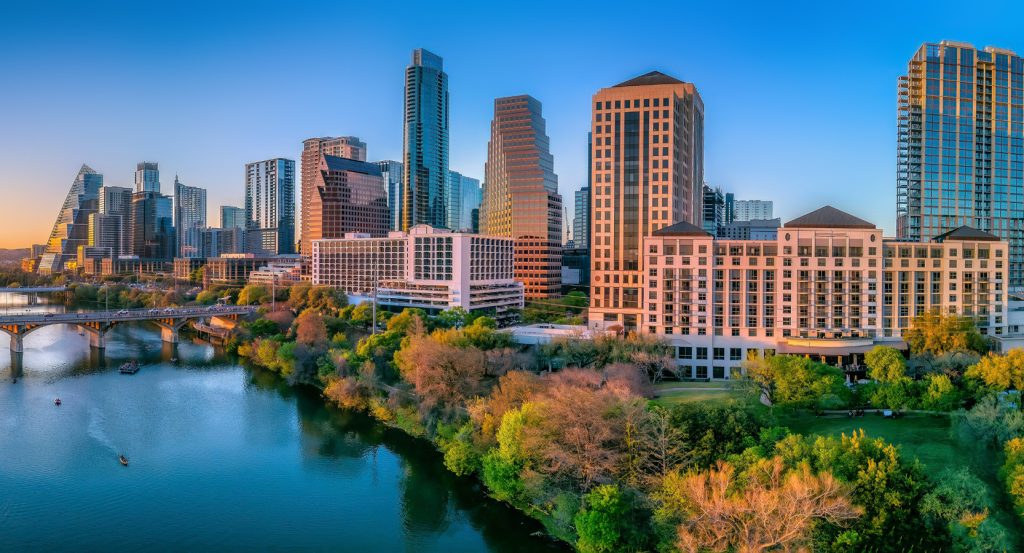
Why you should experience Neches Street in Austin, Texas.
Neches Street is an animated corridor where Downtown's musical legacy, architectural evolution, entrepreneurial energy, and cultural character create one of the city's most recognizable streets.
Running through Downtown between Red River Cultural District and East Cesar Chavez, the corridor connects historic commercial buildings, renowned music venues, hotels, civic institutions, and entertainment destinations that reflect more than a century of Austin's urban development. Each successive stretch reveals restored masonry façades, contemporary towers, illuminated marquees, public art, and lively streetscapes that reinforce the corridor's unmistakable character. The defining moment arrives as Neches Street demonstrates how live music, historic preservation, and downtown reinvestment continue shaping one of Austin's defining corridors. The result is an experience defined by cultural vitality, architectural richness, and one of Downtown's most rewarding streets.
What you should know about Neches Street.
Neches Street is best known for traversing the eastern edge of Downtown, where commercial development accelerated following the arrival of the International-Great Northern Railroad in 1876, establishing warehouse districts, wholesale businesses, hotels, and entertainment venues that expanded eastward from Congress Avenue during the late nineteenth and early twentieth centuries. The corridor lies immediately adjacent to the Red River Cultural District, formally recognized by the Texas Commission on the Arts in 2015, preserving Austin's longest continuous concentration of live music venues through institutions including Stubb's Waller Creek Amphitheater, Mohawk Austin, Empire Control Room & Garage, and Elysium. Nearby civic landmarks include the Austin Convention Center, opened in 1992 and expanded in 2002, the Hilton Austin, completed in 2003 with more than 800 guest rooms, and the Mexic-Arte Museum, founded in 1984, documenting the continued evolution of downtown as a center for tourism, business, and culture. Historic masonry commercial buildings, Contemporary office towers, hotels, adaptive warehouse conversions, granite sidewalks, native live oaks, cedar elms, and landscaped streetscapes collectively demonstrate successive phases of architectural and economic development across the district. Collectively, the corridor's railroad heritage, entertainment legacy, institutional investment, architectural diversity, and cultural significance establish Neches Street as one of Downtown's defining urban corridors.
Adjacent to the corridor, Waterloo Park reopened in 2021 following a comprehensive transformation that introduced restored Waller Creek habitat, new pedestrian connections, and the Moody Amphitheater, an outdoor venue accommodating 5,000 attendees. Nearby, the O. Henry Museum, occupying the author's former residence built in 1886, preserves manuscripts, furnishings, and exhibits documenting the life of William Sydney Porter, better known as O. Henry. The nearby Waller Creek Conservancy, established in 2011, continues directing ecological restoration, flood mitigation, public art initiatives, and park development throughout the creek corridor bordering Neches Street. Together, these cultural venues, historic landmarks, and environmental initiatives demonstrate how Neches Street reflects a corridor where entertainment, preservation, and public investment continue reinforcing one another.
How to fold Neches Street into your trip.
Neches Street works as an exploration of Austin's music culture, downtown history, and public spaces.
Begin at Waterloo Park, where restored creek landscapes, contemporary public spaces, and Moody Amphitheater establish the defining character surrounding Neches Street while introducing one of downtown's most ambitious civic transformations. Continue to Stubb's Waller Creek Amphitheater, where nationally recognized performances, historic surroundings, and Austin's live music tradition deepen the experience before guiding the journey toward its historical conclusion. Conclude at O. Henry Museum, where the preserved nineteenth-century residence, literary collections, and documented history provide the historical payoff by illuminating the life of one of America's most celebrated short story writers. The progression moves naturally from revitalized public space to Austin's music heritage before culminating in one of the city's most enduring literary landmarks.
Where your story begins.
Foresyte Travel reveals places that feel extraordinary long before you arrive.
Experience premium editorial crafted for luxury travelers.