
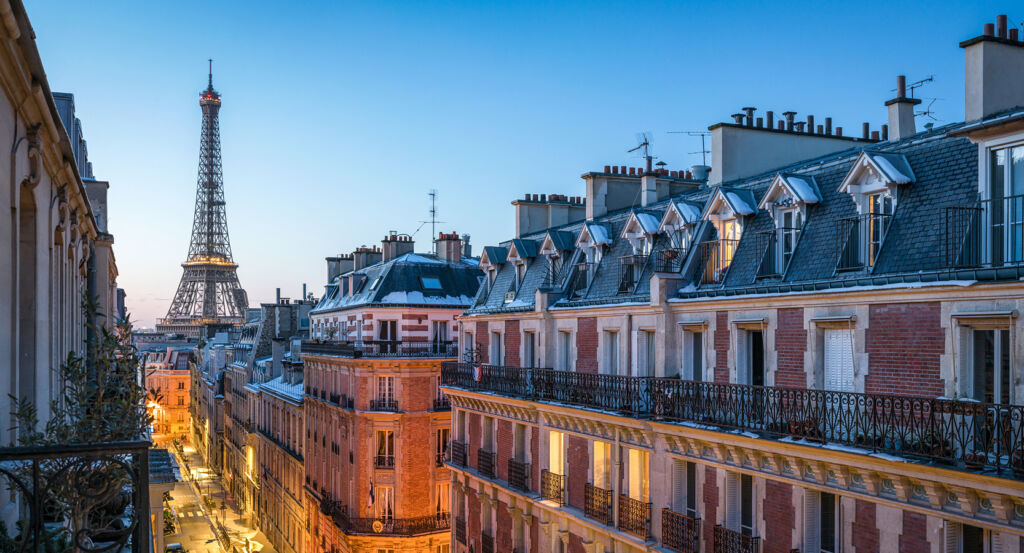
Why you should experience Hôtel Le Rocroy in Paris, France.
Hôtel Le Rocroy is a cosmopolitan four-star hotel where Saint-Vincent-de-Paul's railway heritage, nineteenth-century architectural ambition, international movement and northern Parisian energy converge within a completely renovated Art Deco-inspired address.
Set along Rue de Rocroy near Rue de Maubeuge and just steps from Gare du Nord, the 48-room hotel occupies a quiet street whose name commemorates the Battle of Rocroi, where the future Grand Condé defeated the Spanish army on May 19, 1643. The surrounding quarter took much of its architectural character from Jacques-Ignace Hittorff, who completed Église Saint-Vincent-de-Paul before designing the present Gare du Nord, connecting two of the neighborhood's defining nineteenth-century structures through the career of a single architect. Hôtel Le Rocroy's recent reconstruction introduced an Art Deco style across its rooms and public spaces, using geometric forms, brass accents, saturated tones and decorative patterning to establish a contemporary counterpoint to the surrounding railway-era streetscape. The result is a hotel where the memory embedded in Rue de Rocroy, Hittorff's architectural legacy and the constant international circulation surrounding Gare du Nord give a compact Parisian property a character inseparable from the evolution of its neighborhood.
What you should know about Hôtel Le Rocroy.
Hôtel Le Rocroy is best known for its complete contemporary renovation, documented as a 2022 remodeling, which repositioned the property as a four-star, 48-room hotel organized around an Art Deco-inspired visual character within the Saint-Vincent-de-Paul quarter. The surrounding address carries a considerably deeper historical narrative through Rue de Rocroy, formerly Rue des Jardins-Poissonnière, whose present name commemorates the French victory at Rocroi on May 19, 1643 under Louis de Bourbon, the future Grand Condé, and belongs to the network of northern Paris streets whose names developed alongside the railway district. Gare du Nord became the architectural anchor of that transformation through Jacques-Ignace Hittorff, who designed the present station during the Second Empire after already reshaping nearby Église Saint-Vincent-de-Paul, creating an unusual concentration of his work around the hotel. Hittorff had inherited the church project from his father-in-law Jean-Baptiste Lepère after construction began in 1824, substantially revised its architecture following interruptions associated with financing and the Revolution of 1830, and brought the building to inauguration in 1844. Hôtel Le Rocroy's 2022 renovation inserts its contemporary Art Deco language into a district whose character was already shaped by seventeenth-century military memory, nineteenth-century urban expansion and Hittorff's unusually concentrated architectural authorship.
Jacques-Ignace Hittorff provides an especially rich thread through the immediate neighborhood because his work at Saint-Vincent-de-Paul extended beyond architecture into experiments with polychromy that challenged contemporary assumptions about the visual character of classical buildings. Hittorff replaced Jean-Baptiste Lepère's proposed single bell tower with two façade towers, elevated the church above a system of stairs and ramps inspired by Rome's Spanish Steps and incorporated colored decoration whose enamelled lava panels caused controversy before being removed and eventually restored to the façade in the twenty-first century. Hippolyte Flandrin subsequently created a 92-meter painted frieze of Christian figures inside the church, while William Bouguereau contributed major paintings to the Chapelle de la Vierge added in 1869, several of which have undergone recent conservation by the City of Paris. Hittorff, Flandrin and Bouguereau place Hôtel Le Rocroy within a remarkably concentrated nineteenth-century artistic environment, allowing the hotel's contemporary design chapter to sit within a neighborhood already defined by experimentation across architecture, engineering, painting and decorative technique.
How to fold Hôtel Le Rocroy into your trip.
Hôtel Le Rocroy works as the anchor for an afternoon tracing the architecture, performance culture and engineering ambition that developed around Paris's northern approaches during the nineteenth century.
Begin at Église Saint-Vincent-de-Paul, where Jean-Baptiste Lepère initiated the project in 1824 before Jacques-Ignace Hittorff substantially reworked it, introducing twin façade towers and an elevated approach inspired by Rome while Hippolyte Flandrin later created the interior's 92-meter procession of Christian figures. Continue to Gare du Nord, where Hittorff carried his architectural ambitions into the railway age through the present station, creating a direct connection between the neighborhood's religious and transportation architecture through the career of the same designer. Conclude at Théâtre des Bouffes du Nord, extending the progression from the engineering and circulation of the railway quarter into the performance culture that became another defining strand of northern Paris. The progression moves from Hittorff's experiments with architecture and color through his work for the expanding railway city into a theatrical tradition embedded within the surrounding streets, revealing the cultural layers that give Hôtel Le Rocroy its particular Parisian context.
Where your story begins.
Foresyte Travel reveals places that feel extraordinary long before you arrive.
Experience premium editorial crafted for luxury travelers.














































































































