
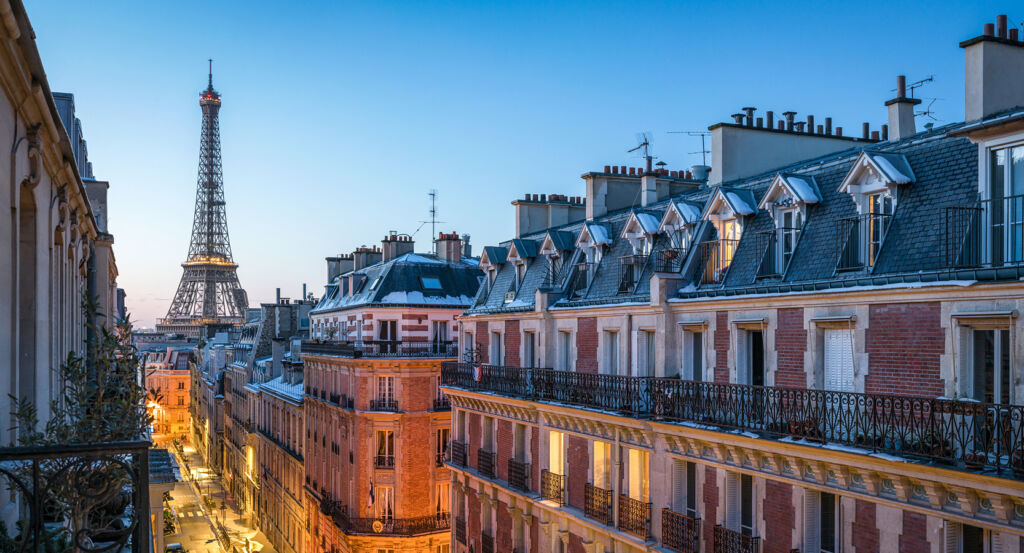
Why you should experience Château Voltaire in Paris, France.
Château Voltaire is a rakish five-star hotel where Palais-Royal's fashion intelligence, centuries-old architectural fabric, creative sociability and instinct for cultivated pleasure converge within Thierry Gillier's deeply personal vision of Parisian hospitality.
Set along Rue Saint-Roch near Avenue de l'Opéra and just steps from Marché Saint-Honoré, the hotel unites three buildings dating from the sixteenth, seventeenth and eighteenth centuries, including former coaching inns and stables from the era of Cardinal Richelieu, into a single 32-key address conceived by artistic director Franck Durand and architects Charlotte de Tonnac and Hugo Sauzay of Festen. Festen restored the individual character of the buildings and drew inspiration from Claude Sautet's films and lively village squares in southern France, while travertine, oak, foliage-patterned carpets, medieval tapestries and vintage Louis XIII-style armchairs give the interiors a deliberately accumulated quality. The result is a hotel where Gillier's fashion sensibility, Durand's art direction and Festen's architectural restraint make several centuries of Rue Saint-Roch feel less preserved than confidently inhabited.
What you should know about Château Voltaire.
Château Voltaire is best known for transforming the former Zadig & Voltaire administrative headquarters, spread across three buildings dating from the sixteenth, seventeenth and eighteenth centuries, into Thierry Gillier's first hotel, with Franck Durand directing the creative character and Festen founders Charlotte de Tonnac and Hugo Sauzay responsible for architecture, interiors and decoration. The complex had previously incorporated coaching inns and stables associated with Richelieu's period, prompting Festen to restore the façades and recover the individual architectural character of each structure before connecting them as one property. Gillier conceived the project after building Zadig & Voltaire into an international fashion house, while Durand approached his first hotel project through references extending from Claude Sautet's cinema to convivial southern French village squares. The completed Maison contains 31 guestrooms and a private rooftop apartment across five accommodation floors, with views toward Opéra and the Paris rooftops, while MICHELIN has since awarded Château Voltaire One MICHELIN Key. The transformation connects three centuries of architecture, a former fashion headquarters, among French ready-to-wear's best-known founders and a creative team whose hospitality concept was intentionally built from cinema, domestic interiors and Parisian social culture.
Festen carried that historical layering into the material composition through solid oak joinery, custom-patterned carpets, travertine, vintage furniture and architectural details calibrated differently across the three constituent buildings, while Gillier's collecting sensibility extends into corridors combining Cubist painting with contemporary sculpture. La Coquille d'Or gives the hotel its darker nocturnal register through leather and velvet, while Brasserie Emil occupies the social center of the property with traditional, seasonal French cooking and a clientele extending beyond hotel residents. Beneath those spaces, a concealed staircase descends into a white-stone aquatic room containing a relaxation pool, sauna, cold showers and heated stone bench, creating an unexpectedly monastic counterpoint to the activity above. Gillier extended the character beyond hospitality in 2024 with an independent Château Voltaire clothing capsule, producing a hoodie, T-shirt and socks bearing the hotel's initials and an artist's drawing of the façade after guests repeatedly asked for objects connected specifically with the property. Together, Thierry Gillier, Franck Durand, Charlotte de Tonnac and Hugo Sauzay have made Château Voltaire unusually coherent as a fashion founder's hotel, with architecture, collecting, food, nightlife and even clothing functioning as extensions of the same authored Parisian world.
How to fold Château Voltaire into your trip.
Château Voltaire works as the anchor for an afternoon tracing how royal patronage, decorative craftsmanship and contemporary collecting repeatedly turned the streets around Palais-Royal into a laboratory for French taste.
Begin at Galerie Vivienne, where architect François-Jean Delannoy created one of Paris's great covered passages in 1823, combining Pompeian-inspired mosaics by Giandomenico Facchina, sculpture and a glazed roof into an elegant commercial interior that opened in 1826. Continue to Bibliothèque nationale de France - Richelieu, where collections assembled by French kings ultimately occupied Cardinal Mazarin's seventeenth-century palace complex, later expanded by architects including Henri Labrouste, whose celebrated reading room opened in 1868 beneath nine ceramic domes supported by slender cast-iron columns. Conclude at Bourse de Commerce - Pinault Collection, where Tadao Ando inserted a 29-metre-wide, nine-metre-high concrete cylinder inside the former commodities exchange to house François Pinault's contemporary collection, reopening the building in 2021 after a collaboration with NeM / Niney et Marca Architectes and Pierre-Antoine Gatier. The progression moves from nineteenth-century commercial refinement through Labrouste's structural imagination into Ando's intervention for one of France's major private collectors, revealing the continuing exchange between commerce, architecture and creative patronage that makes Château Voltaire feel native to this particular part of Paris.
Where your story begins.
Foresyte Travel reveals places that feel extraordinary long before you arrive.
Experience premium editorial crafted for luxury travelers.














































































































