
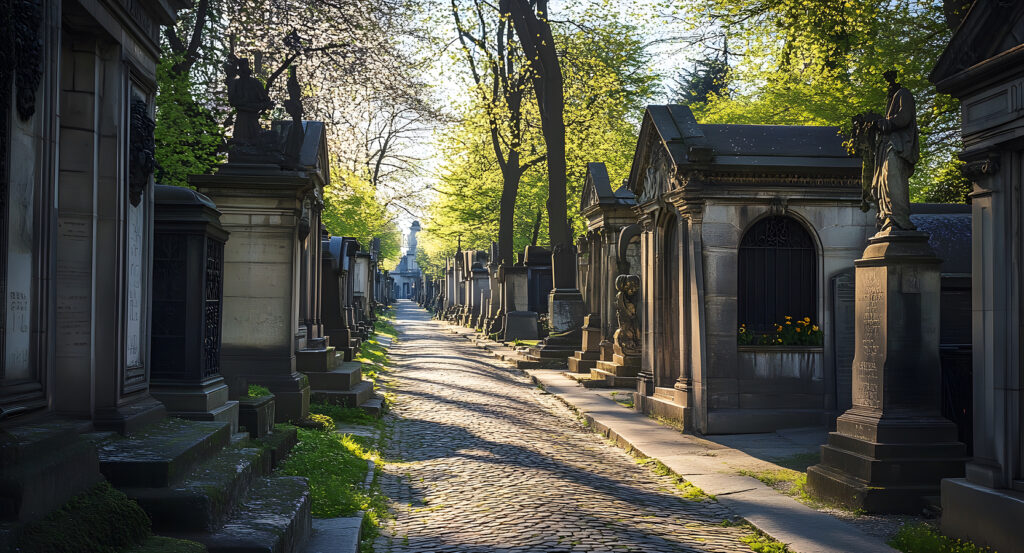
Why you should experience Oscar Wilde's Tomb in Paris, France.
Oscar Wilde's Tomb is an influential literary monument where Père-Lachaise Cemetery's artistic legacy, funerary sculpture, cultural memory, and modern pilgrimage commemorate one of the English language's greatest writers.
Set along Avenue Circulaire near Chemin Denon and just steps from the Tomb of Frédéric Chopin, this striking Art Deco funerary monument commands attention through Jacob Epstein's grand winged figure, whose bold geometric forms transformed a traditional gravesite into one of the twentieth century's most celebrated works of cemetery sculpture. Carved stone, symbolic abstraction, and thoughtful restoration invite visitors to reflect upon Wilde's extraordinary literary achievements while exploring one of the world's most historically significant cemeteries. More than a century after its unveiling, the monument continues attracting readers, artists, and scholars from across the globe. The result is a memorial defined by artistic innovation, literary significance, and enduring cultural influence.
What you should know about Oscar Wilde's Tomb.
Oscar Wilde's Tomb is best known for the grand sculpture commissioned by British admirer Helen Carew shortly after Wilde's death and created by pioneering sculptor Sir Jacob Epstein between 1908 and 1912, introducing one of the earliest and most controversial examples of modernist funerary art to Père-Lachaise Cemetery through a grand winged Assyrian-inspired figure carved from twenty-ton Hopton Wood stone. Oscar Wilde died in Paris on November 30, 1900 and was initially buried in Cimetière de Bagneux before his remains were transferred to Père-Lachaise in 1909, where Epstein's ambitious monument challenged prevailing artistic conventions with its powerful abstraction, stylized anatomy, and symbolic references to spiritual ascent, provoking public controversy that led authorities to cover parts of the sculpture shortly after its installation. The monument became one of the cemetery's defining works while celebrating the enduring legacy of the author of The Picture of Dorian Gray, The Importance of Being Earnest, Salome, and De Profundis, whose literary achievements, imprisonment following his 1895 conviction for gross indecency, exile, and posthumous rehabilitation established him as one of modern literature's most influential cultural figures. Extensive conservation completed in 2011 introduced a transparent glass barrier surrounding the monument after decades during which admirers covered the stone with lipstick kisses that gradually damaged its surface despite repeated restoration campaigns.
Literary pilgrimage has surrounded the tomb for generations, with readers, playwrights, historians, LGBTQ+ communities, and admirers continuing to visit one of Paris's most recognizable memorials to reflect upon Wilde's extraordinary artistic legacy and enduring influence on modern literature, theatre, aesthetics, and human rights. Epstein's sculpture remains a landmark achievement within twentieth-century British sculpture, demonstrating the artist's synthesis of archaic forms, modernist abstraction, and grand carving that later shaped public sculpture throughout Europe. Conservation science, heritage management, and ongoing scholarly interpretation collectively preserve both the monument and its layered cultural significance within Père-Lachaise, ensuring that Wilde's final resting place continues serving as one of the world's foremost destinations devoted to literary history.
How to fold Oscar Wilde's Tomb into your trip.
Oscar Wilde's Tomb works as part of an exploration through Père-Lachaise Cemetery's celebrated artistic, literary, and musical heritage.
Begin at Tomb of Frédéric Chopin, where one of classical music's most revered memorials establishes the cemetery's extraordinary cultural significance before continuing to Oscar Wilde's Tomb to experience one of modern literature's most celebrated monuments. Continue to Tomb of Jim Morrison, whose enduring popularity demonstrates Père-Lachaise's remarkable concentration of internationally influential cultural figures. Conclude at Père-Lachaise Cemetery Crematorium, where distinguished funerary architecture provides a fitting finale celebrating the artistry, history, and cultural legacy preserved throughout one of the world's most renowned cemeteries. The progression moves naturally from musical genius to literary achievement before concluding through one of the cemetery's defining architectural works, revealing why Oscar Wilde's Tomb remains among Paris's most meaningful cultural destinations.
Where your story begins.
Foresyte Travel reveals places that feel extraordinary long before you arrive.
Experience premium editorial crafted for luxury travelers.














































































































