
Why Albert Embankment matters.
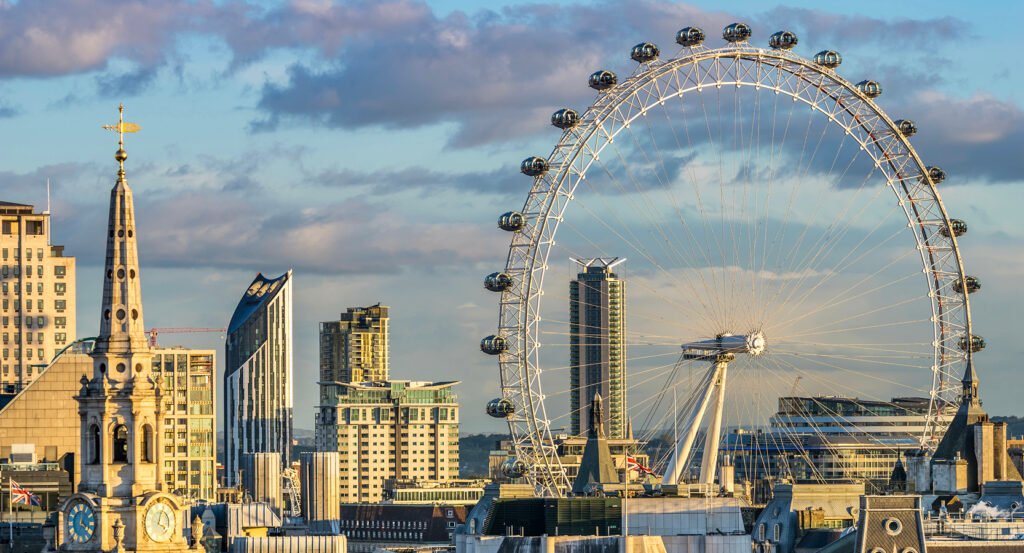
Albert Embankment is a riverine corridor where Lambeth's civic character meets uninterrupted Thames frontage, imposing institutional architecture and one of Central London's most expansive perspectives toward Westminster.
Running through Lambeth between South Bank, and Vauxhall, the north-south corridor occupies the eastern bank of the Thames opposite Westminster, extending through a linear river landscape where the roadway, pedestrian promenade and building line remain closely aligned with the water. Long masonry façades and freestanding twentieth-century towers establish its physical scale, opening between substantial institutional complexes to expose unusually broad sections of sky and river. Westminster supplies the primary encounter across the Thames, with the corridor repeatedly framing the opposite bank through open water rather than through the compressed sightlines characteristic of inner London streets. Railway infrastructure, surviving industrial buildings and newer residential architecture deepen the setting inland, revealing a sharp transition between the formal riverside edge and the denser fabric behind it. The result is a corridor where Lambeth acquires an unusually panoramic metropolitan presence, combining river, infrastructure and large-scale architecture along a continuous approach to Central London.
What defines Albert Embankment.
Albert Embankment is best known for the engineering campaign led by Sir Joseph Bazalgette between 1866 and 1870 to protect low-lying Lambeth from tidal flooding and carry part of the capital's new drainage system along a reconstructed Thames edge. The Metropolitan Board of Works had been created in 1855, and Parliament authorized the Lambeth project in 1863 as London confronted sewage, recurrent flooding and the exposed mud banks lining the river opposite the Palace of Westminster. Construction swept away the courts, alleys, timber yards and boat-building premises clustered around Upper Fore Street, replacing the old shoreline through extensive reclamation from the Thames. Work began in July 1866, and the new embankment opened on 24 November 1869 after expenditure exceeding £1 million, creating a roadway about a mile long alongside the engineered river wall. Bazalgette employed Portland cement extensively for its strength and resistance to water, subjecting the relatively new product to stringent quality controls as it became fundamental to the retaining structure. Reclamation produced 8.5 acres subsequently sold to the governors of St. Thomas' Hospital, helping finance the works and supplying the institution with a new riverside site after railway construction displaced it from Southwark. The Albert name commemorated Prince Albert, who had died in 1861, binding a practical undertaking in drainage and flood control to the commemorative geography reshaping Victorian London.
E. P. Wheeler introduced a separate civic mechanism when the London County Council selected the former Doulton pottery land for a new London Fire Brigade headquarters during the 1930s. The Brigade's original Southwark Bridge Road headquarters had become too constricted by 1929, prompting a search that ended with the purchase of the Lambeth property for £85,000 in 1934, including the disused Stiff's Dock. Wheeler, assisted by G. Weald, divided the complex across two parcels, placing command functions and the operational fire station toward the Thames and assigning workshops, garages and training facilities to land farther inland. The completed 1936 to 1937 headquarters used a steel frame, brown brick and Portland stone within a severe Moderne composition, with seven appliance exits incorporated directly into the river-facing elevation and sculptural panels by Gilbert Bayes depicting the fire service above them. King George VI and Queen Elizabeth opened the complex on 21 June 1937, and its administrative role immediately placed Albert Embankment at the center of London firefighting shortly before the Second World War. The headquarters directed operations during the wartime bombing of the capital, giving Wheeler's purpose-built command center a role far beyond the architectural ambitions of its commission. London Fire Brigade administration departed for Union Street in 2007, leaving the surviving complex as a physical record of the moment when metropolitan emergency services acquired a headquarters designed around motorized firefighting, communications, training and river operations.
How Albert Embankment fits.
Albert Embankment works as the anchor for an afternoon tracing Lambeth through the institutional preservation of modern conflict, the conversion of theatrical production buildings into contemporary exhibition space and an artist-led organization established inside a former school.
Begin at Imperial War Museum London, an institution created during the First World War after the War Cabinet approved a National War Museum in March 1917 to preserve the experiences of a conflict still underway. Participation by Dominion governments soon prompted adoption of the Imperial War Museum name, and King George V opened the first museum at Crystal Palace in June 1920 before the collection transferred to South Kensington in 1924. A further move brought the institution to Lambeth in July 1936, occupying the surviving central portion of the former Bethlem Royal Hospital, where the future George VI reopened it. War transformed the museum again: collections were dispersed for protection in 1939, the London building remained closed from 1940 to 1946 and its remit expanded to encompass the Second World War. Foster + Partners subsequently reworked the interior around a new atrium for the First World War centenary, extending an institution founded during active conflict into a museum addressing warfare across successive generations. Continue to Newport Street Gallery, where Damien Hirst's private art collection occupies an architectural complex assembled by Caruso St. John from former theatrical workshops and new construction. Three constituent buildings were purpose-built in 1913 as scenery-painting studios serving the West End theater industry, giving their high internal volumes an industrial purpose tied directly to stage production. Caruso St. John retained and converted those structures, added two new buildings and joined the five into a 37,000-square-foot gallery extending across half of Newport Street. Six exhibition spaces occupy two levels, including a gallery rising eleven metres, translating the proportions demanded by theatrical scenery into spaces suited to large contemporary artworks. The completed institution realized Hirst's long-standing ambition to place works from his collection before the public, shifting the site from backstage manufacture for commercial theater into the presentation of contemporary art. Conclude at Beaconsfield, founded by artists David Crawforth and Naomi Siderfin after their experimental project Nosepaint had staged monthly interdisciplinary events between 1991 and 1994. The organization incorporated in November 1994, gained charitable status the following May and took over the derelict former Lambeth Ragged Schools on Newport Street in July 1995. Renovation converted the nineteenth-century educational building into an art center, and Beaconsfield opened publicly that September with an exhibition-residency involving Mattias Jackisch and Felix Ziem. The organization deliberately occupied territory between established institutions, commercial galleries and alternative practice, using commissions, residencies, performances and exhibitions as interconnected forms of artistic production. Three decades of operation have preserved that founding emphasis inside a building whose earlier educational purpose supplied the permanent base that its itinerant predecessor lacked. The progression moves from a wartime collecting institution repeatedly reshaped by twentieth-century conflict through theatrical workshops converted for Hirst's collection into Crawforth and Siderfin's artist-led occupation of a former school, connecting preservation, architectural reuse and independent cultural production across Lambeth.
Where your story begins.
Foresyte Travel reveals places that feel extraordinary long before you arrive.
Enjoy editorial crafted for luxury travelers.
Foresyte may earn a commission when you book.














































































































