
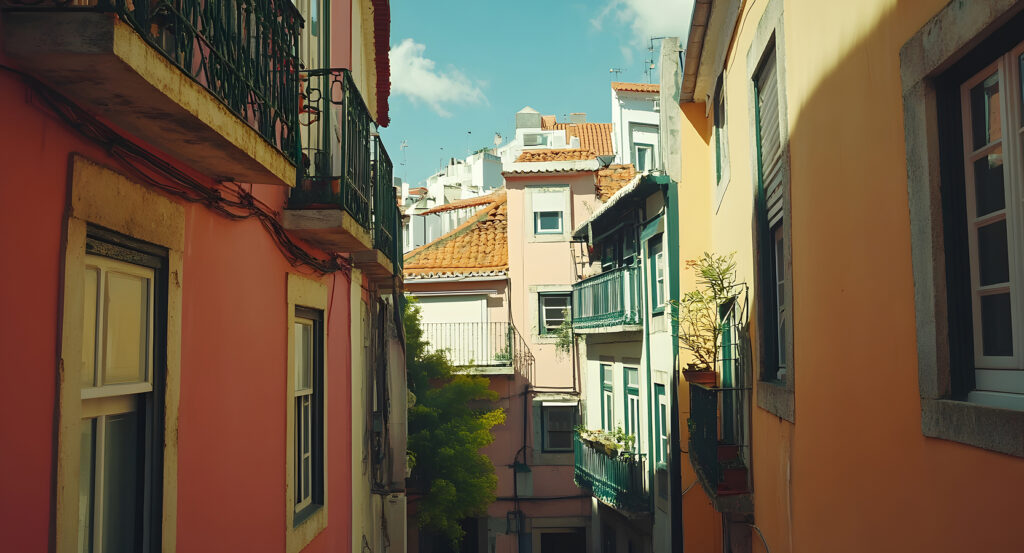
Why Miradouro de Santa Luzia matters.
Miradouro de Santa Luzia is Lisbon's most romantic pause, a terrace where time slows, the air glows, and the city unfolds like a living painting.
Perched on the western edge of Alfama, this viewpoint feels suspended between sky and sea. Bougainvillea drapes over white columns, the scent of jasmine mingles with ocean breeze, and the Tagus shimmers below in a spectrum of silver and blue. Beneath the pergola, shadows dance across azulejo tiles that tell Lisbon's own story, caravels departing for the Indies, the walls of the old city still standing proud. From here, the view stretches across Alfama's terracotta rooftops to the domes of the National Pantheon and São Vicente de Fora, while ferries drift lazily across the river. Everything feels both infinite and intimate. The hum of the city fades, replaced by birdsong and the soft murmur of conversation. It's the kind of place where you stop speaking without realizing it, because the view does the talking for you.
What defines Miradouro de Santa Luzia.
The terrace is named after the nearby Church of Santa Luzia, a small Baroque chapel dedicated to the patron saint of sight, an irony that feels intentional, because this is where Lisbon is best seen.
Built on the remnants of the medieval city wall, the miradouro occupies a site that has been a lookout for nearly a thousand years, first for Moorish sentries, later for sailors' families awaiting the return of ships. The viewpoint as it appears today was designed in the early 20th century, blending Portuguese classicism with modern restraint. Its most distinctive feature is the azulejo mural that lines the terrace walls, hand-painted in blue and white ceramic tiles. One panel depicts the Praça do Comércio before the 1755 earthquake; the other demonstrates the Christian reconquest of Lisbon in 1147, two moments of triumph separated by centuries, united in color and light. The pergola above the lower terrace was added later, its climbing vines framing the view like brushstrokes. Few visitors notice the subtle design symmetry: the pergola's alignment mirrors the curve of the Tagus, creating a visual rhythm that draws the eye outward toward the horizon. In late afternoon, the space becomes a study in gold, the tiles glowing softly, the river igniting, and Lisbon seeming to float on light alone.
How Miradouro de Santa Luzia fits.
To experience this terrace properly, arrive when the city begins to exhale.
Early morning offers serenity, mist rising from the river, sunlight creeping down the walls of Alfama, but sunset is where the magic resides. Approach from Rua do Limoeiro, passing the white façade of the church, and step through the iron gate onto the terrace. Move slowly; let the view expand around you. Sit beneath the pergola and listen: the clink of espresso cups from the café, the flutter of pigeon wings, a distant guitar from somewhere in Alfama below. Take a moment to study the azulejos, their scenes of Lisbon before and after transformation are more than decoration; they're memory rendered in pigment. Stay until the light turns amber and the city begins to glow. Watch how the river mirrors the sky, how rooftops catch fire, and how the domes across the water turn to silhouettes. When the first streetlights flicker on, the terrace becomes something quieter, a sanctuary above the living city. Before you leave, turn back once more to see Alfama's rooftops in twilight; the view feels eternal, as if Lisbon itself were pausing to breathe with you.
Where your story begins.
Foresyte Travel reveals places that feel extraordinary long before you arrive.
Enjoy editorial crafted for luxury travelers.
Foresyte may earn a commission when you book.














































































































