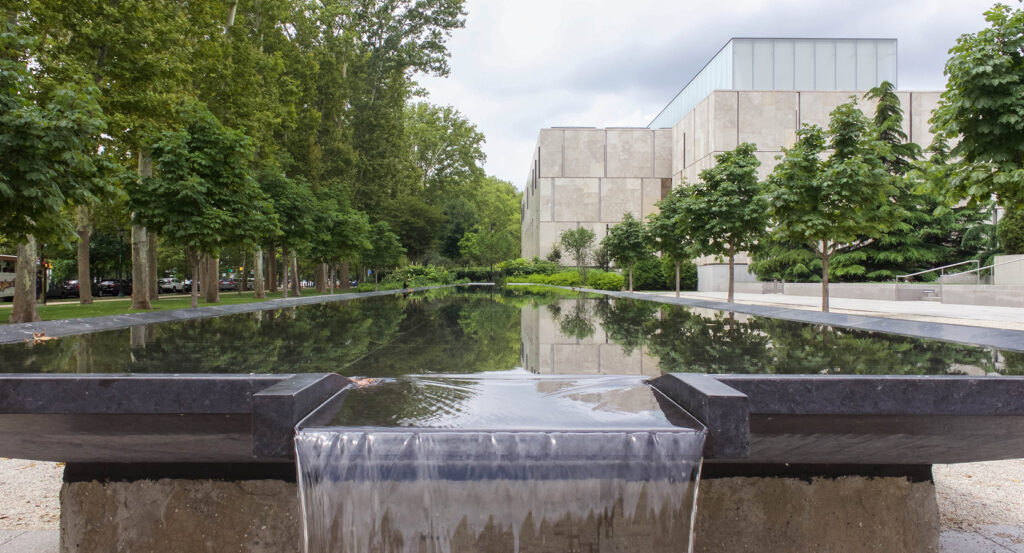
Why you should experience Ensembles at Barnes Foundation in Philadelphia, Pennsylvania.
Ensembles at Barnes Foundation in Philadelphia is where the spirit of Dr. Albert C. Barnes's genius reveals itself most clearly, a symphony of composition, contrast, and conversation that transforms how we understand art.
Unlike any conventional gallery, this room is not organized by artist, era, or geography. Instead, it's a living arrangement, or “ensemble”, where paintings, sculptures, metalwork, and furniture interact as parts of a single, unified design. A Cézanne landscape might hang beside a medieval hinge; an African mask may mirror the rhythm of a Matisse pattern; a wrought-iron key could echo the curvature of a Renoir figure. The space feels like stepping into the collector's mind, meticulous yet free, disciplined yet imaginative. Every detail, every contrast, speaks to Dr. Barnes's rebellious belief that art should be felt through form, not dissected through theory. Ensembles at Barnes Foundation is the beating heart of that philosophy, an immersive experience where visual harmony replaces hierarchy and where beauty speaks in universal language.
What you should know about Ensembles at Barnes Foundation.
Ensembles at Barnes Foundation is more than a gallery, it's a manifesto, meticulously preserved according to Dr. Barnes's original vision from his Merion estate.
In curating his collection, Dr. Barnes developed a system of “ensembles,” wall arrangements that juxtaposed art and craft to highlight relationships of line, light, color, and space. Each wall was carefully balanced like a musical composition, symmetry guiding placement, contrast creating rhythm. He viewed paintings, furniture, and metalwork as equals, rejecting the academic hierarchy that elevated fine art above decorative art. The Barnes Foundation's curators have painstakingly reconstructed these ensembles in their exact original configuration, right down to the millimeter, ensuring that visitors experience the same visual logic Dr. Barnes intended nearly a century ago. The approach was so revolutionary that art critics once called it chaotic, but today, it's recognized as one of the most profound expressions of relational aesthetics ever achieved in a museum. Few know that Dr. Barnes used these ensembles as teaching tools for his students, asking them to identify visual connections. To him, art education was about seeing, not studying. Ensembles at Barnes Foundation remains his classroom, silently instructing every visitor who steps inside.
How to fold Ensembles at Barnes Foundation into your trip.
When visiting the Barnes Foundation, plan to enter Ensembles at Barnes Foundation early in your visit, before physical fatigue sets in, it's where the collection's visual discussion comes alive most fully.
Stand near the center of the room and let your eyes wander freely rather than focusing on a single work. You'll begin to notice subtle harmonies: a curve in an African sculpture echoed in a Cézanne vase, a warm ochre tone repeating from a Renoir to a carved chest below it. Move slowly from wall to wall, tracing these patterns of rhythm and geometry, this is how Dr. Barnes meant his collection to be seen. Use the digital guide sparingly; let intuition lead. Try viewing the walls as if they were pieces of music, each element contributing to a greater composition. Afterward, step into one of the adjacent galleries to see how this concept expands throughout the museum, connecting Impressionism, Modernism, and folk art into a continuous story of human creativity. Before you leave, pause in the Annenberg Court, where light and architecture reflect the same balance of proportion that defines the ensembles themselves. Ensembles at Barnes Foundation is not merely a gallery, it's a revelation in perception, a reminder that art's deepest truths are found not in isolation, but in relationship.
Where your story begins.
Foresyte Travel reveals places that feel extraordinary long before you arrive.
Experience premium editorial crafted for luxury travelers.