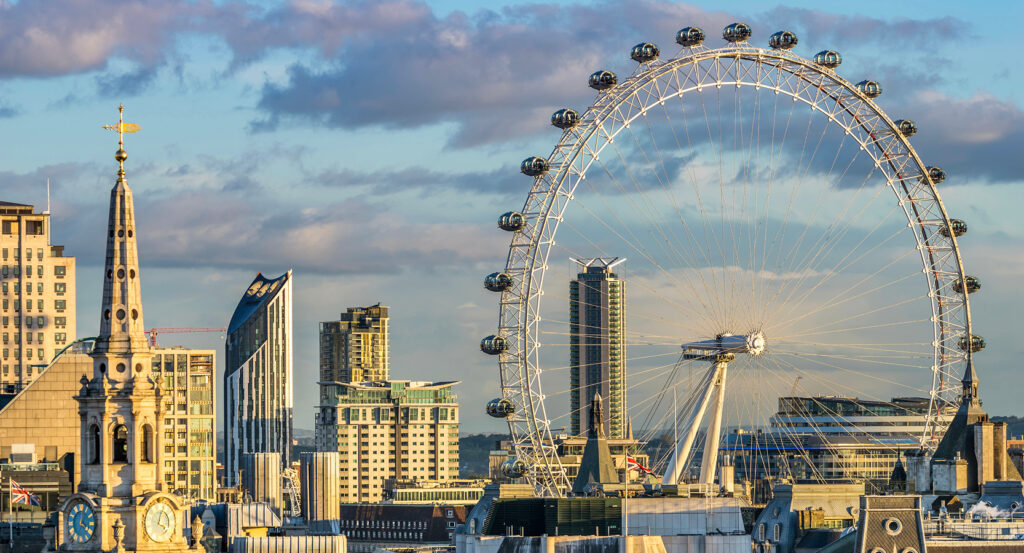
Why Battersea Park matters.
Battersea Park is a sweeping Victorian park where Battersea's riverside character meets broad avenues, ornamental gardens, expansive lawns and an unusually varied landscape extending along the Thames.
Set along the south bank of the Thames near Albert Bridge Road and just steps from Chelsea Bridge, the park occupies 200 acres between the river and the dense residential streets extending toward Clapham Junction. Broad carriage drives and tree-lined avenues establish the underlying geometry, then curving paths, secluded planting and open grassland repeatedly loosen that form into smaller landscape compartments. The boating lake creates the primary encounter through irregular shorelines, islands and mature vegetation that interrupt long terrestrial views and draw movement toward the park's interior. Riverside promenades introduce a distinct mechanism as the landscape opens toward the Thames, framing bridges and the Chelsea bank across an uninterrupted strip of water. The result is a park where formal Victorian planning, intimate planted spaces, extensive recreation grounds and a broad river edge create one of inner London's most spatially varied public landscapes.
What defines Battersea Park.
Battersea Park is best known for emerging from a major Victorian public-works project that converted low-lying riverside fields into one of the earliest large municipal parks in Britain. Parliamentary authority for the project arrived in 1846 after years of concern over the condition of Battersea Fields, an area associated with market gardening, industrial activity and the popular Sunday gathering ground around the Red House tavern. The Crown acquired 320 acres, allocating part of the land to the park and reserving surrounding plots for residential development intended to offset the immense acquisition expense. James Pennethorne produced the initial plan in 1845, organizing the landscape around strong geometric axes, perimeter drives and areas assigned to formal and informal recreation. Construction advanced during the 1850s under John Gibson, who developed Pennethorne's scheme through Gardenesque planting influenced by Edward Kemp and introduced greater variety through curved beds, specimen trees and differentiated horticultural spaces. The finished project cost £80,000 beyond the £230,000 required for land acquisition, demonstrating the extraordinary financial scale attached to creating a major public landscape from the Thames-side site. Queen Victoria formally opened Battersea Park in 1858, establishing a public ground equipped for boating, cricket, plant exhibitions, promenading, music and visits to an aviary. Development continued beyond the opening as planting matured and specialized gardens expanded across the site, completing a landscape constructed between 1854 and 1870. Battersea Park joined municipal engineering, public health ambitions, recreation and horticultural design within a single metropolitan project, turning former riverside fields into an influential Victorian model for publicly accessible urban parkland.
Wartime occupation and the Festival of Britain imposed a separate sequence of changes that substantially recast the Victorian landscape during the twentieth century. First World War demands brought allotments, an anti-aircraft station and a clothing depot into the grounds, and military vehicles damaged the original gravel drives so severely that the routes received tarmac surfaces after the conflict. Thirteen hectares became allotments during World War II, accompanied by a piggery, barrage-balloon installation and experimental radio station, with the running track converted into an anti-aircraft gun position. A radically different intervention arrived in 1951 when 15 hectares beside the Thames were requisitioned for the Festival Gardens, the principal recreational counterpart to the Festival of Britain exhibition across London. Designer James Gardner developed the Pleasure Gardens with architect James Holland, introducing illuminated landscapes, performance spaces and entertainment architecture conceived as an escape from postwar austerity. John Piper designed the theatrical Battersea Fun Fair entrance, and the amusement ground survived the festival itself, continuing as a permanent attraction until 1974. Management transferred to the Greater London Council in 1966, and extensive discussions over renewal beginning in 1979 produced proposals approved in 1984 before responsibility passed to Wandsworth following abolition of the GLC. A Heritage Lottery Fund-supported restoration program initiated during the 1990s subsequently addressed decades of physical deterioration, extending the park's history from wartime utility and postwar performance into large-scale landscape conservation.
How Battersea Park fits.
Battersea Park works as the anchor for a daytime exploration through three nearby institutions connecting seventeenth-century military welfare, centuries of botanical exchange and the creation of a national collection devoted to Britain's Army.
Begin at Royal Hospital Chelsea, established by Charles II as a permanent home for veteran soldiers and entrusted in 1682 to Christopher Wren, who developed the riverside institution on the site of the unfinished Chelsey College. Wren drew inspiration from the Hôtel des Invalides in Paris and organized Figure Court around residential ranges for 412 veterans and their officers, then expanded the complex through Light Horse Court and College Court as demand increased; the first 99 Chelsea Pensioners entered in 1692, and deductions from Army pay remained the principal funding mechanism until 1847. Continue to Chelsea Physic Garden, founded by the Worshipful Society of Apothecaries in 1673 to train apprentices in identifying medicinal plants and established behind protective walls that generated a favorable microclimate beside the Thames. An international seed-exchange program began in 1682, Sir Hans Sloane secured the garden's future through his 1722 agreement with the Apothecaries and Philip Miller directed it for 50 years, a period that helped establish Chelsea as an internationally connected center of botany; its heated glasshouse cultivated tropical fruit from 1723, and the Pond Rockery created in 1773 became an early experiment in specialized botanical display. Conclude at National Army Museum, whose origins followed the 1947 consolidation of the Royal Military College and Royal Military Academy at Sandhurst, where collections associated with disbanded regiments and the former Indian Army accumulated after World War II. A Royal Charter established the museum on 8 April 1960, Queen Elizabeth II opened its first permanent home that July and rapidly expanding holdings prompted construction of purpose-built premises in Chelsea, opened by the Queen on 11 November 1971; the collection now exceeds one million objects spanning 600 years of British Army history. The progression moves from Wren's institution for veteran soldiers through the Apothecaries' internationally connected botanical garden into a national military collection assembled from Sandhurst and regimental holdings, revealing the Thames corridor through welfare, scientific exchange and the preservation of military history.
Where your story begins.
Foresyte Travel reveals places that feel extraordinary long before you arrive.
Enjoy editorial crafted for luxury travelers.
Foresyte may earn a commission when you book.