
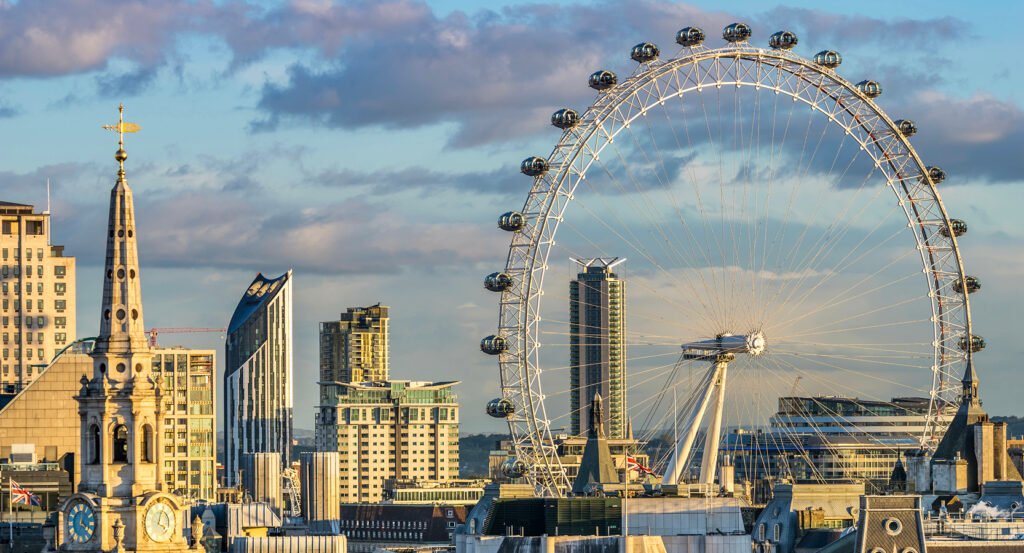
Why Blackfriars Road matters.
Blackfriars Road is a metropolitan corridor where Southwark's industrious character meets Georgian boulevard planning, railway infrastructure and the architectural scale produced by more than two centuries of movement between the Thames and the southern districts.
Running through Southwark between Bankside, and Elephant and Castle, the broad north-south corridor occupies a direct axis from Blackfriars Bridge to St. George's Circus, cutting across an older network of smaller streets whose alignments preserve the district that developed around it. Its exceptional width creates long perspectives rarely encountered among the tighter historic streets of northern Southwark, with mature trees, substantial pavements and continuous building lines reinforcing the boulevard geometry. Railway viaducts introduce massive brick arches across the surrounding townscape, preserving the physical imprint of the nineteenth-century transport expansion that overlaid the earlier Georgian district. Closer to the Thames, larger commercial buildings and towers amplify the corridor's scale before the route settles into lower historic fabric around its southern approach. The result is a corridor where the dimensions of an eighteenth-century metropolitan intervention remain powerful enough to organize later layers of railway architecture, commerce and high-rise development without losing the clarity of its original river-to-circus axis.
What defines Blackfriars Road.
Blackfriars Road is best known for the eighteenth-century engineering project that created Blackfriars Bridge and drove a new Georgian boulevard across previously open ground south of the Thames. Parliamentary authority for the bridge arrived in 1756, and Robert Mylne won the design competition with a proposal that combined nine elliptical stone arches with an unusually direct southern approach. Blackfriars Bridge opened in 1769 as the third Central London bridge, establishing a new connection between the City and Southwark at a moment when London's growth was placing increasing pressure on the older crossings. An Act passed in 1768 authorized the accompanying road across St. George's Fields, allowing Mylne to extend the geometry of his bridge inland through an eighty-foot-wide avenue originally called Great Surrey Street. St. George's Circus organized the southern termination, distributing movement toward Borough Road Road and routes deeper into Surrey through a formal radial junction. Development followed the infrastructure: houses and businesses gathered along the new frontage, east-west streets intersected the boulevard and continuous building had consumed the surrounding ground by the 1830s. Factories and warehouses concentrated toward the Thames as river trade intensified, then railway construction during the nineteenth century inserted viaducts and tracks through the surrounding plots and gave the district another powerful transport system. Great Surrey Street became Blackfriars Road in 1829, fixing the corridor more explicitly to the bridge whose construction had created it. Mylne's bridge, the boulevard and St. George's Circus were conceived as parts of the same metropolitan mechanism, turning an open tract beyond the river into a structured southern gateway whose geometry still controls movement through this part of Southwark.
Surrey Chapel gave Blackfriars Road an extraordinary second history in which religious experimentation, social reform and professional boxing occupied the same building across successive generations. Rowland Hill established the independent chapel in 1783 inside William Thomas's unusual sixteen-sided building, creating a preaching hall whose centralized form supported Hill's ministry as the surrounding fields rapidly urbanized. Hill combined preaching with social initiatives, and Surrey Chapel became associated with missionary work, education and his advocacy of inoculation before James Sherman and Christopher Newman Hall succeeded him during the nineteenth century. The congregation departed for a new Christ Church complex in 1876, and the old chapel passed through Primitive Methodist and commercial occupation before former boxing champion Dick Burge and his wife Bella transformed it into The Ring in 1910. Burge established the converted chapel as a leading small-hall boxing venue, where Welsh fighter Jimmy Wilde made his London debut and future British champion Bandsman Dick Blake built an eleven-fight winning sequence during 1913. Bella Burge continued managing the arena after her husband's death, sustaining a rare female presence at the center of early twentieth-century professional boxing promotion. The building's circular religious interior had become a sporting arena without surrendering the spatial form inherited from Thomas and Hill, turning one architectural shell from a Nonconformist experiment into a center of working-class spectator culture. Bombing destroyed The Ring during the Second World War, ending a sequence in which the same Blackfriars Road site had moved from evangelical preaching and social work into one of London's significant boxing venues.
How Blackfriars Road fits.
Blackfriars Road works as the anchor for a Southwark exploration through a pioneering Victorian engineering laboratory, a theater that generated several major British performing institutions and the industrial architecture that became a national museum of modern art.
Begin at Kirkaldy Testing Museum, where Scottish engineer David Kirkaldy established the world's first purpose-built independent commercial testing laboratory after leaving Robert Napier's Glasgow shipyard to pursue systematic investigation of wrought iron and steel. Kirkaldy published his experiments in 1862, patented his universal testing machine the following year and commissioned Greenwood and Batley of Leeds to construct the immense apparatus, which entered service in Southwark in 1865 before Thomas Roger Smith designed its permanent Italian Romanesque home in 1873. Investigations conducted through Kirkaldy's operation included structural components and failures associated with major engineering works, helping standardized testing become fundamental to modern structural engineering. Continue to The Old Vic, where Emma Cons took control in 1880 and converted a troubled entertainment venue into an alcohol-free hall offering variety, concerts and penny science lectures, educational work that expanded into the institution later known as Morley College. Her niece Lilian Baylis inherited the enterprise in 1912, secured a theater licence and developed a Shakespeare company that completed the entire First Folio cycle by 1923; Baylis's collaboration with Ninette de Valois subsequently produced the company from which the Royal Ballet developed. Conclude at Tate Modern, where Sir Giles Gilbert Scott's Bankside Power Station was converted by Herzog & de Meuron into a museum that opened in 2000, preserving the vast Turbine Hall as the organizing volume for a new cultural institution on the Thames. The progression moves from Kirkaldy's conversion of industrial testing into a scientific discipline through Cons and Baylis's transformation of popular entertainment into enduring educational and performing institutions into the reinvention of Scott's power station for modern art, tracing how engineering, performance and industrial architecture acquired new cultural consequences across northern Southwark.
Where your story begins.
Foresyte Travel reveals places that feel extraordinary long before you arrive.
Enjoy editorial crafted for luxury travelers.
Foresyte may earn a commission when you book.














































































































