
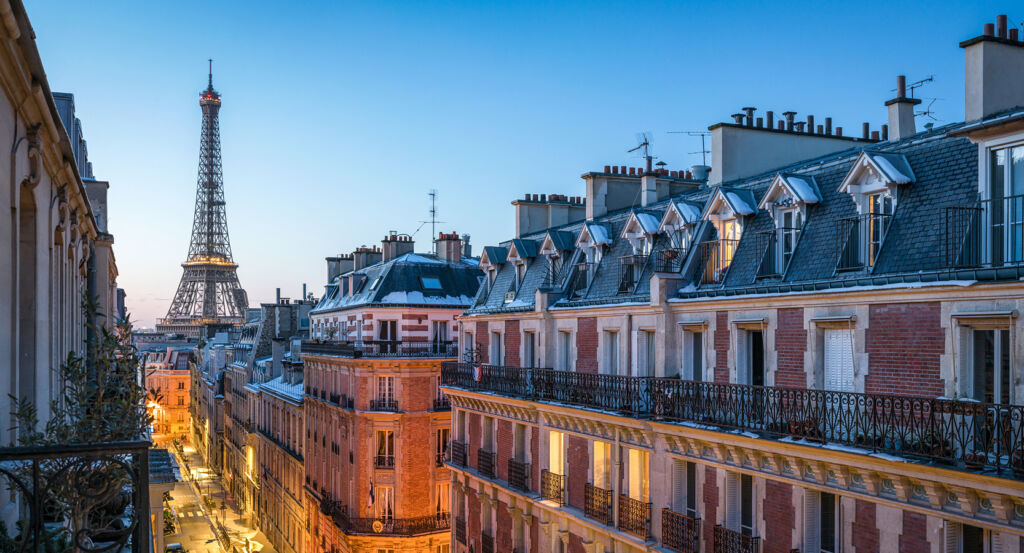
Why Boulevard Haussmann matters.
Boulevard Haussmann is a grand Chaussée-d'Antin corridor where visionary urban planning, architectural grandeur, luxury retail, and Belle Époque elegance converge along one of the capital's most influential boulevards.
Running through Chaussée-d'Antin between Boulevard des Capucines and Avenue de Friedland, this grand boulevard unfolds through world-famous department stores, prestigious financial institutions, elegant Haussmann architecture, celebrated museums, refined cafés, and distinguished commercial avenues that define the sophistication of Central Paris. Broad tree-lined sidewalks, harmonious stone façades, grand retail palaces, and energetic streetscapes create an atmosphere where commerce, culture, and architectural excellence have flourished for more than 150 years. Every section of the boulevard reveals another expression of Paris' transformation into one of the world's great modern capitals. The result is a corridor defined by urban innovation, commercial prestige, and one of the city's most iconic ceremonial avenues.
What defines Boulevard Haussmann.
Boulevard Haussmann is best known as the namesake boulevard of Baron Georges-Eugène Haussmann, whose sweeping reconstruction of Paris under Emperor Napoleon III between 1853 and 1870 fundamentally transformed the medieval capital into the modern city recognized around the world today. Completed in stages between 1857 and 1926, the boulevard became the physical example of Haussmann's revolutionary urban vision, introducing broad avenues, uniform limestone façades, modern sewer and water systems, gas lighting, landscaped streets, and coordinated architectural regulations that established a new international model for city planning. The avenue also became synonymous with luxury retail through the rise of Galeries Lafayette, founded by Théophile Bader and Alphonse Kahn in 1893, whose striking Art Nouveau glass dome was completed in 1912 by Ferdinand Chanut with master glassmaker Jacques Grüber, and Printemps, established by Jules Jaluzot in 1865, pioneering the modern department store concept through fixed pricing, seasonal displays, large-scale advertising, and innovative consumer experiences. Beyond commerce, Boulevard Haussmann preserves internationally significant cultural institutions including the Musée Jacquemart-André and the former residence of novelist Marcel Proust at No. 102, where he wrote substantial portions of À la recherche du temps perdu, among the defining literary achievements of the twentieth century. Together, these architectural, commercial, literary, and urban accomplishments establish Boulevard Haussmann as one of the world's most influential examples of modern city planning.
Monumental department stores, impeccably preserved Second Empire architecture, internationally celebrated museums, and thriving commercial institutions continue illustrating how Haussmann's vision permanently reshaped both Paris and modern urban design across the globe. The boulevard's remarkable combination of architectural uniformity, engineering innovation, luxury retail, and literary history demonstrates why it remains one of the defining achievements of nineteenth-century urbanism. Few city streets anywhere embody the evolution of modern planning, commerce, architecture, and cultural life with such extraordinary international influence.
How Boulevard Haussmann fits.
Boulevard Haussmann works as an exploration through Chaussée-d'Antin's celebrated architectural landmarks and cultural institutions.
Begin at Galeries Lafayette Haussmann, where the grand Art Nouveau dome introduces the extraordinary architectural and commercial legacy of the boulevard before strolling beneath its elegant rows of Haussmannian façades. Continue to the Musée Jacquemart-André, whose exceptional collection of Renaissance masterpieces reveals another dimension of the avenue's cultural prestige. Conclude at the Palais Garnier, where one of the world's greatest opera houses provides a memorable finale celebrating the remarkable relationship between architecture, urban planning, commerce, and artistic achievement that continues defining Central Paris. The progression moves naturally from retail innovation to artistic heritage before culminating in operatic grandeur, revealing why Boulevard Haussmann remains one of the world's most celebrated urban avenues.
Where your story begins.
Foresyte Travel reveals places that feel extraordinary long before you arrive.
Experience premium editorial crafted for luxury travelers.
Foresyte Travel may earn a commission when you book through the link on this page.














































































































