Why Brennan's matters.
Brennan's is a storied Creole restaurant where French Quarter's historic elegance meets the Brennan family's culinary legacy, the invention of Bananas Foster and the elaborate breakfast traditions that helped define New Orleans hospitality.
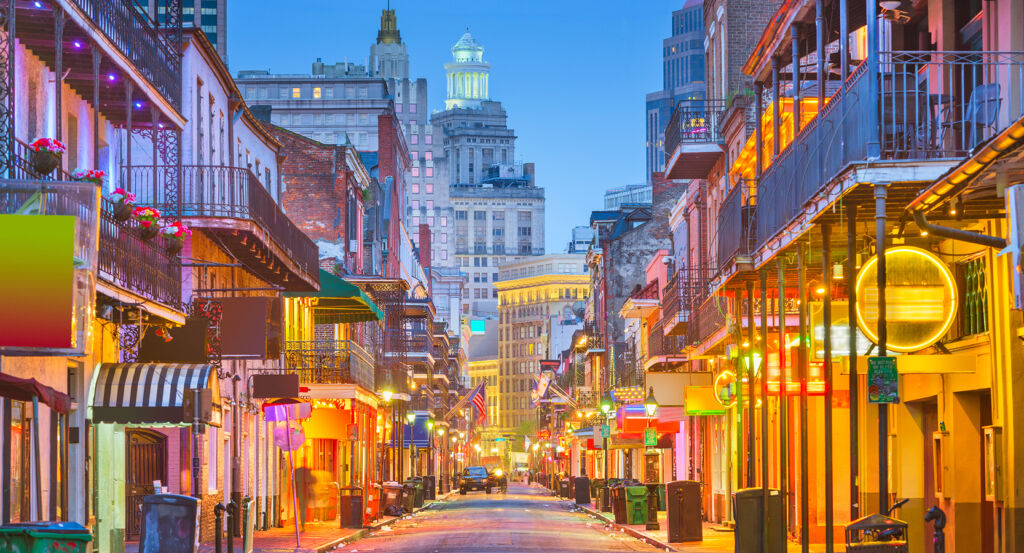
Set along Royal Street near Conti Street and a short walk from Jackson Square, the restaurant occupies a historic French Quarter block between Bourbon Street and Chartres Street, surrounded by antique galleries, nineteenth-century commercial buildings and the narrow streets extending toward the Mississippi River. Its distinctive pink façade introduces a two-story historic building whose shuttered windows, wrought-iron balconies and richly ornamented entrance preserve the architectural character of old New Orleans. An elegant sequence of dining rooms unfolds through the property, with elaborate wall coverings, decorative furnishings and carefully restored architectural details creating an atmosphere of cultivated formality. The enclosed courtyard introduces a quieter setting framed by historic masonry, tropical planting and the intimate spatial arrangement characteristic of French Quarter residential compounds. The result is a restaurant whose historic architecture, secluded courtyard and ceremonial dining rooms embody the enduring relationship between New Orleans preservation and Creole hospitality.
What defines Brennan's.
Brennan's is best known for transforming breakfast into an elaborate Creole dining occasion and creating Bananas Foster, among the most recognizable desserts in American restaurant history. Founder Owen Edward Brennan entered the hospitality business through the Old Absinthe House, the celebrated Bourbon Street establishment he acquired in 1943. A challenge from fellow restaurateur Count Arnaud Cazenave, who questioned an Irishman's ability to operate a serious French restaurant, helped inspire Brennan to establish Owen Brennan's Vieux Carré Restaurant in 1946. The enterprise quickly became a family undertaking, drawing Owen's siblings into an ambitious hospitality business that would eventually produce several of New Orleans's most influential restaurant institutions. Ella Brennan emerged as a particularly consequential figure, helping establish the elaborate breakfast service and ambitious culinary presentation that distinguished the restaurant from conventional morning dining. In 1951, chef Paul Blangé developed Bananas Foster in collaboration with Ella Brennan, naming the dessert for Richard Foster, a civic leader associated with the New Orleans Crime Commission. The preparation transformed bananas, a commodity central to the city's international port economy, into a theatrical restaurant creation built around butter, brown sugar, rum and a dramatic flambé presentation. A dispute over the Bourbon Street lease prompted the family to pursue a new location, and Owen Brennan died in 1955 before the relocation was completed. Brennan's moved to Royal Street in 1956, occupying a property constructed in 1795 for merchant Don José Faurie that subsequently housed the Banque de la Louisiane. The building later became the residence of the Morphy family, including Paul Morphy, the nineteenth-century chess prodigy whose victories against leading European competitors brought international attention to New Orleans. The family's expanding restaurant interests eventually divided into separate enterprises operated by different branches of the Brennan dynasty, creating a remarkable network of culinary institutions across the city. Brennan's received Wine Spectator's Grand Award in 1983, reflecting the importance of its extensive wine program within the restaurant's formal dining tradition. Financial difficulties culminated in the restaurant's closure in June 2013, ending a long period of ownership by Owen Brennan's descendants. Restaurateur Ralph Brennan and businessman Terry White subsequently acquired the property and restaurant name, undertaking a substantial restoration before reopening Brennan's on November 25, 2014. Interior designer Richard Keith Langham directed the decorative renewal, and chef Slade Rushing led the reopening kitchen, establishing a new chapter for one of New Orleans's most consequential culinary institutions.
Ella Brennan's conception of breakfast as an elaborate social occasion continues to shape the restaurant's distinctive relationship between Creole cooking, formal hospitality and theatrical presentation. The morning meal unfolds through a deliberately leisurely sequence, beginning with the ceremonial arrival of cocktails and continuing into preparations that draw upon the rich sauces, precise egg cookery and layered flavors of classical New Orleans cuisine. Eggs Hussarde exemplifies this culinary inheritance through the combination of poached eggs, hollandaise and savory components associated with the city's longstanding adaptation of French restaurant technique. The kitchen's treatment of breakfast establishes a rhythm in which richness and refinement develop together, giving familiar morning ingredients the structure and complexity of a substantial Creole meal. Bananas Foster supplies the culmination of that tradition through a tableside preparation whose dramatic appeal grows directly from its culinary technique. Butter and brown sugar form a warm caramel base, bananas soften in the sauce, and the addition of rum introduces the flame that has made the dessert an enduring performance. The finished preparation brings the warmth of the sauce into contact with cold vanilla ice cream, creating a contrast of temperature and texture that gives the performance a satisfying culinary conclusion. Ralph Brennan's stewardship has also renewed the restaurant's longstanding commitment to wine, with wine director Braithe Tidwell helping restore the program to Wine Spectator's Grand Award level in 2021. The extensive cellar supports the same ceremonial approach that defines the dining room, connecting thoughtful wine service with the restaurant's broader culture of hospitality and celebration. Brennan's distinctive achievement lies in the continuity between these elements: an elaborate morning meal, a historically significant culinary invention and a style of service that transforms dining into an essential expression of New Orleans social life.
How Brennan's fits.
Brennan's works as the anchor for an outing connecting the French Quarter's architectural preservation, the development of American medical practice and the musical inheritance that established New Orleans jazz as one of the city's most consequential cultural achievements.
Begin at The Historic New Orleans Collection, whose Royal Street museum occupies historic buildings devoted to preserving the history and culture of New Orleans and the Gulf South. Founded in 1966 by General L. Kemper Williams and Leila Hardie Moore Williams, the institution grew from their extensive collection of Louisiana historical materials and commitment to protecting the French Quarter's architectural heritage. Its Seignouret-Brulatour Building dates to 1816 and became an important cultural address during the twentieth century when the Arts and Crafts Club of New Orleans established galleries and classrooms within the property. The building later housed television station WDSU, whose broadcasting operations introduced another chapter of cultural production before the museum acquired the property in 2006. The restored Brulatour Courtyard preserves the architectural setting of those successive transformations, connecting nineteenth-century domestic life with the neighborhood's artistic and broadcasting history. Continue to New Orleans Pharmacy Museum, occupying the Creole townhouse constructed in 1822-1823 for Louis J. Dufilho Jr., the first licensed pharmacist in the United States. Dufilho operated an apothecary on the ground floor and maintained his family residence above the business until selling the property in 1855. The building subsequently passed to Dr. James Dupas, who maintained his medical practice on the second floor and continued the pharmaceutical operation below, preserving its association with nineteenth-century healthcare. Established in 1950, the museum developed a collection of 18,400 historical items, including medical instruments, pharmaceutical containers, reference books and an 1855 Lippincott soda fountain. The collection traces the transformation of pharmacy from an individually operated trade into an increasingly specialized profession, preserving material evidence of changing medical practices and commercial life. Conclude at Preservation Hall, the St. Peter Street institution whose origins lie in the traditional jazz revival that renewed interest in New Orleans's pioneering musicians during the mid-twentieth century. Art dealer Larry Borenstein began hosting informal performances in his gallery, bringing together musicians whose careers connected the earliest generations of jazz with audiences discovering the music decades later. Allan and Sandra Jaffe encountered those performances during a visit to New Orleans in 1960 and subsequently helped establish Preservation Hall as a dedicated performance venue in 1961. The institution created opportunities for Black and Creole musicians during the segregation era, sustaining musical careers and preserving a collective improvisational tradition central to the city's cultural history. The Preservation Hall Jazz Band carried that inheritance into international performance, extending the institution's influence across successive generations of musicians and audiences. The progression moves from the preservation of the French Quarter's architectural and cultural history through the professional development of American pharmacy and culminates in the living musical tradition of Preservation Hall, revealing the institutions that have sustained New Orleans's distinctive cultural inheritance.
Where your story begins.
Foresyte Travel reveals places that feel extraordinary long before you arrive.
Enjoy editorial crafted for luxury travelers.
Foresyte may earn a commission when you book.