
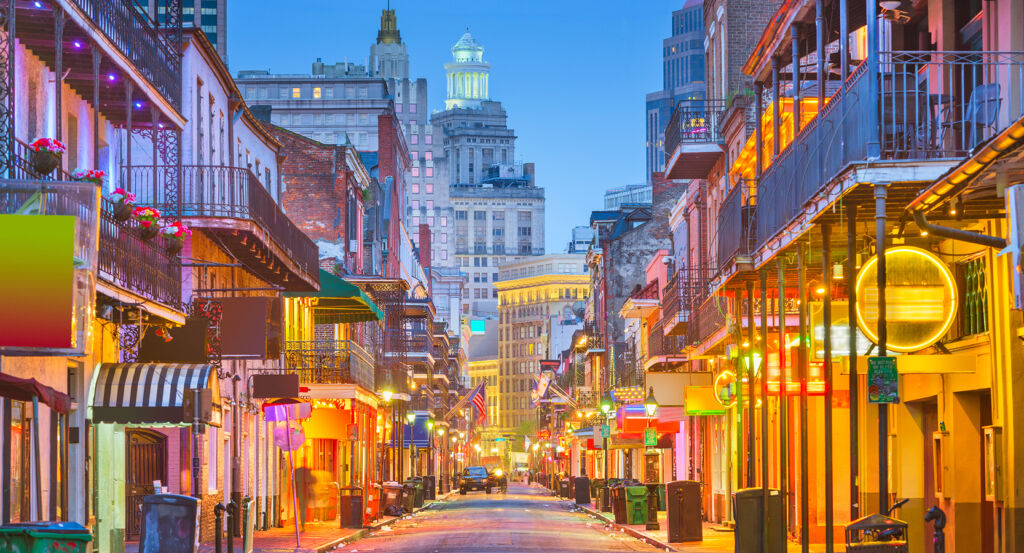
Why Jackson Square matters.
Jackson Square is a historic public square where the French Quarter's Creole heritage meets the colonial foundations of New Orleans, the political transformation of Louisiana and the architectural grandeur of the Mississippi River's most consequential historic port.
Set along Chartres Street between St. Peter Street and St. Ann Street and just steps from the Mississippi River waterfront, the square occupies a prominent position within the French Quarter, framed by expansive civic buildings, nineteenth-century commercial residences and the historic streets of the original colonial settlement. Ornamental iron fencing encloses a formal garden of geometric pathways, manicured lawns and carefully arranged planting beds. A central equestrian monument rises above the landscaped grounds, establishing a commanding focal point beneath the surrounding tree canopy. The adjoining pedestrian streets accommodate portrait artists, musicians and performers whose activities extend the square's longstanding role as a public gathering place. The result is an exceptionally preserved civic landscape whose architectural composition and continuous public use connect the city's colonial origins with its enduring cultural traditions.
What defines Jackson Square.
Jackson Square is best known for its role as the ceremonial center of colonial New Orleans and the site of the formal transfer of Louisiana to the United States in 1803. French colonists established the original public square in 1718 as the Place d'Armes, positioning it within the settlement plan developed under the direction of Jean-Baptiste Le Moyne de Bienville. The square served as a military parade ground and gathering place, reflecting the administrative and defensive priorities of the emerging colonial port. French authorities organized the surrounding streets around a central civic composition incorporating religious and governmental buildings. Spanish administration subsequently transformed the architectural character of the district following the transfer of Louisiana in the eighteenth century. The great fires of 1788 and 1794 destroyed substantial portions of the surrounding colonial settlement, creating opportunities for the reconstruction of major public buildings. Spanish colonial officials developed a more substantial civic environment through masonry construction and formal architectural planning. The Louisiana Purchase transferred the territory to American sovereignty in 1803, bringing the square into the political history of the expanding United States. The ceremonial transfer took place on December 20, 1803, establishing the former French colonial capital as an American city. During the nineteenth century, the square underwent substantial landscape improvements associated with the development of New Orleans as a prosperous commercial center. The space was renamed Jackson Square in 1851 to honor Andrew Jackson, whose military victory at the Battle of New Orleans in 1815 had established his national reputation. Sculptor Clark Mills created the equestrian statue of Jackson installed in the square in 1856, introducing the monument that continues to define its central garden. The surrounding district subsequently became an important focus of historic preservation efforts, protecting the square's architectural setting as New Orleans expanded into newer neighborhoods.
How Jackson Square fits.
Jackson Square works as the historical anchor for a French Quarter outing connecting New Orleans' colonial commercial institutions, the preservation of Creole domestic architecture and the distinctive cultural traditions of the Mississippi River waterfront.
Begin at Old Ursuline Convent, the historic religious complex completed in 1752 on Chartres Street. Its French colonial architecture preserves one of the oldest surviving buildings in the Mississippi Valley, reflecting the importance of Catholic religious institutions in early Louisiana. The Ursuline nuns established educational and charitable programs that contributed substantially to the social development of colonial New Orleans. The building's restrained masonry facade, steep roof and formal interior spaces preserve important architectural characteristics of the French colonial period. Its preserved grounds and museum interpretation introduce the religious and educational history of the early settlement. Continue to Hermann-Grima House, the distinguished Creole townhouse completed in 1831 for merchant Samuel Hermann. Its Federal-style architecture incorporates a substantial courtyard and carefully organized domestic interiors, preserving the spatial arrangement of an affluent nineteenth-century urban residence. The property includes a historic stable and functional open-hearth kitchen, providing insight into household operations and the specialized labor required to sustain them. Its interpretation addresses the lives of enslaved people who worked within the residence, examining the relationship between domestic wealth and coerced labor. Period furnishings and preserved architectural finishes establish a detailed account of Creole domestic life during the antebellum period. Conclude at French Market, the historic commercial district extending along the Mississippi River waterfront near the eastern end of the French Quarter. Its origins reach into the colonial period, when riverfront trading activity supported the exchange of agricultural produce, seafood and imported goods. The market developed into a substantial commercial institution during the nineteenth century, incorporating covered stalls and permanent structures serving the surrounding neighborhood. Its commercial history reflects the contributions of Indigenous traders, African American vendors, European immigrants and the diverse communities associated with the port. Contemporary market halls accommodate food merchants, specialty vendors and regional craftspeople, preserving a substantial connection with the district's longstanding trading traditions. The progression moves from Old Ursuline Convent's colonial religious history through Hermann-Grima House's preserved Creole domestic architecture and culminates at French Market's historic waterfront commerce, connecting three essential dimensions of New Orleans' early urban development.
Where your story begins.
Foresyte Travel reveals places that feel extraordinary long before you arrive.
Enjoy editorial crafted for luxury travelers.














































































































