
Why St. Ann Street matters.
St. Ann Street is a layered corridor where the French Quarter's Creole architectural character meets the original colonial grid, Jackson Square's nineteenth-century remaking and generations of LGBTQ cultural life around Bourbon Street.
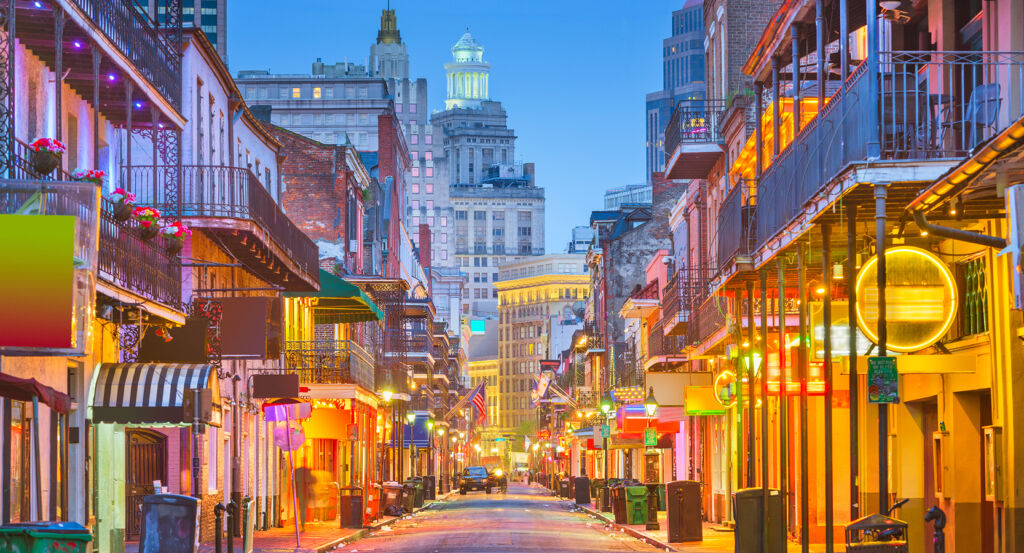
Running through the French Quarter between the Mississippi River and North Rampart Street, the corridor begins against the expansive civic ensemble surrounding Jackson Square before passing through increasingly intimate blocks toward the inland edge of the Vieux Carré. The Lower Pontalba Building gives its riverward end an unusually disciplined architectural wall, followed by narrower Creole townhouses, courtyards and commercial buildings as the street crosses Chartres, Royal and Bourbon. Iron galleries project above the sidewalks through the central blocks, and masonry facades frequently conceal deep lots organized around interior courtyards. Near North Rampart Street, the enclosed colonial grid opens abruptly toward Louis Armstrong Park and the historic landscape beyond the former city boundary. The result is a short corridor whose changing scale carries the French Quarter from its formal nineteenth-century civic center through dense Creole streetscapes to the historic threshold between the Vieux Carré and Tremé.
What defines St. Ann Street.
St. Ann Street is best known for preserving one of the transverse axes of New Orleans' original colonial street plan and subsequently accumulating architecture that records the city's passage through French, Spanish and American rule. Jean-Baptiste Le Moyne de Bienville founded New Orleans in 1718, and engineer Adrien de Pauger arrived in 1721 to formalize the settlement as the rectilinear Vieux Carré. An April 1723 plan already identifies Rue Sainte-Anne among the streets running parallel to Orleans, St. Peter, Dumaine and St. Philip, placing the name among the earliest surviving elements of the city's geography. The corridor crossed the original settlement from the Mississippi River side toward the defensive edge that became Rampart Street, tying its history directly to the compact colonial city. Spanish rule subsequently transformed the architecture surrounding it after fires in 1788 and 1794 destroyed more than a thousand buildings across New Orleans and stricter construction requirements favored brick, stucco, tiled roofs and fire-resistant party walls. American acquisition of Louisiana in 1803 brought another period of growth. Micaela Almonester, Baroness de Pontalba, imposed the street's most consequential nineteenth-century architectural intervention when she developed the Lower Pontalba Building along its Jackson Square edge between 1849 and 1851, part of a pair of expansive red-brick rows designed by James Gallier Sr. Their combination of residences and commercial premises transformed the former Place d'Armes into a more formally enclosed urban square and introduced the cast-iron galleries that became inseparable from its later appearance. The persistence of St. Ann Street through these successive political and architectural regimes makes the corridor a surviving piece of eighteenth-century urban planning whose buildings register the city that developed around it.
A second cultural history concentrated around the intersection with Bourbon Street as the surrounding blocks became one of the principal centers of LGBTQ life in New Orleans. Organized gay Carnival culture developed during the mid-twentieth century, with the Krewe of Yuga formed in 1958 and the Krewe of Petronius following in 1961. The Bourbon Pub opened at the Bourbon and St. Ann intersection in 1974 and developed into one of the city's principal gay nightlife institutions, placing the crossing at the center of a community that had already built its own Carnival organizations, social traditions and gathering places. The Bourbon Street Awards subsequently made the St. Ann area a major Mardi Gras stage for elaborate drag and costume presentations, with competitive categories including drag, leather, group and overall costume. Southern Decadence added another major annual gathering to the surrounding streets after beginning as a small 1972 house party in Tremé and expanding into a citywide LGBTQ celebration. New Orleans & Company identifies the St. Ann intersection as the point where Bourbon Street's gay nightlife district begins, with the Bourbon Pub and Oz facing one another across the crossing. St. Ann Street carries a cultural importance distinct from its colonial architecture, marking a junction where organized gay Carnival, nightlife and public costume traditions became embedded in the modern social geography of the French Quarter.
How St. Ann Street fits.
St. Ann Street works as the spine for an outing connecting an antebellum residence inside the Pontalba Buildings, a preserved nineteenth-century Creole courtyard complex and the African American gathering ground fundamental to New Orleans musical history.
Begin at 1850 House, where the Louisiana State Museum reconstructs upper-middle-class domestic life inside the Lower Pontalba Building. Baroness Micaela Almonester de Pontalba developed the paired rows flanking Jackson Square after returning to New Orleans from France, creating fourteen townhouses on either side of the square with commercial rooms below residential floors. The museum occupies No. 8 on the St. Ann side and preserves Old Paris porcelain, New Orleans silver, paintings and John Slidell china within period interiors. The household structure represented there also exposes the labor sustaining that prosperity: the 1860 census counted 171 people across the Pontalba Buildings, with nearly half identified as enslaved people or servants. Continue to Hermann-Grima House, constructed in 1831 for German-born merchant Samuel Hermann and his family during the commercial expansion that made New Orleans one of the wealthiest American cities of the antebellum period. Architect William Brand designed the Federal-style residence around a courtyard complex containing service spaces essential to the household. Hermann lost the property after the financial crisis of 1837, and Creole attorney Félix Grima acquired it in 1844. Its surviving domestic ensemble subsequently became particularly important for interpreting the lives of enslaved women and men whose labor sustained affluent urban households, extending the architectural history of the Quarter beyond its public facades. Conclude at Congo Square, where enslaved and free people of African descent gathered on Sundays before the Civil War to trade, socialize, drum and dance outside the old city walls. The site became a formal square after Fort St. Ferdinand was demolished in 1812, and an 1817 ordinance concentrated Sunday gatherings there. African musical practices maintained in the square contributed to the cultural environment from which later New Orleans music developed, giving the ground significance extending far beyond its physical boundaries. The city incorporated Congo Square into Louis Armstrong Park during twentieth-century redevelopment after demolitions displaced hundreds of Tremé families, and the square entered the National Register of Historic Places in 1993. The progression moves from the domestic hierarchy preserved inside a Pontalba townhouse through the merchant wealth and enslaved labor embedded in a Creole courtyard complex and culminates at the public ground where African music, dance and commerce endured beyond the colonial city walls, connecting three distinct social worlds that shaped nineteenth-century New Orleans.
Where your story begins.
Foresyte Travel reveals places that feel extraordinary long before you arrive.
Enjoy editorial crafted for luxury travelers.
Foresyte may earn a commission when you book.














































































































