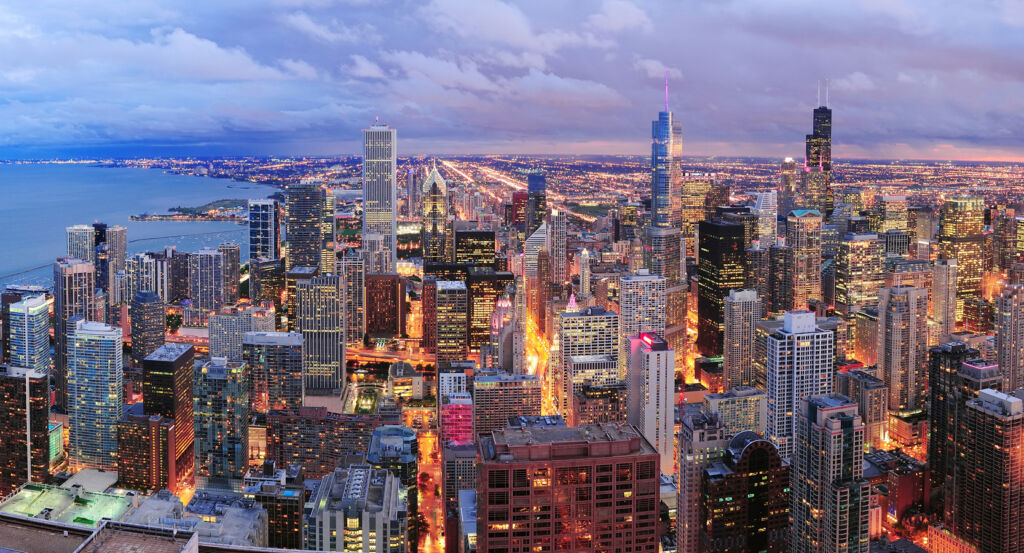
Why you should experience Carroll Avenue in Chicago, Illinois.
Carroll Avenue is an enterprising corridor where Fulton Market's industrial heritage, transportation innovation, commercial reinvention, and Chicago's downtown history converge along one of the West Loop's most enduring streets.
Running through Fulton Market between the Chicago River and the Near West Side, Carroll Avenue connects former warehouse districts, rail infrastructure, commercial buildings, office campuses, and longstanding business corridors that collectively reflect more than 170 years of metropolitan development. The corridor reveals how freight railroads, wholesale commerce, food distribution, and adaptive redevelopment reshaped an industrial district into one of Chicago's foremost centers of business and innovation. Historic brick warehouses, converted loft buildings, modern office architecture, and preserved industrial streetscapes continue defining the avenue while reinforcing its enduring identity. The result is a corridor distinguished by commercial resilience, architectural continuity, and generations of economic reinvention.
What you should know about Carroll Avenue.
Carroll Avenue is best known for developing alongside Chicago's expanding freight network during the mid-nineteenth century, serving industries concentrated west of the North Branch of the Chicago River after the arrival of the Galena and Chicago Union Railroad in 1848 and subsequent growth of the Chicago & North Western Railway. Construction of freight houses, cold-storage facilities, wholesale produce markets, food-processing plants, warehouses, and manufacturing buildings between the 1850s and the 1930s established the corridor as an integral component of Chicago's distribution economy. The avenue also became closely associated with the Kinzie Street rail corridor, extensive switching yards, and elevated freight infrastructure that supported regional commerce while connecting river terminals with industries throughout metropolitan Chicago. Following the decline of heavy industry during the late twentieth century, former industrial buildings underwent extensive rehabilitation for offices, technology companies, design firms, and creative enterprises while preserving substantial collections of historic masonry architecture. Continued investment in transportation infrastructure, preservation initiatives, and commercial redevelopment has maintained Carroll Avenue as one of the West Loop's most historically representative industrial corridors.
Organizations including the West Central Association have advanced economic development through infrastructure advocacy, business recruitment, planning initiatives, and long-term investment supporting the corridor's continued evolution. Engineering improvements administered by the Chicago Department of Transportation, planning efforts coordinated by the Chicago Metropolitan Agency for Planning, modernization of freight infrastructure, and preservation of historic warehouse buildings collectively demonstrate how transportation engineering, commerce, architecture, and civic leadership have sustained Carroll Avenue's historic identity. Together, the Galena and Chicago Union Railroad, the Chicago & North Western Railway, the Kinzie Street rail corridor, the West Central Association, the Chicago Metropolitan Agency for Planning, the Chicago Department of Transportation, and generations of freight investment establish Carroll Avenue among Chicago's most historically significant commercial corridors.
How to fold Carroll Avenue into your trip.
Carroll Avenue works as an exploration of the West Loop's industrial heritage, architectural evolution, and creative energy.
Begin at Fulton Market District, where preserved warehouse architecture introduces the commercial history that shaped Carroll Avenue before naturally expanding into the surrounding neighborhood. Continue to Chicago French Market, where regional food traditions and the area's transportation legacy reflect the district's continuing economic vitality before guiding the experience toward its conclusion. Conclude at Merchandise Mart, where pioneering commercial architecture and enduring business influence provide the historical and architectural payoff, illustrating how commerce, design, and thoughtful reinvestment continue shaping the West Loop. The progression moves naturally from industrial history to culinary culture before concluding with one of Chicago's defining commercial buildings.
Where your story begins.
Foresyte Travel reveals places that feel extraordinary long before you arrive.
Experience premium editorial crafted for luxury travelers.