
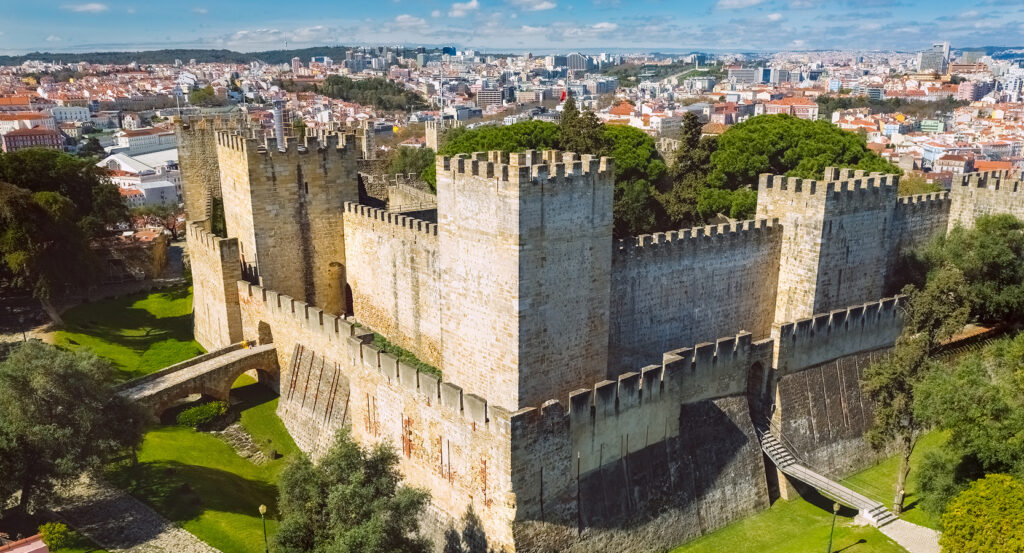
Why you should experience Archaeological Site of Castelo de São Jorge in Lisbon, Portugal.
Archaeological Site of Castelo de São Jorge is a secret to Lisbon, a city layered in silence and dust.
The archaeological site is not a reconstruction or a gallery; it is Lisbon's memory unearthed. Here, under the same hill that carries the castle's ramparts and towers, lie the remains of civilizations that shaped the city long before the Portuguese crown. Step inside the sheltered excavation area and the air changes, cooler, drier, touched with the scent of earth and stone. Light filters softly through glass panels above, glancing across fragments of homes, ovens, and foundations preserved in situ. Standing here, you sense time collapsing: the medieval walls of the castle towering above, the traces of Islamic courtyards beneath, and deeper still, Roman and Iron Age relics that predate language itself. The quiet hum of the present fades, replaced by the pulse of the ancient.
What you should know about Archaeological Site of Castelo de São Jorge.
This site is one of Lisbon's most significant time capsules, revealing continuous human occupation from the 7th century BC to the 12th century AD.
Excavations began in the 1990s, uncovering an extraordinary stratigraphy, Iron Age fortifications, Roman dwellings, Moorish foundations, and the outlines of the first Christian royal quarters after the 1147 Reconquest. Each layer tells a different story: the geometric precision of Roman walls built for permanence; the flowing, organic layout of Moorish homes, arranged around shaded courtyards with water channels running through; and the rough-hewn medieval stones marking the rebirth of Lisbon under Portuguese rule. Among the most remarkable finds are ceramics decorated with Andalusian motifs, imported amphorae that once carried olive oil and wine across the Mediterranean, and fragments of tools and jewelry that whisper of daily life. The remains of a Moorish domestic complex sit at the center, its small cisterns and tiled floors evidence of a culture attuned to balance and beauty. Archaeologists also uncovered traces of the earliest Christian palace on this hill, modest compared to the fortress above, but crucial to Lisbon's emergence as a capital. Few visitors realize that beneath this single courtyard, over two thousand years of Lisbon coexist within a few meters of soil, each civilization leaving its fingerprint on the one below.
How to fold Archaeological Site of Castelo de São Jorge into your trip.
To explore the archaeological site is to walk inside Lisbon's foundation, both literally and metaphorically.
Begin your visit to the castle as usual, climbing through the main gate and wandering the courtyards until you reach the discreet entrance marked “Núcleo Arqueológico.” Inside, a glass canopy shelters the excavated remains, preserving them exactly as they were found. Move slowly along the elevated walkways; they hover above the ruins, allowing you to see each layer from above, Iron Age stones giving way to Roman masonry, Moorish tiles shimmering faintly in the light. Plaques and subtle illumination guide you through eras. Pause often; the space invites stillness more than movement. Visit in the late afternoon when sunlight slants through the canopy, turning the stones golden and the shadows long. If you listen closely, the wind outside carries through the cracks of the glass, a reminder that life, even buried for centuries, continues to breathe. Before you leave, step out to the courtyard and look up at the castle walls rising above the excavation. The contrast is haunting: the fortress of kings standing guard over the bones of forgotten worlds. In that moment, you realize that Lisbon isn't built upon history, it is history, layer by living layer.
Where your story begins.
Foresyte Travel reveals places that feel extraordinary long before you arrive.
Experience premium editorial crafted for luxury travelers.














































































































