Why you should experience Chicago Marriott Downtown Grand Mile in Chicago, Illinois.
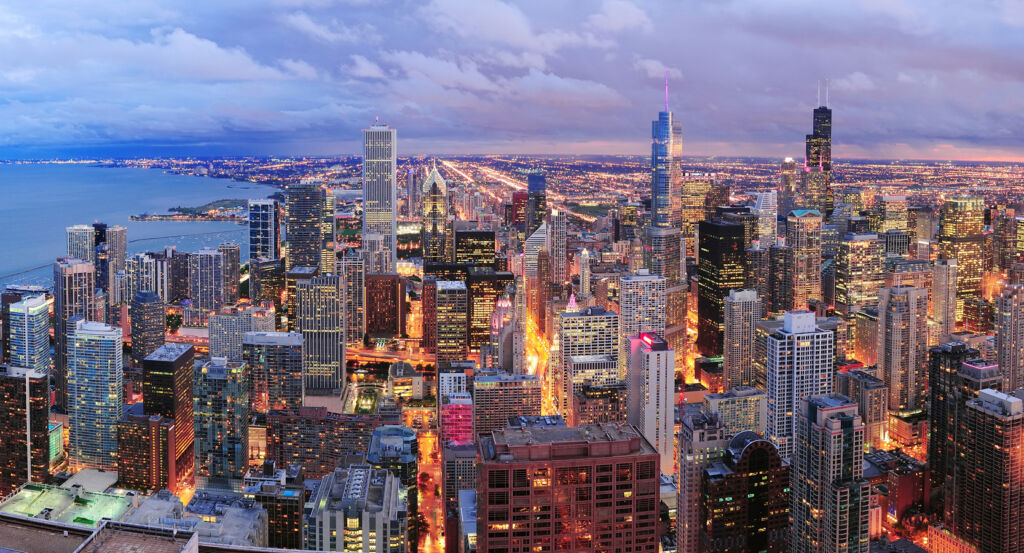
Chicago Marriott Downtown Grand Mile is a metropolitan high-rise hotel where Streeterville's architectural confidence, Michigan Avenue commerce, convention culture and appetite for vertical performance converge inside a Harry Weese tower that has anchored the avenue since 1978.
Set along North Michigan Avenue near East Ohio Street and just steps from The Shops at North Bridge, the 46-story, 460-foot hotel was designed by Harry Weese & Associates and completed on the former site of Michigan Square Building, the Holabird & Root complex also remembered for its dramatic Diana Court. The 1930 predecessor was demolished in 1973, clearing one of Michigan Avenue's celebrated earlier architectural compositions before Weese, already responsible for projects including Washington Metro stations and Chicago's Time-Life Building, supplied the site with an emphatically vertical replacement. De Stefano + Partners renovated the building in 2001, adding another architectural chapter to a property whose prominent Michigan Avenue position has remained constant through successive eras of the shopping corridor. The result is a hotel where Holabird & Root's vanished Michigan Square Building and Harry Weese's 1978 tower compress two generations of Chicago architectural ambition into the same Streeterville parcel.
What you should know about Chicago Marriott Downtown Grand Mile.
Chicago Marriott Downtown Grand Mile is best known for operating continuously since 1978 and developing into one of Marriott's largest Central Chicago properties, with 1,200 guestrooms and suites, 64,647 square feet of function space and a 2019 renovation that refreshed a hotel already more than four decades into its Michigan Avenue tenure. Marriott International recognized the property as its Western Region Hotel of the Year in 2019, while Cvent has included it among its Top 100 Meeting Hotels, reinforcing a convention character built around one of the company's largest room inventories in the city. Executive Chef Frank Sanchez assumed leadership of the culinary operation in 2017 after joining Marriott in 2010, serving as executive chef at Coronado Island Marriott Resort & Spa and leading the banquet kitchen at JW Marriott Tucson Starr Pass Resort & Spa before becoming executive sous chef in Chicago in October 2014. Sanchez subsequently took responsibility for Harvest, Rush Street Pantry and the property's rooftop agricultural program, connecting a 1970s convention hotel with a distinctly twenty-first-century approach to Midwestern sourcing and hotel cooking.
Four Star Mushrooms, Closed Loop Farms and Great American Cheese Company develop that culinary thesis through named Midwestern suppliers incorporated into the hotel's contemporary kitchens, creating a regional ingredient network around Harvest's Chicago-focused cooking. Wild Blossom Meadery extends the same relationship onto the roof through an apiary whose honey enters house-made dishes, pairing one of Chicago's large downtown hotels with a company rooted in Illinois honey and mead production. Harvest translates those partnerships into seasonal Midwestern cooking, while Reviver and Rush Street Pantry extend the property's food program through separate identities without displacing the locally sourced structure established by the kitchen. Together, Frank Sanchez, Four Star Mushrooms, Closed Loop Farms, Great American Cheese Company and Wild Blossom Meadery give Chicago Marriott Downtown Grand Mile a culinary narrative built around identifiable regional practitioners and producers rather than the anonymity often associated with a 1,200-room convention property.
How to fold Chicago Marriott Downtown Grand Mile into your trip.
Chicago Marriott Downtown Grand Mile works as the anchor for an afternoon tracing infrastructure, private wealth and experimental art through the architectural layers surrounding North Michigan Avenue.
Begin at Chicago Water Tower, where William W. Boyington completed the castellated Gothic Revival structure in 1869 from yellow Joliet-Lemont limestone, enclosing a standpipe added to Ellis S. Chesbrough's pioneering Lake Michigan water system after a nearly two-mile offshore tunnel began supplying cleaner water to the growing city in 1867. Continue to Richard H. Driehaus Museum, where First National Bank of Chicago founder Samuel Mayo Nickerson commissioned Burling & Whitehouse for a 24,000-square-foot residence completed in 1883 for $450,000, with R. W. Bates & Co., William August Fiedler and George A. Schastey & Co. creating interiors so elaborate that the residence became known as the Marble Palace. Conclude at Museum of Contemporary Art Chicago, where Berlin architect Josef Paul Kleihues designed the $45 million building completed in 1996 after the institution secured a 99-year lease on the former Illinois National Guard Chicago Avenue Armory site in 1990, welcoming more than 25,000 people during its 24-hour opening preview. The progression moves from Boyington and Chesbrough's nineteenth-century engineering through Nickerson's Gilded Age patronage into Kleihues's late-twentieth-century museum architecture, revealing the successive ambitions surrounding Chicago Marriott Downtown Grand Mile in Streeterville.
Where your story begins.
Foresyte Travel reveals places that feel extraordinary long before you arrive.
Experience premium editorial crafted for luxury travelers.