
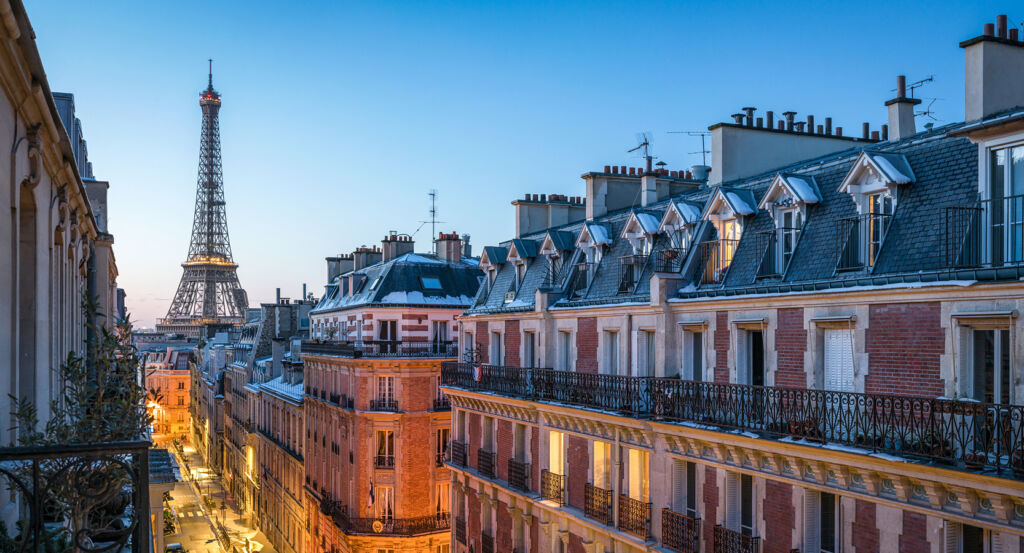
Why you should experience Chouchou Hotel in Paris, France.
Chouchou Hotel is a renowned four-star hotel where Opéra's theatrical swagger, chanson heritage, Parisian sociability and rebellious French pop culture converge inside a contemporary guinguette conceived as a living celebration of France.
Set along Rue du Helder near Boulevard des Capucines and just steps from Palais Garnier, the 63-room property was conceived by Parisian interior architect Michael Malapert, who translated French cultural references into a blue-and-white façade, parquet-lined guestrooms, a glass-roofed social hall and three suites dedicated to Édith Piaf, Serge Gainsbourg and Boris Vian. Malapert designed the public spaces around the spirit of a guinguette and French market, allowing dining, drinking and live music to share the same theatrical environment while contemporary art and French craftsmanship continue through the accommodation floors. The three signature suites sharpen that premise through La Vie en Rose, L'Anamour and L'Arrache-Coeur, turning three works inseparable from twentieth-century French music and literature into distinct residential environments. The result is a hotel where Malapert's design, chanson, literature and the communal energy of the guinguette give Opéra's performance culture a knowingly contemporary Parisian expression.
What you should know about Chouchou Hotel.
Chouchou Hotel is best known for opening in September 2020 as a 63-room, three-suite addition to Elegancia Hotels, with Michael Malapert designing the property around French craftsmanship and pop culture after earlier projects including Cédric Grolet's Opéra pâtisserie and Station F. The opening had originally been scheduled for April 2020 before the pandemic forced its postponement, and restrictions interrupted its first launch before the hotel fully reopened in June 2021. Malapert organized the accommodation program around parquet floors, cornices, bespoke artistic references and French-made decorative elements, then reserved its three largest compositions for cultural figures: the La Vie en Rose Junior Suite references Édith Piaf, L'Anamour references Serge Gainsbourg, and the 46-square-meter L'Arrache-Coeur Suite takes its name from Boris Vian's 1953 novel while facing Palais Garnier. The ground floor was conceived simultaneously as a contemporary guinguette and food market, originally dividing its French sourcing between seafood counter La Mer à Boire and La Grande Bouffe for meat, cheese and products sourced from French producers. Three reservable private baths beneath the hotel completed the original program, giving a relatively compact four-star property an unusually elaborate combination of hospitality, music, food culture and private bathing.
Michael Malapert carried the cultural premise beyond recognizable names by treating the hotel as a sequence of French references, with the guestrooms combining traditional parquet and cornices with contemporary furnishings while the public spaces borrow the informal social codes of the guinguette. Édith Piaf supplies La Vie en Rose, the song she wrote in 1945 and recorded the following year, while Serge Gainsbourg's L'Anamour, written for Françoise Hardy and released in 1968, gives the second Junior Suite its identity. Boris Vian provides the literary counterpoint through L'Arrache-Coeur, his final novel published in 1953, with the corresponding 46-square-meter suite adding books, a record player, separate living space, bathtub and a direct Opéra view to the hotel's most developed cultural composition. Elegancia's decision to combine these references with live programming and an exclusively French market concept makes Chouchou's cultural thesis unusually legible: Piaf, Gainsbourg and Vian are not incidental decoration, but three anchors within Malapert's broader attempt to translate twentieth-century French popular culture into hospitality.
How to fold Chouchou Hotel into your trip.
Chouchou Hotel works as the anchor for an afternoon tracing how performance, performance and popular entertainment repeatedly reinvented the streets surrounding Opéra.
Begin at Olympia, the music hall opened by Joseph Oller in 1893 and relaunched by Bruno Coquatrix in 1954, where Édith Piaf, Jacques Brel, Dalida and later generations of performers turned its red-lettered Boulevard des Capucines façade into shorthand for French popular music. Continue to Théâtre Édouard VII, created for King Edward VII and inaugurated in 1913 before Sacha Guitry became one of the theater's defining figures, writing and performing works there with Yvonne Printemps during a period that embedded boulevard theater into the district's cultural identity. Conclude at Opéra Comique, an institution founded in 1714 whose Salle Favart became the birthplace of works including Bizet's Carmen in 1875 and Debussy's Pelléas et Mélisande in 1902, carrying the sequence from chanson and boulevard entertainment into operatic works that entered the international repertoire. The progression moves from Olympia's popular-music mythology through Guitry's theatrical Paris into the centuries-deep repertoire of Opéra Comique, revealing the performance culture that makes Chouchou Hotel's Piaf, Gainsbourg, Vian and guinguette references feel native to this particular part of Paris.
Where your story begins.
Foresyte Travel reveals places that feel extraordinary long before you arrive.
Experience premium editorial crafted for luxury travelers.














































































































