
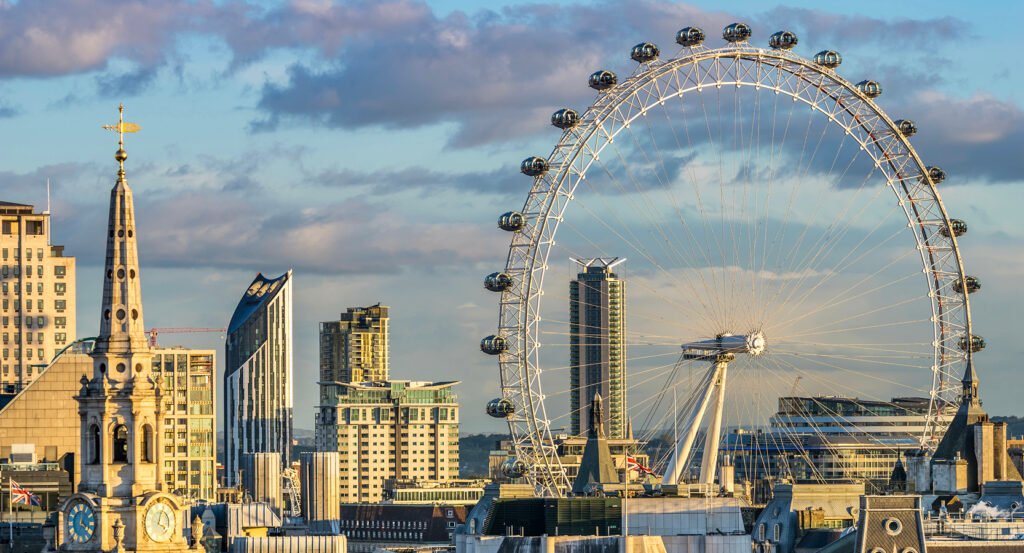
Why DoubleTree Tower of London matters.
DoubleTree Tower of London is a contemporary hotel where Tower Hill's layered City character meets an ambitious purpose-built property conceived by an independent British hotel company before a major acquisition brought it into Hilton's international network.
Set along Pepys Street near Seething Lane and just steps from St. Olave Hart Street, the hotel occupies an island site between Fenchurch Street station and the eastern edge of the historic City, with Tower Hill descending toward the Thames immediately beyond. Natural stone façades follow the irregular street edges, giving the substantial building a perimeter shaped by the older urban grain surrounding it. An external colonnade leads into a double-height central lobby beneath a vaulted glass roof, concentrating the interior around daylight and a planted courtyard wall. Upper terraces open the enclosed plan toward broad views across the City, Tower Hill and the river corridor. The result is a large urban hotel whose strongest physical qualities come from the attempt to reconcile substantial contemporary scale with one of London's most historically constrained street patterns.
What defines DoubleTree Tower of London.
DoubleTree Tower of London is best known for beginning as one of the culminating projects in the rise of City Inn, the independent hotel company created by David Orr, Sandy Orr and Donald MacDonald in 1995. David Orr entered hospitality development after studying political science at Birmingham and completing postgraduate work at Reading on the prospects for budget hotels, eventually applying that property background to a new urban hotel business. City Inn debuted in Bristol in 1999 and subsequently expanded through Glasgow, Birmingham, Westminster, Manchester and Leeds, developing a portfolio concentrated in purpose-built metropolitan properties. The company's Westminster opening became an important precursor to Pepys Street, winning the 2004 Catey for Hotel of the Year in the group category and establishing the Orrs' London credentials. Tower of London represented a much larger late-stage commitment as the company prepared simultaneous expansion in Britain and continental Europe. Construction began in 2006 with investment reaching £65 million, placing considerable capital behind a location positioned between the traditional City and its eastern approaches. The company simultaneously confronted a branding problem: City Inn no longer conveyed the market position David Orr believed the business had achieved. City Inn became Mint Hotel in November 2010, immediately before the Pepys Street property debuted under the new name on December 20. Amsterdam followed as the company's first overseas opening, making the Tower of London project part of the brief period when the Orr family business was attempting to turn a British independent chain into an international urban brand. Pepys Street also generated 300 jobs, giving the development economic significance beyond the expansion of Mint itself. That independent chapter proved remarkably short. Blackstone agreed to acquire the eight-hotel Mint portfolio for more than £600 million in September 2011, bringing sixteen years of Orr-led development to an end less than a year after the Tower property entered operation.
Where your story begins.
Foresyte Travel reveals places that feel extraordinary long before you arrive.
Enjoy editorial crafted for luxury travelers.














































































































