
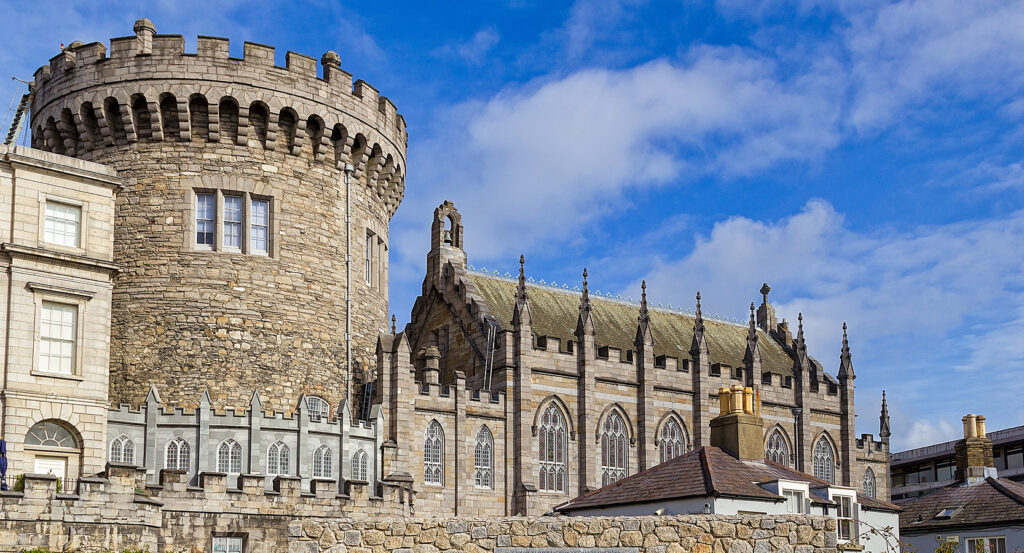
Why you should experience Great Courtyard at Dublin Castle in Dublin, Ireland.
Great Courtyard at Dublin Castle is where Ireland's history stands fully exposed to the open air, a vast, elegant expanse where medieval might meets Georgian grace.
Step through the stone gates, and you feel the centuries compress around you: cobblestones whispering of horses and soldiers, façades lined with perfect symmetry masking centuries of conflict and ceremony. Once the fortified heart of Norman power in Ireland, the courtyard evolved into a symbol of British administration and, later, Irish independence. Its architecture tells that story in layers, from the Record Tower's thick 13th-century walls to the stately red-brick and limestone wings added in the 18th century. The space feels both grand and intimate: a cloistered square in the center of the city, open to the sky yet steeped in weighty silence. Standing here, you can feel the paradox of Dublin itself, a city that has been ruled, rebuilt, and reborn countless times, but never broken. As the echo of your footsteps crosses the cobbles, it's impossible not to imagine the countless figures who walked here before, knights, governors, presidents, each leaving their invisible mark on the stone.
What you should know about Great Courtyard at Dublin Castle.
Few visitors realize that Great Courtyard at Dublin Castle was never designed as a single unified space but evolved organically over seven centuries of rule, rebellion, and renewal.
When the Normans first built the castle in the early 1200s, the courtyard was enclosed by defensive walls and towers, a fortified bailey meant to guard the River Poddle, which once flowed beneath its moat. The Record Tower, completed around 1228, anchored the southeast corner, while the opposite side was lined with timber halls used for administration and storage. As English control solidified, the castle transformed from fortress to symbol of royal authority. In the 1700s, after a devastating fire, the medieval structures were replaced with Georgian façades, their elegant red brick and limestone arcades reflecting a new era of order and ceremony. The central archways, now leading to the Upper Courtyard and State Apartments, once funneled carriages to viceregal processions. At the courtyard's heart stood the gallows, used for public executions during the Tudor period, a grim reminder of its darker function. Later, the space became the ceremonial stage for military parades, royal arrivals, and, ultimately, the transfer of sovereignty when Michael Collins accepted the handover of power from British authorities in 1922. Beneath the cobblestones, archaeologists have uncovered remnants of the medieval moat, Viking artifacts, and even fragments of Dublin's earliest city walls, all revealing that the courtyard is not just a place of gathering but a living archive.
How to fold Great Courtyard at Dublin Castle into your trip.
To experience Great Courtyard at Dublin Castle is to walk through Ireland's shifting center of gravity, from colonization to nationhood.
Begin your visit by entering through the Palace Street Gate, where the first glimpse of the courtyard feels like stepping into another era. Pause in the middle and slowly take it in: the Record Tower to your right, the State Apartments rising opposite, and the Chapel Royal's Gothic spires adding a whisper of grace to the skyline. Each side of the square represents a distinct chapter, Norman defense, Georgian ceremony, Victorian piety, unified now under the Irish flag. Join a guided castle tour; the guides often share stories that transform the stones into characters, revealing where prisoners once marched, where queens were received, and where presidents now host state events. If you visit in the morning, the cobbles glow gold under Dublin's soft light; in the evening, the courtyard hums with quiet, reflecting the city's endurance. For photographers, this is one of Dublin's most cinematic scenes, symmetry, history, and light converging in a single frame. Before leaving, step through to the Dubh Linn Garden beyond the lower archway, a circular green oasis that echoes the courtyard's geometry in living form. Great Courtyard at Dublin Castle is more than the castle's heart; it's the stage on which Ireland found its voice.
Where your story begins.
Foresyte Travel reveals places that feel extraordinary long before you arrive.
Experience premium editorial crafted for luxury travelers.














































































































