
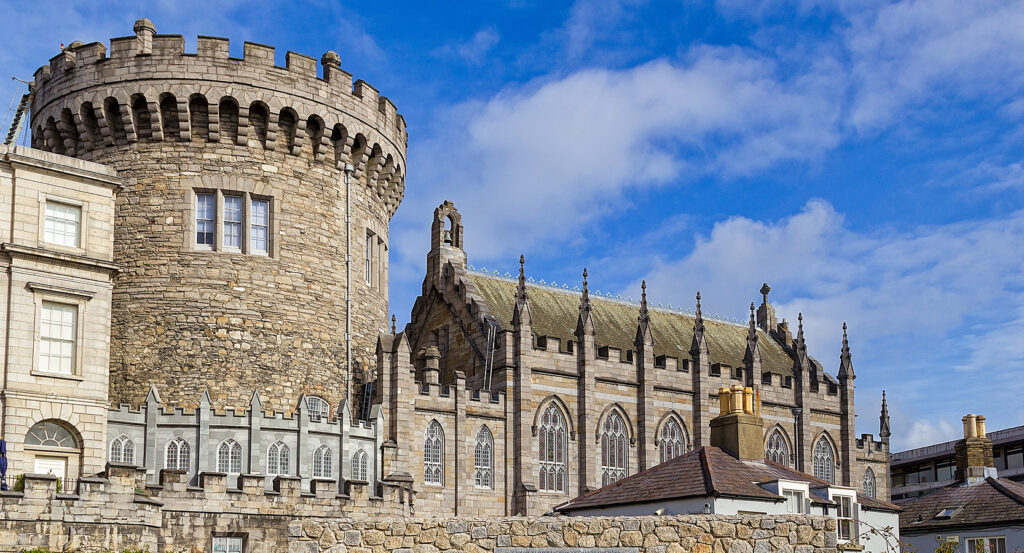
Why you should experience The State Apartments at Dublin Castle in Dublin, Ireland.
The State Apartments at Dublin Castle are the city's most dazzling tribute to ceremony, craftsmanship, and power, an architectural theater where centuries of Irish history have played out in gilded detail.
Step inside, and the air itself changes. The hum of the city disappears behind velvet curtains as your footsteps fall on polished parquet floors that have felt the weight of monarchs, viceroys, presidents, and poets. Sunlight glints off crystal chandeliers and gilded cornices, washing over walls lined with portraits of nobility and revolutionaries alike. Built in the 18th century after a fire destroyed much of the medieval castle, the apartments were designed to impress, and they still do. The Grand Staircase, with its sweeping banister and frescoed ceiling, sets the tone for what follows: a procession of opulent chambers that embody Ireland's complex dance between subjugation and self-expression. Each room feels alive with echoes of its former grandeur, a place where the British crown once reigned, and where the Irish state now celebrates independence. The result is breathtaking not only for its beauty but for the layered story it tells, among transformation, reconciliation, and the quiet dignity of reclaiming one's past.
What you should know about The State Apartments at Dublin Castle.
The State Apartments are more than ornamental halls, they are a living archive of political and artistic evolution.
Constructed between 1750 and 1770, the apartments replaced the medieval residential quarters destroyed by fire, marking Dublin's transition into the Georgian age. The design, by architects such as Arthur Jones Neville and later Francis Johnston, drew inspiration from London's royal palaces, blending Palladian symmetry with Irish craftsmanship. Each room had a purpose within the ceremonial life of the British administration in Ireland. The Throne Room, crowned by a massive canopy of state embroidered with the royal arms, was once the stage for formal receptions and investitures. The Drawing Room, later known as the President's Room, became a salon for high society, where music, diplomacy, and intrigue intertwined. The St. Patrick's Hall, the grandest of them all, remains one of the most grand ceremonial chambers in Europe, a barrel-vaulted masterpiece adorned with allegorical murals celebrating virtues, victories, and empire. Ironically, this same hall would later host the inauguration of Ireland's presidents, symbolizing the republic's reclamation of its own narrative. Hidden in the details are the fingerprints of Irish artisans, stucco work by Michael Stapleton, mahogany joinery from local craftsmen, and handwoven silk damasks that once graced Viceregal receptions. Through careful restoration, these rooms have been preserved not as relics of subjugation but as spaces of continuity, where old authority gave way to new sovereignty.
How to fold The State Apartments at Dublin Castle into your trip.
Visiting The State Apartments is an essential step in understanding Dublin's layered identity, and the paradox of beauty born from empire.
Begin in the Upper Courtyard, where the elegant Georgian façades contrast with the medieval Record Tower nearby. Enter through the main staircase, pausing beneath the frescoed ceiling to admire how art, architecture, and propaganda once worked hand in hand. Move through the apartments slowly, room by room: the Drawing Room with its glittering mirrors, the Throne Room with its crimson canopy and gilt chair, and finally St. Patrick's Hall, where sunlight spills through arched windows onto the checkerboard floor. If possible, time your visit to coincide with one of the guided tours, the docents here are historians and storytellers who bring each chamber to life with anecdotes of royal pageantry and political turning points. Don't rush; listen to how the wood creaks underfoot, how the chandeliers refract light into prisms across the walls, how the silence feels reverent but not mournful. Before leaving, step onto the terrace overlooking the Dubh Linn Garden, the castle's quiet green refuge, and take a moment to reflect: you've just walked through the rooms where Ireland's colonial past transformed into its independent present. The State Apartments of Dublin Castle are not just a monument to power, they're a mirror held up to Ireland itself, reflecting a journey from rule to self-realization, from grandeur to grace.
Where your story begins.
Foresyte Travel reveals places that feel extraordinary long before you arrive.
Experience premium editorial crafted for luxury travelers.














































































































