Why you should experience Cellblock 15 at Eastern State Penitentiary in Philadelphia, Pennsylvania.
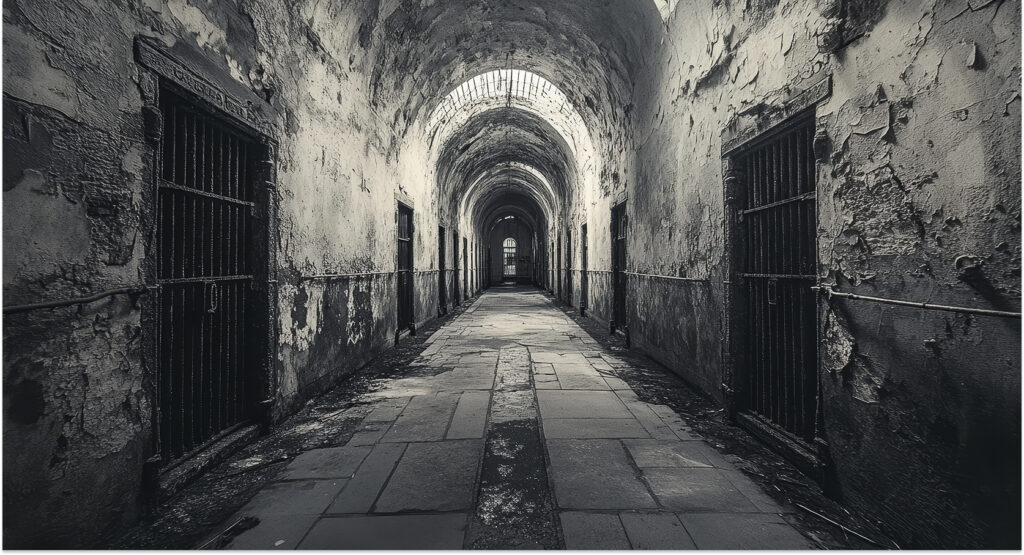
The Death Row Corridor at the Eastern State Penitentiary in Philadelphia is among the most chilling and contemplative spaces in American penal history, a narrow, dimly lit passage that distills the weight of final judgment into stone and silence.
Here, the penitentiary's ideals of reflection and solitude take on their most somber form. The air feels heavy, the light restrained, and every echo of your footsteps seems amplified by the knowledge of what this corridor once represented. Though executions never took place within Eastern State's walls, this wing housed inmates condemned to die elsewhere, men awaiting transfer, facing both isolation and inevitability. The architecture itself amplifies the tension: low ceilings, iron doors, and narrow sightlines create an oppressive intimacy that is as psychological as it is physical. To walk the Death Row Corridor is to step inside the deepest shadow of the prison's reformist vision, a place where hope and finality coexist in uneasy silence.
What you should know about Cellblock 15 at Eastern State Penitentiary.
The Death Row Corridor was a late addition to the penitentiary, built during the 1950s when the once-revolutionary institution had already begun to crumble under its own contradictions.
Originally intended for short-term confinement of high-risk prisoners, it soon became known as “death row” because of the nature of its occupants, inmates awaiting capital punishment elsewhere in the state system. Its design was a stark evolution from the penitentiary's earlier radial plan: tighter cells, reinforced bars, and more advanced surveillance. Unlike the early cellblocks with their skylights symbolizing divine oversight, the Death Row Corridor was nearly devoid of natural light, a shift from the penitentiary's original belief in spiritual illumination to pure containment. Historians note that its oppressive atmosphere reflected a broader societal change: from the Quaker ideal of redemption to the bureaucratic management of punishment. When Eastern State closed in 1971, this corridor was sealed and left untouched for decades. Today, the peeling paint and rusting hinges are not staged effects but authentic decay, a raw tribute to the passage of time and the burden of memory that walls like these can hold.
How to fold Cellblock 15 at Eastern State Penitentiary into your trip.
When visiting the Eastern State Penitentiary, the Death Row Corridor is not a casual stop, it's an experience to approach with reflection and respect.
Located deep within the complex, this section is typically part of the guided tour route rather than the self-paced audio experience, allowing staff to frame its context thoughtfully. Visit late in the day when light filters weakly through the cracks, the subdued atmosphere mirrors the corridor's history. As you walk past each cell, take note of how sound changes: your breath, your footsteps, even a whisper seem amplified against the stone, as if the space itself still listens. The interpretive signs and recordings here discuss the evolution of capital punishment and the moral debates surrounding it, grounding the experience in both history and ethics. Afterward, step back into the open air of the central rotunda or courtyard, the shift from confinement to sky is powerful and deeply symbolic. The Death Row Corridor is not a spectacle; it's a reckoning, a quiet, uncomfortable reminder of how thin the line can be between justice and despair.
Where your story begins.
Foresyte Travel reveals places that feel extraordinary long before you arrive.
Experience premium editorial crafted for luxury travelers.