Why Eastern State Penitentiary matters.
Eastern State Penitentiary in Philadelphia is an experience that lingers in your mind long after you've walked its haunting halls.
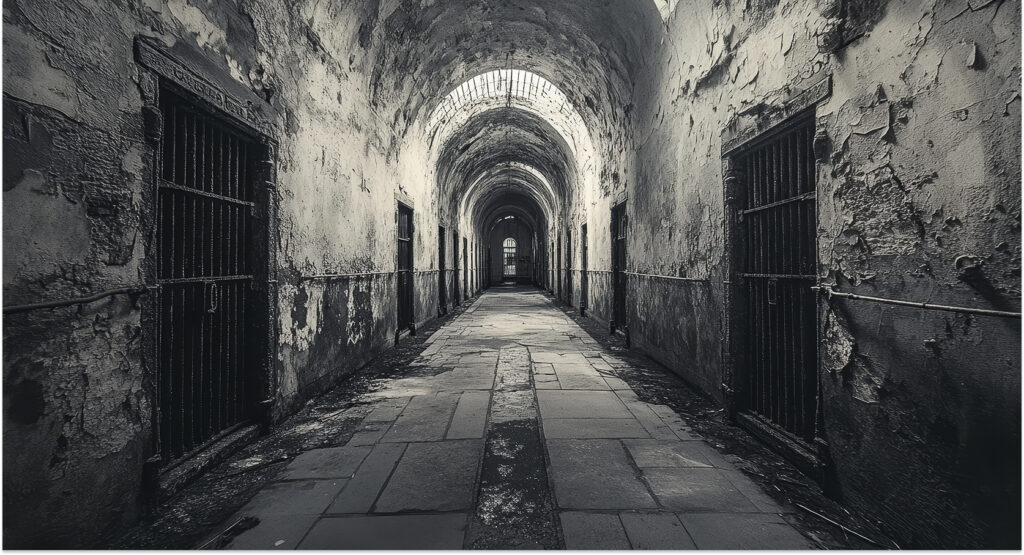
Once the most famous and expensive prison in the world, this massive Gothic fortress now stands as a striking monument to the evolution of justice and humanity. The moment you step through its castle-like entrance, time bends, light filters through fractured skylights, casting eerie patterns on stone walls that have held nearly two centuries of stories. Each crumbling cell tells its own tale: of solitude, reform, and the fragile line between punishment and redemption. The penitentiary was revolutionary when it opened in 1829, introducing the concept of “penitence”, encouraging reflection and moral rehabilitation through isolation. It's an idea that both defined and haunted modern corrections. As you wander its echoing corridors, the silence is broken only by the creak of iron doors and the distant cooing of pigeons that now roost where guards once stood watch. The architecture, both austere and strangely beautiful, evokes a sense of reverence, as if the building itself is still whispering lessons from its past. Eastern State is more than a ruin; it's a mirror to society's conscience, an open question about what it means to punish and what it means to forgive.
What defines Eastern State Penitentiary.
Eastern State's history is as layered and complex as the city it calls home, a narrative that stretches from idealistic beginnings to chilling realities.
Designed by architect John Haviland, the prison was built on the dramatic idea that solitude would lead to moral reform. Each inmate was confined to a single cell with a skylight, “the eye of God”, meant to inspire introspection. There was no talking, no labor with others, and no escape from the weight of one's own thoughts. It was a bold social experiment that drew global attention, influencing more than 300 prisons worldwide. Yet the ideal soon collided with human frailty. Prolonged isolation led to mental breakdowns, despair, and a growing awareness that the system's intentions, however noble, carried devastating costs. By the early 20th century, the penitentiary had shifted toward a more conventional model, housing notorious figures like Al Capone, whose cell remains luxuriously furnished as it was during his stay in 1929. The prison officially closed in 1971 after 142 years of operation, falling into eerie disrepair until preservation efforts in the 1990s reopened it as a museum. Today, Eastern State Penitentiary is both a historical landmark and an active forum for reflection. Its annual art installations, like the haunting “Voices of Eastern State” audio tour narrated by Steve Buscemi, weave together fact, emotion, and the moral weight of incarceration. The site also hosts “Terror Behind the Walls,” a nationally acclaimed haunted experience each fall, an ironic nod to the building's dark charisma.
How Eastern State Penitentiary fits.
Visiting Eastern State Penitentiary is like walking through living history, a blend of education, atmosphere, and quiet contemplation that makes it one of Philadelphia's most unforgettable stops.
Begin your visit in the morning, when the crowds are thinner and the light slants through the narrow cellblock windows like stained glass in a forgotten cathedral. The self-guided audio tour is essential; it leads you through the penitentiary's most evocative spaces, from the central rotunda, where guards once stood at the crossroads of power, to the narrow exercise yards that whisper with echoes of solitude. Take time to stand inside one of the original cells and look up at the skylight, it's a humbling moment, a reminder of how isolation was meant to illuminate but often destroyed. Don't miss Al Capone's cell, meticulously recreated with rugs, furniture, and a vintage radio that hint at the paradox of privilege within punishment. If you're drawn to history, spend time with the exhibits that explore the evolution of criminal justice in America, they're deeply researched and emotionally resonant, connecting the penitentiary's past to modern reform conversations. For the brave, return in the evening for the haunted attraction, where the same corridors take on a theatrical, pulse-quickening life of their own. After the visit, head to nearby Fairmount Avenue, a lively neighborhood lined with restaurants and cafés, perfect for decompressing after the weight of history. Pair the experience with a stop at the Philadelphia Museum of Art or the Rocky Steps just a short walk away. Eastern State Penitentiary isn't just a window into the past, it's a haunting reflection of humanity's struggle between justice and mercy, a place where every echo reminds you that even walls built for silence still have something profound to say.
Where your story begins.
Foresyte Travel reveals places that feel extraordinary long before you arrive.
Enjoy editorial crafted for luxury travelers.
Foresyte may earn a commission when you book.