Why you should experience Fort Worth Avenue in Dallas, Texas.
Fort Worth Avenue is a historic Oak Cliff corridor where frontier commerce, neighborhood character, and westward ambition converge along one of Dallas' oldest gateway thoroughfares.
Running through Oak Cliff between Downtown, Trinity Groves, and North Oak Cliff, this historic corridor connects beautifully preserved commercial districts, landmark theaters, neighborhood restaurants, established residential communities, public parks, and welcoming pedestrian spaces that collectively showcase Dallas' remarkable westward expansion. Historic storefronts, architecturally significant civic landmarks, mature tree lined streets, thoughtfully revitalized commercial districts, thriving local businesses, cultural venues, and energetic gathering places create an urban landscape where generations of merchants, entrepreneurs, artists, and residents have shaped one of North Texas' defining urban corridors. Fort Worth Avenue developed as the principal route linking Dallas with Fort Worth before evolving into a defining connector between historic Oak Cliff and the city's expanding western neighborhoods while preserving its commercial heritage and enduring civic identity. The result is a corridor defined by historical significance, architectural distinction, and lasting community vitality.
What you should know about Fort Worth Avenue.
Fort Worth Avenue is best known for its historic role as the primary overland route connecting Dallas and Fort Worth, carrying generations of travelers, freight, and commerce between North Texas' two largest cities long before the arrival of the modern interstate system.
During the late nineteenth and early twentieth centuries, the avenue became a vital commercial artery supporting regional trade, neighborhood development, and westward expansion across Dallas County. Businesses, streetcar lines, and residential communities flourished along the route, helping establish Oak Cliff as one of Dallas' most influential urban districts. Today, Fort Worth Avenue continues to preserve that transportation legacy while serving as one of the city's most recognizable historic corridors. That remarkable history has established Fort Worth Avenue as a corridor anchored by one of North Texas' most important historic roadways.
How to fold Fort Worth Avenue into your trip.
Fort Worth Avenue works as an exploration of Dallas' historic neighborhoods, architecture, and cultural landmarks.
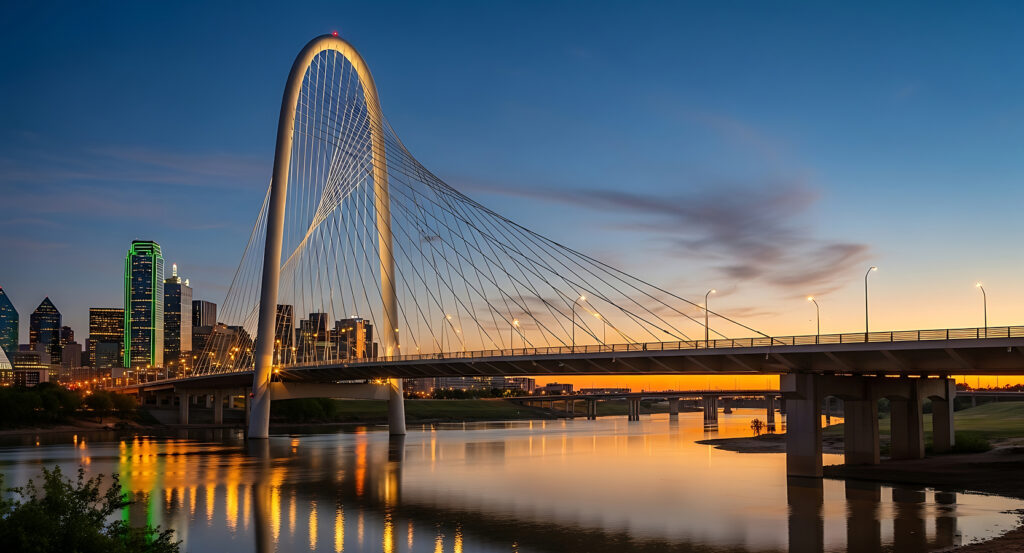
Begin at the Texas Theatre, where the beautifully restored 1931 movie palace immediately establishes the corridor's defining identity. Continue toward Trinity Groves, where acclaimed restaurants, adaptive reuse architecture, and skyline views provide broader perspective on the area's contemporary renaissance. From there, make your way to the Margaret Hunt Hill Bridge, where Santiago Calatrava's celebrated cable stayed design provides a memorable conclusion while highlighting the corridor's enduring role as a western gateway into Downtown. Along the route, you'll encounter architecturally significant historic buildings, welcoming public spaces, thriving neighborhood businesses, beautifully restored commercial districts, celebrated cultural landmarks, and energetic community gathering places that reveal Oak Cliff's exceptional depth. The progression moves naturally from a landmark historic theater to one of Dallas' premier dining districts to an internationally recognized bridge, demonstrating how Fort Worth Avenue connects transportation history, community life, and urban transformation.
Where your story begins.
Foresyte Travel reveals places that feel extraordinary long before you arrive.
Experience premium editorial crafted for luxury travelers.