Why Four Seasons Resort Bora Bora matters.
Four Seasons Resort Bora Bora is a Polynesian luxury resort where Motu Tehotu's coral-island geography meets the architectural ambitions of international hospitality and the conservation of Bora Bora's marine environment.
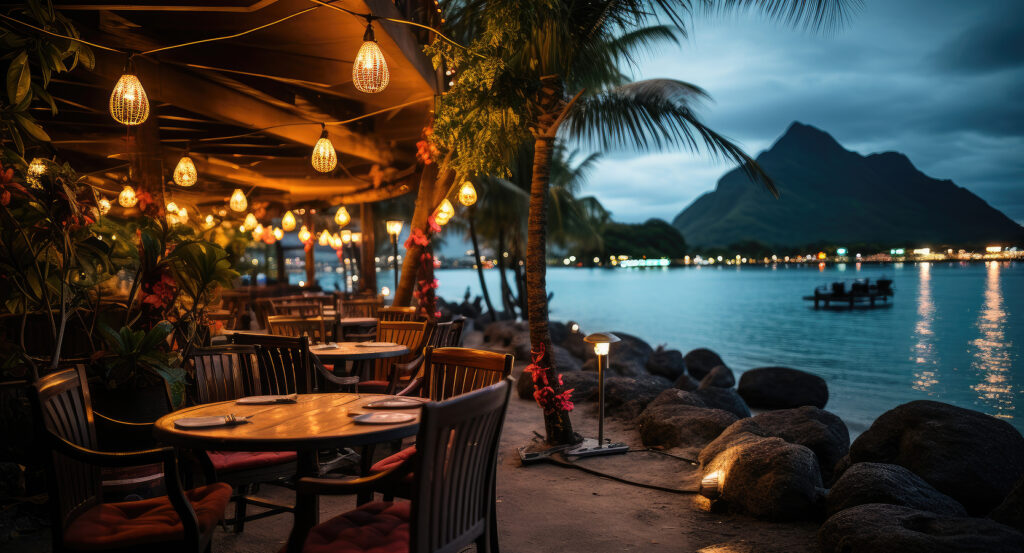
Occupying a private coral islet along Bora Bora's northeastern barrier reef, Four Seasons Resort Bora Bora faces the island's volcanic interior across a sheltered lagoon, with Mount Otemanu and Mount Pahia rising above the western shoreline and the open Pacific extending beyond the outer reef. The resort's thatched-roof pavilions, timber structures, and overwater walkways establish a low horizontal composition that follows the contours of the motu, preserving an uninterrupted relationship between the buildings and surrounding water. Arrival by boat leads into a landscaped waterfront reception area, where the transition from open lagoon to shaded gardens establishes the property's principal architectural encounter. Beyond the reception buildings, branching wooden walkways extend across shallow water toward individual bungalows, creating a second perspective through the changing colors of the lagoon and the mountainous island beyond. The result is a resort whose architecture transforms the relationship between coral reef, volcanic landscape, and Polynesian building traditions into the defining character of its physical setting.
What defines Four Seasons Resort Bora Bora.
Four Seasons Resort Bora Bora is best known for introducing Four Seasons hospitality to French Polynesia through a purpose-built island development that combined international architectural expertise with the established traditions of Polynesian overwater accommodation. Developer Thierry Barbion initiated the project on Motu Tehotu, selecting a site along the coral barrier surrounding Bora Bora's principal volcanic island. The development emerged during a period of substantial investment in the territory's luxury resort sector, when international hotel companies were establishing increasingly elaborate properties across the Society Islands. Architects Didier Lefort and Pierre-Jean Picart developed the original design, organizing the complex around separate accommodation structures, landscaped gardens, and communal buildings distributed across the islet. San Francisco-based design practice BAMO received the interior commission, establishing a collaboration that subsequently extended through major renovations. Landscape architect Burton contributed the garden design, incorporating tropical planting into the resort's architectural composition. The property opened in September 2008, becoming the first Four Seasons resort in French Polynesia and extending the Canadian hospitality company's Pacific portfolio into the Society Islands. Its opening established a new international luxury property during a period when Bora Bora's accommodation market was becoming increasingly concentrated around high-end overwater resorts. The development received significant international recognition in 2012 when Condé Nast Traveler named it the leading resort in French Polynesia. A substantial renovation program followed during the late 2010s, renewing the original interiors and expanding the property's private outdoor facilities. Diego Stembert, who had previously served as resort manager, became general manager in July 2019 after directing important elements of the improvement program. The completed enhancements incorporated additional plunge pools into existing overwater structures and expanded the beachfront residential component of the property. BAMO retained responsibility for the redesigned bungalow interiors, preserving the original architectural concept through updated furnishings, lighting, and integrated technology. Solar panels installed on the bungalow roofs provided renewable energy for water heating, connecting the refurbishment with improvements in the property's environmental infrastructure. The resort's continuing development established a relationship between its original architectural commission and successive investments in contemporary hospitality design. Its history connects the international expansion of Four Seasons, the commercial development of Bora Bora's private motus, and the evolution of Polynesian resort architecture through a sustained collaboration between developers, architects, and interior designers.
Pamela Babey and the BAMO design team developed the property's interior character through references to traditional Polynesian craftsmanship, particularly the symbolic patterns of Tahitian tattooing and the construction techniques associated with Oceanic maritime culture. The original interiors incorporated custom fabrics derived from tattoo designs, connecting decorative surfaces with ancestral symbols used throughout the Society Islands. Sculptural plaster panels incorporated mother-of-pearl medallions, extending these geometric patterns into architectural decoration. The designers selected teak, coral stone, woven fibers, and natural finishes to establish a consistent relationship between the enclosed interiors and the surrounding island environment. Traditional fishing equipment and decorative objects provided another source of inspiration, with reproductions of fishhooks, carved tools, woven ropes, and personal ornaments assembled into carefully composed display cases. Art historian Bruce Carpenter supervised the production of these objects through artisan workshops in Bali, bringing specialist knowledge of Oceanic and Southeast Asian decorative traditions to the commission. The later refurbishment retained the original collections, preserving the cultural references that had distinguished the initial interiors. BAMO principal Anne Wilkinson directed important elements of the redesign, developing a more restrained decorative palette through natural fibers, timber finishes, and contrasting tattoo-inspired fabrics. The team collaborated with Avalon Carpenter through the Kalpa Taru furniture workshop, commissioning carved wooden screens and decorative objects that extended the original artistic program. A sculptural shell derived from work by artist Carola Vooges became part of the revised decorative collection. Prototype interiors underwent evaluation during a November 2018 site visit, allowing the designers to refine lighting, furniture proportions, and the arrangement of decorative elements before wider implementation. The refurbishment introduced contemporary electrical infrastructure and improved task lighting alongside the handcrafted furnishings, preserving the original decorative concept through a substantial technical modernization. Te Mahana Spa developed a complementary architectural character through a soaring interior ceiling, teak-lined reception spaces, and treatment facilities overlooking a secluded lagoon. Its design incorporated the same emphasis on natural finishes and Polynesian decorative references, extending the interior commission across the property's principal hospitality environments. The result is a sustained design program in which traditional craftsmanship, international artisan collaborations, and contemporary architectural refinement contribute to the resort's distinctive visual character.
How Four Seasons Resort Bora Bora fits.
Four Seasons Resort Bora Bora works as a base for exploring the ceremonial institutions of ancient Polynesia, the military infrastructure of the Second World War, and the maritime history connecting Bora Bora with international ocean exploration.
Begin at Marae Fare-Opu, a surviving Polynesian ceremonial site along the shoreline of Faanui Bay. The complex preserves substantial stone platforms associated with the religious and political institutions that organized Society Islands communities before European colonization. Its surviving upright stones include carved turtle petroglyphs, a significant element of Polynesian religious symbolism associated with sacred authority and the relationship between human communities and ancestral spirits. The site occupies a position beside the lagoon, preserving the connection between ceremonial architecture and the maritime environment that supported traditional island settlements. Marae throughout the Society Islands served as gathering places for religious observances, chiefly investitures, and ceremonies associated with the transmission of political authority. Fare-Opu provides a surviving example of the architectural traditions that preceded the establishment of European religious institutions across Bora Bora. Continue to the Ha'amaire World War II Cannons, a surviving coastal defense installation constructed during the American military occupation of Bora Bora. Following the Japanese attack on Pearl Harbor in December 1941, the United States selected the island as a strategic refueling base for military vessels operating across the South Pacific. Operation Bobcat began in February 1942, bringing 3,500 American servicemen to an island whose resident population numbered 1,200. Military engineers constructed roads, harbor facilities, fuel storage infrastructure, and an airfield as part of the substantial logistical undertaking. Eight seven-inch naval guns were positioned around the island to defend its maritime approaches, with the surviving Ha'amaire battery overlooking the eastern lagoon. The island experienced no enemy attack, and the American military withdrew in 1946 after supporting the movement and refueling of more than a thousand vessels. Conclude at the Alain Gerbault Memorial in Vaitape, commemorating the French navigator whose solo ocean voyages established an important connection between European maritime exploration and the islands of the South Pacific. Gerbault became internationally known after crossing the Atlantic alone in 1923 aboard the sailing yacht Firecrest. He subsequently completed a solo circumnavigation, returning to France in 1929 after several years of navigation across the world's oceans. His later travels concentrated on Polynesia, where he developed a strong interest in indigenous communities and criticized the cultural consequences of European colonial expansion. Gerbault died in Dili, East Timor, in December 1941, during the Pacific War. His remains were transferred to Bora Bora in 1947, establishing a permanent memorial to a navigator whose writings and travels contributed to international understanding of Polynesian societies. The progression moves from Fare-Opu's ancestral ceremonial traditions through the American military occupation of Bora Bora and culminates in Alain Gerbault's maritime legacy, connecting three distinct periods in the island's cultural and international history.
Where your story begins.
Foresyte Travel reveals places that feel extraordinary long before you arrive.
Enjoy editorial crafted for luxury travelers.
Foresyte may earn a commission when you book.