
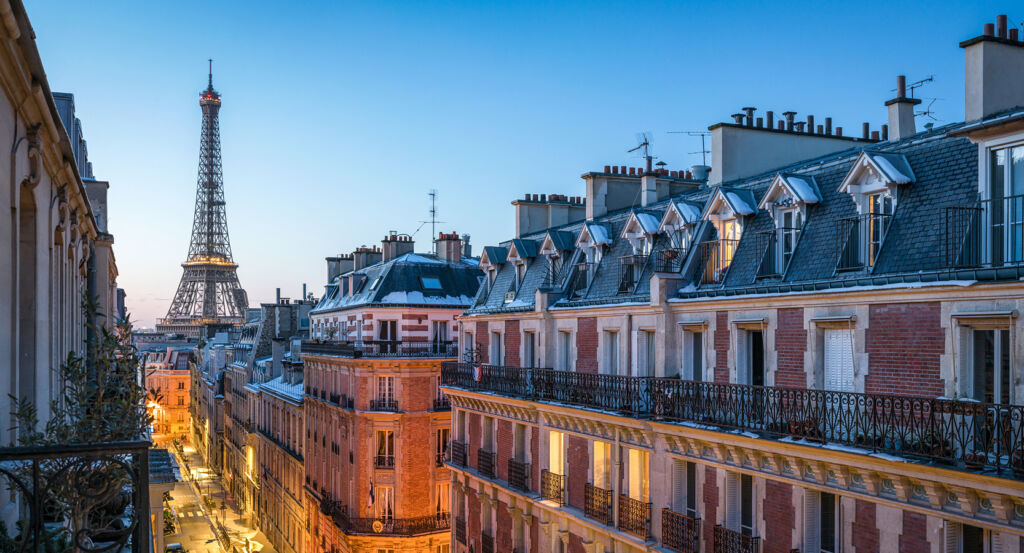
Why you should experience Hôtel du Beaumont in Paris, France.
Hôtel du Beaumont is a clandestine four-star hotel where Montmartre's cabaret mythology, Belle Époque exuberance, theatrical sensuality and irrepressible creative spirit converge inside a nineteenth-century house rumored to conceal secret passages into the Moulin Rouge.
Set along Rue Lepic near Boulevard de Clichy and just steps from Moulin Rouge, the 19-room hotel occupies a building dating to 1890 whose original stone walls remain embedded within interiors conceived around Belle Époque references, saturated colors and individually differentiated rooms. A 2012 renovation reshaped the five-floor property while retaining the masonry that gives several accommodations and the breakfast room their pronounced architectural character, with the 28-square-meter Junior Suite occupying the uppermost floor. The most fascinating element remains inside those original walls, where passages discovered during renovation are said to have connected the building directly with the stage of the neighboring cabaret, collapsing the boundary between hotel architecture and Montmartre performance culture. The result is a hotel where nineteenth-century stonework, a 2012 reinvention and the possibility of concealed theatrical circulation give a diminutive Rue Lepic house a character inseparable from the nocturnal imagination surrounding it.
What you should know about Hôtel du Beaumont.
Hôtel du Beaumont is best known for occupying a five-floor building constructed in 1890 and comprehensively renovated in 2012, with 19 individually decorated rooms organized around a Belle Époque style and original stone walls that conceal passages once connecting the property with the Moulin Rouge stage. The renovation retained exposed masonry across the house while establishing an unusually compact accommodation hierarchy comprising 12-square-meter Classic Rooms, 16-square-meter Comfort Rooms and a 28-square-meter Junior Suite on the fifth floor. Nineteenth-century construction remains particularly visible in the vaulted stone breakfast room and guestrooms where exposed walls, fireplaces and mansarded upper-floor volumes place surviving architectural fabric directly inside the contemporary accommodation program. Frette Italian linens, memory-foam bedding and rainfall showers add a separate layer of Italian textile craftsmanship and contemporary specification to rooms whose architecture continues to reveal the building preceding the hotel. The 1890 structure, 2012 reconstruction, 19-room scale, surviving masonry, reported cabaret passages and deliberately differentiated Belle Époque interiors collectively establish Hôtel du Beaumont as a property whose strongest character derives from the physical peculiarities of the house itself.
The 2012 project becomes more consequential through the tension between the building's nineteenth-century envelope and the unusually small hospitality program inserted within it, with only 19 accommodations distributed across five floors rather than standardized into a large inventory. Hôtel du Beaumont carries that individualism into room design, where no single decorative scheme governs the complete collection and courtyard-facing and street-facing accommodations combine Belle Époque references with surviving stone, bold chromatic treatments and objects selected separately across the house. Frette supplies the Italian bed linens used throughout the property, while the fifth-floor Junior Suite expands the standard room program to 28 square meters and accommodates four people within the building's upper level. Hôtel du Beaumont's 1890 fabric, 2012 intervention, Frette textiles and intentionally nonuniform 19-room composition consequently reinforce the same concept: the house operates through architectural particularity and small-scale differentiation.
How to fold Hôtel du Beaumont into your trip.
Hôtel du Beaumont works as the anchor for an afternoon tracing Romantic salons, cinematic rebellion and Impressionist creation through the artistic institutions climbing from Pigalle into Montmartre.
Begin at Musée de la Vie Romantique, where Ary Scheffer settled in 1830, added two north-facing studios, hosted Chopin, Liszt, Dickens and George Sand, and turned his Friday gatherings into a nucleus of nineteenth-century artistic Paris. Continue to Studio 28, where Jean-Placide Mauclaire opened the Right Bank's first avant-garde cinema in 1928 before a 1930 screening of Luis Buñuel's L'Âge d'or provoked a notorious confrontation and subsequent ban. Conclude at Musée de Montmartre, created in 1960 within seventeenth-century Maison du Bel Air, where Renoir worked between 1875 and 1877 and painted Bal du moulin de la Galette, La Balançoire and Jardin de la rue Cortot. The progression moves from Scheffer's Romantic salon through Mauclaire's cinematic insurgency into Renoir's Impressionist Montmartre, revealing how successive generations turned the hill surrounding Hôtel du Beaumont into a laboratory for artistic experimentation.
Where your story begins.
Foresyte Travel reveals places that feel extraordinary long before you arrive.
Experience premium editorial crafted for luxury travelers.














































































































