
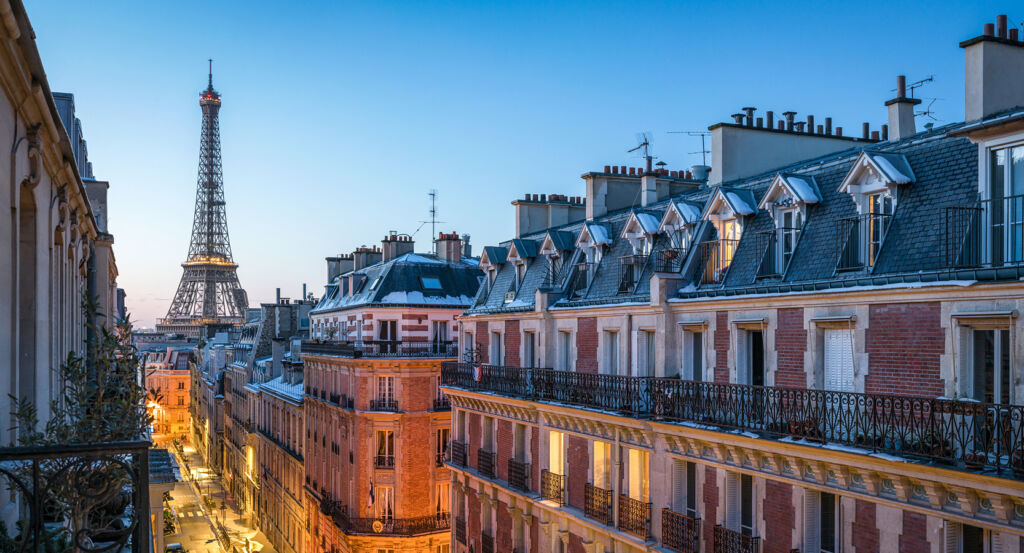
Why you should experience Hôtel Eden Paris Porte de Versailles in Paris, France.
Hôtel Eden Paris Porte de Versailles is a serene four-star hotel where Saint-Lambert's garden culture, residential intimacy, natural materials and contemporary design converge within Vincent Bastie and Emilie Corre's botanical interpretation of Parisian hospitality.
Set along Rue Blomet near Rue de la Convention and just steps from Square Saint-Lambert, the 37-room hotel organizes its character around nature, with architect Vincent Bastie and decorator Emilie Corre developing five distinct room atmospheres named Palm, Flower, Feather, Bark and Sun. Natural materials, lively lighting and botanical references carry the concept through the accommodations, while a flower garden maintained throughout the year extends the same style beyond the guestrooms. The property's May 2013 opening announcement explicitly described vegetal, mineral and forest environments as the basis of its new design universe, establishing the nature concept as an original organizing principle of the hotel. The result is a hotel where Bastie and Corre translate plant forms, natural textures and shifting light into a coherent 37-room retreat grounded in the quieter residential character of Saint-Lambert.
What you should know about Hôtel Eden Paris Porte de Versailles.
Hôtel Eden Paris Porte de Versailles is best known for unveiling its renewed design character in May 2013 around architect Vincent Bastie and decorator Emilie Corre's nature-driven conception, with the four-star property currently comprising 37 rooms organized into five atmospheres named Palm, Flower, Feather, Bark and Sun. Bastie and Corre conceived those environments through natural materials and differentiated visual narratives, allowing botanical, mineral and forest references to determine the rooms' colors, textures and lighting rather than treating nature as surface ornament. Contemporary hotel documentation from 2013 actually identified six room designs, adding Apple to Sun, Bark, Flower, Palm and Feather, demonstrating that the design program has been refined from six original expressions into the five maintained by the property today. The garden supplies another intrinsic component of the original concept, with the hotel describing its room designs as an homage to that planted space and continuing to maintain a flower garden throughout the year. Hôtel Eden Paris Porte de Versailles consequently has a traceable design biography connecting its 2013 renewal, Bastie's architecture, Corre's decoration, an evolving room taxonomy and the physical garden that inspired the property's natural vocabulary.
Vincent Bastie and Emilie Corre extended that style through specific material and decorative decisions, with documentation identifying recycled coconut mosaic within the entrance and a broader composition drawing upon natural surfaces and a pronounced 1950s influence. Hermès wallpaper and Porcelanosa Céram stoneware introduce identifiable design houses into the interiors, reinforcing the project's botanical premise through crafted surfaces. The present room structure ranges from 13-to-15-square-meter Classic Rooms and 15-to-17-square-meter Superior Rooms to 23-square-meter Triple Rooms, while connecting and family configurations expand the same five-theme design system across larger accommodation formats. Bastie, Corre, recycled coconut mosaic, Hermès wallcovering and Porcelanosa stoneware build a material narrative intrinsically tied to Hôtel Eden Paris Porte de Versailles, carrying its nature concept from the original 2013 design concept into the physical surfaces of the house.
How to fold Hôtel Eden Paris Porte de Versailles into your trip.
Hôtel Eden Paris Porte de Versailles works as the anchor for an afternoon tracing industrial land reclamation, scientific memory and sculptural preservation through the cultural history of the southern Left Bank.
Begin at Square Saint-Lambert, created in 1933 across the former Vaugirard gasworks, which had occupied nearly six hectares from 1835 into the twentieth century, replacing industrial infrastructure with gardens subsequently enriched by Auguste Guénot's 1939 bas-relief. Continue to Musée Pasteur, where Louis Pasteur moved into his Institut Pasteur apartment in 1888, lived for the final seven years of his life until 1895, and left domestic spaces later preserved as the museum devoted to his scientific legacy. Conclude at Musée Bourdelle, established in the studios Antoine Bourdelle occupied for more than 40 years, opened in 1949 following donations by Cléopâtre and Rhodia, expanded by Henri Gautruche in 1961 and Christian de Portzamparc in 1992. The progression moves from the conversion of Vaugirard's industrial ground through Pasteur's preserved scientific residence into Bourdelle's studios and successive museum architecture, revealing how production, research and artistic creation accumulated across this quieter stretch of the Left Bank.
Where your story begins.
Foresyte Travel reveals places that feel extraordinary long before you arrive.
Experience premium editorial crafted for luxury travelers.














































































































