
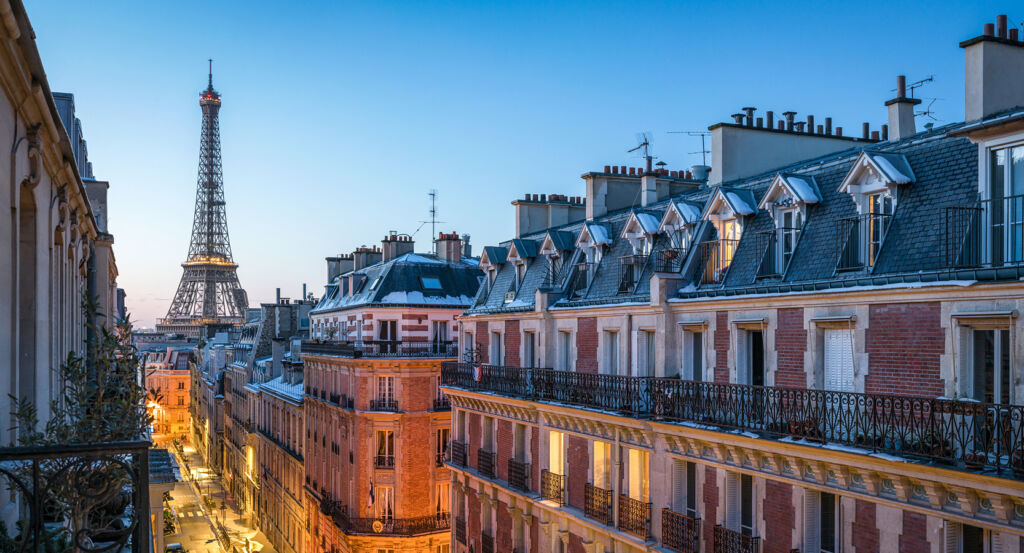
Why you should experience Hôtel Gramont Paris in Paris, France.
Hôtel Gramont Paris is an eclectic four-star hotel where Quartier Gaillon's theatrical heritage, eighteenth-century urban history, cosmopolitan character and contemporary design culture converge within a house whose character celebrates encounters between periods, materials and influences.
Set along Rue de Gramont near Boulevard des Italiens and just steps from Opéra-Comique, the 25-room hotel occupies an address whose building foundations date to 1789, the culmination of a property history that began with financier Nicolas Monnerot's construction of Hôtel de Gramont in 1658. Architect Aurélie Lambert shapes the contemporary interiors through an intentionally eclectic vocabulary, moving between animal and botanical patterns, Asian references, Californian glamour and African influences while pairing delicate finishes with rawer materials. The hotel extends that collecting instinct into cabinet-of-curiosities compositions and guestrooms differentiated through distinct visual themes, turning stylistic contrast into the central principle of the house. The result is a hotel where centuries of architectural inheritance and Lambert's cross-cultural design language give a compact Parisian property a character rooted in the accumulated histories and creative contrasts of Quartier Gaillon.
What you should know about Hôtel Gramont Paris.
Hôtel Gramont Paris is best known for occupying a property whose foundations date to 1789 and whose historical lineage traces directly to Hôtel de Gramont, the private residence constructed in 1658 by financier Nicolas Monnerot before Louis XIV seized his holdings and the house was sold on May 17, 1667 to Marshal Antoine III de Gramont. The Gramont family retained the estate for almost a century, with Antoine III and Antoine IV enlarging its marshy rear parcels into a formal French garden that by 1725 extended from Rue Saint-Augustin to the former city rampart corresponding to present-day Boulevard des Italiens. Count Antoine-Armand de Gramont sold the estate and dependencies on September 2, 1763 to Abbé Pierre Clément, with the transaction carrying a royal right granted in 1726 to cut a new street through the former Gramont property, a project realized with the opening of Rue de Gramont in 1765 before subdivision produced the foundations of the present hotel building in 1789. The contemporary house contains 25 rooms conceived by architect Aurélie Lambert, whose interiors deliberately combine different periods, motifs and geographic references through animal-patterned carpeting, botanical wallpapers and decorative influences spanning Asia, California and Africa. Hôtel Gramont Paris connects the Gramont family's seventeenth-century estate, an eighteenth-century royal street authorization, the 1765 creation of its namesake street, the property's 1789 foundations and Lambert's present architectural authorship within one unusually continuous address history.
Aurélie Lambert deepens that character by organizing all 25 guestrooms around eclecticism itself, combining contrasting motifs and materials while allowing individual accommodations to develop separate visual personalities. The hotel's public spaces carry the same premise through objects gathered from varied origins and arranged with the logic of a cabinet of curiosities, while pale woods, natural tones and brass accents introduce another documented layer of material contrast. Four decorative themes structure the property's travel-inspired interior narrative, and the staircase divides at the fifth floor to reach sixth-floor accommodations including a duplex and another room with a terrace, extending Lambert's composition through the building's upper architecture. Aurélie Lambert, the four thematic narratives, the cabinet-of-curiosities collection and the unusual upper-floor configuration consequently translate the hotel's historical accumulation into a contemporary design philosophy built around deliberate encounters between different periods and cultural references.
How to fold Hôtel Gramont Paris into your trip.
Hôtel Gramont Paris works as the anchor for an afternoon tracing accumulated knowledge, operatic reinvention and the birth of Parisian performance through the cultural institutions surrounding Quartier Gaillon.
Begin at Bibliothèque nationale de France - Richelieu, where the royal library entered Cardinal Mazarin's former palace in 1721, Henri Labrouste built his nine-cupola reading room between 1861 and 1868, and Bruno Gaudin and Virginie Brégal directed the renovation completed in 2022 after twelve years of work. Continue to Opéra-Comique, where the current Salle Favart emerged after the devastating 1887 fire through Louis Bernier's competition-winning design, inaugurated in 1898 with a puddled-iron structure, innovative electrical systems and an auditorium now containing 1,200 seats. Conclude at Passage des Panoramas, created in 1799 when Thayer built two rotundas for panoramic exhibitions and opened a covered passage to draw audiences from Palais-Royal, before Théâtre des Variétés joined the complex in 1807 and reinforced its role in boulevard entertainment culture. The progression moves from three centuries of architectural accumulation at the national library through the technological rebuilding of Salle Favart into the panorama craze that helped redefine public entertainment, revealing the dense culture of knowledge, theater and performance surrounding Hôtel Gramont Paris.
Where your story begins.
Foresyte Travel reveals places that feel extraordinary long before you arrive.
Experience premium editorial crafted for luxury travelers.














































































































