
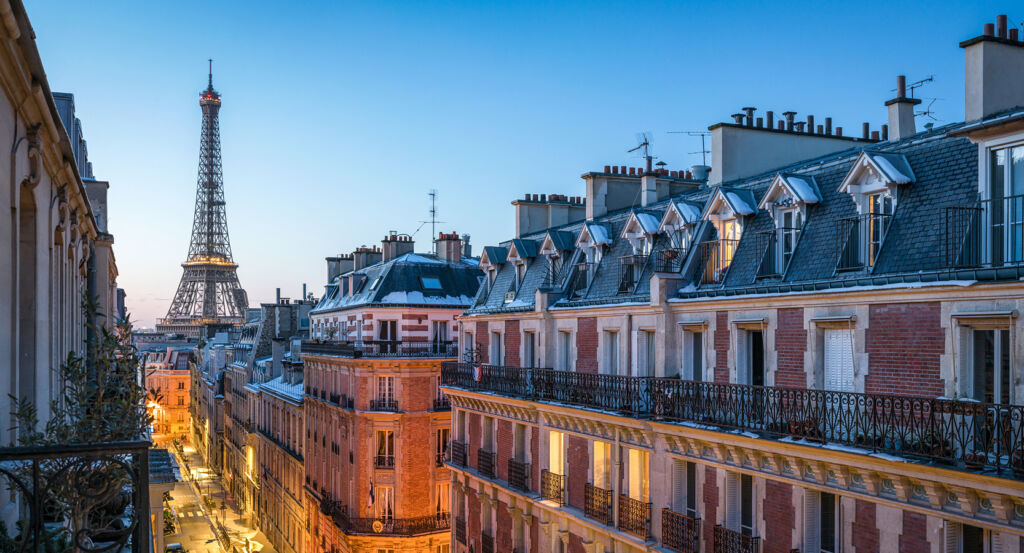
Why you should experience Hôtel Hor in Paris, France.
Hôtel Hor is a contemporary four-star hotel where Saint-Vincent-de-Paul's railway heritage, nineteenth-century urban expansion, international connectivity and architectural eclecticism converge within a purpose-built retreat at the northern gateway to Central Paris.
Set along Rue La Fayette near Rue de Saint-Quentin and just steps from Gare du Nord, the hotel opened in summer 2012 as a newly constructed property whose street-facing rooms were engineered around substantial sound isolation while a spacious lobby opens toward a planted interior garden. The 47-room program introduces a different decorative motif across individual accommodations, combining oak parquet with lively graphic references that reinterpret patterns historically associated with smaller French hotels. Architectural responsibility is identified by the property with Architectes @ Constructions, while the purpose-built structure distinguishes the project from the converted townhouses and inherited nineteenth-century buildings that dominate much of Parisian boutique hospitality. The result is a hotel where new construction, individualized graphic design and deliberate acoustic engineering create a contemporary hospitality response to the intensity of Saint-Vincent-de-Paul's railway quarter.
What you should know about Hôtel Hor.
Hôtel Hor is best known for being constructed specifically as a hotel in 2012 and opening that summer as a four-star property at 160 Rue La Fayette, with Architectes @ Constructions identified by the hotel as the architectural practice associated with the project. The accommodation program contains 47 rooms, with contemporary documentation recording individualized decorative motifs across the guestrooms rather than a completely standardized visual scheme, alongside oak parquet and unusually lively reinterpretations of traditional French hotel wallpaper. Purpose-built acoustic isolation became another defining component of the architecture, addressing the intense railway environment through guestrooms specifically constructed to suppress exterior noise. The interior organization places a spacious, naturally illuminated lobby against a planted garden, creating a spatial transition from the dense surrounding quarter into an enclosed green court. The 2012 construction date, Architectes @ Constructions attribution, 47-room program, individualized graphic treatments and acoustic engineering collectively provide Hôtel Hor with a factual character rooted in the architecture of a newly conceived hotel.
Rue La Fayette supplies an independent historical layer through a thoroughfare whose nineteenth-century development accompanied the expansion of northern Paris and the increasingly important connection between the center and emerging railway infrastructure. Saint-Vincent-de-Paul developed simultaneously into a district shaped by major civic and religious construction, including Hôpital Lariboisière, inaugurated on March 13, 1854 after the Comtesse de Lariboisière left her fortune for a hospital serving the poor. The institution received 2.6 million gold francs from her estate and became France's first hospital constructed according to hygienist principles, using separated pavilions to disperse the miasmas then believed responsible for disease and initially providing 600 beds before another 60 were added for maternity care. Comtesse de Lariboisière's philanthropy and the pioneering pavilion model consequently preserve another dimension of the nineteenth-century metropolitan development that established the urban structure into which Hôtel Hor was inserted more than 150 years later.
How to fold Hôtel Hor into your trip.
Hôtel Hor works as the anchor for an afternoon tracing nineteenth-century religious architecture, four centuries of institutional reinvention and the grand railway culture that defines Saint-Vincent-de-Paul.
Begin at Église Saint-Vincent-de-Paul, constructed between 1824 and 1844 by Jean-Baptiste Lepère and Jacques Hittorff on the hill associated with Vincent de Paul's Lazarists, with two organs subsequently created by master nineteenth-century organ builder Aristide Cavaillé-Coll. Continue to Couvent des Récollets, founded by Franciscans with support from Henri IV and Marie de Médicis in 1603 before becoming a grenadier barracks, spinning workshop, hospice and military hospital, then undergoing restoration by Reichen & Robert completed in 2003. Conclude at Gare du Nord, where James Mayer de Rothschild selected Jacques Ignace Hittorff to design the present station, constructed from 1861 and opened during 1864 with a grand façade populated by sculptures personifying Paris and European destinations served by the railway. The progression moves from Lepère and Hittorff's sacred architecture through the Récollets' extraordinary succession of institutional lives into Hittorff's railway terminus, revealing how religion, architecture and transportation successively shaped the quarter surrounding Hôtel Hor.
Where your story begins.
Foresyte Travel reveals places that feel extraordinary long before you arrive.
Experience premium editorial crafted for luxury travelers.














































































































