
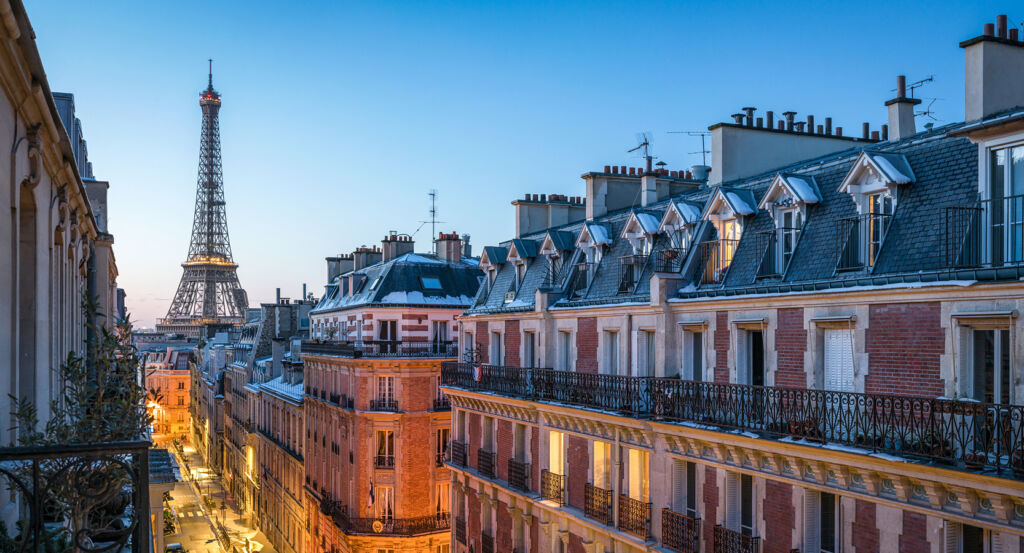
Why you should experience Hôtel La Villa des Ternes in Paris, France.
Hôtel La Villa des Ternes is a polished four-star hotel where Ternes's village origins, residential refinement, nineteenth-century expansion and western Parisian cosmopolitanism converge within a quietly contemporary address near Porte Maillot.
Set along Avenue des Ternes near Boulevard Gouvion-Saint-Cyr, the 39-room property occupies the western reaches of a thoroughfare descended from the principal route through the former hamlet of Ternes, territory that remained outside Paris until the city's 1860 annexation. The district grew around Château des Ternes, whose origins reach Pierre Habert's 1548 acquisition of the Ferme de l'Esterne and whose estate later passed to architect Samson-Nicolas Lenoir, who divided the domain and drove a road directly through the château. Nearby Villa des Ternes emerged from another portion of this semi-rural landscape after François Toussaint Verzy began developing the former château grounds in 1822, following an amusement park established there in 1816 with early montagnes russes. The result is a hotel where contemporary hospitality occupies a district whose present residential character emerged from a château estate, speculative subdivision and the absorption of an independent settlement into nineteenth-century Paris.
What you should know about Hôtel La Villa des Ternes.
Hôtel La Villa des Ternes is best known for operating as a recently renovated 39-room four-star property at 97 Avenue des Ternes within territory whose recorded history reaches the Ferme de l'Esterne, acquired in 1548 by royal secretary Pierre Habert and enlarged into a fortified residence with two turrets, a drawbridge and surrounding ditches. Louis XIII elevated the estate into a fief in 1634 under Habert's grandson Isaac, while royal secretary and finance official Pomponne de Mirey acquired the property in 1715 and rebuilt the château as a manor surrounded by parkland. Architect Samson-Nicolas Lenoir acquired Château des Ternes in 1778, subdivided and sold portions of its domain, cut through the building to create the route now known as Rue Bayen and established an ironworks within the former outbuildings before selling the diminished residence in 1802. A neighboring portion of the former estate entered another development cycle when an amusement park with early montagnes russes appeared in 1816 and François Toussaint Verzy began creating Villa des Ternes in 1822, with his heirs subsequently parceling the property under building regulations that culminated in an 1880 agreement protecting trees and restricting commercial activity. Hôtel La Villa des Ternes consequently occupies a quarter whose physical structure can be traced through nearly three centuries of estate ownership, architectural alteration, speculative development and residential planning.
The surviving Château des Ternes provides unusually tangible evidence of that chronology because the estate had already evolved substantially before the surrounding territory became part of Paris, passing from Pierre Habert's sixteenth-century fortified residence to Pomponne de Mirey's eighteenth-century manor and then Lenoir's commercially subdivided domain. François Toussaint Verzy's 1822 residential project developed a different model on the former estate, while an August 16, 1880 agreement among Villa des Ternes property owners regulated building placement, protected existing trees and prohibited commercial and professional uses. Paris absorbed this portion of Neuilly-sur-Seine in 1860, converting what had developed beyond the capital into part of the seventeenth Arrondissement while preserving fragments of the older estate structure within its streets and private residential enclaves. Pierre Habert, Pomponne de Mirey, Samson-Nicolas Lenoir and François Toussaint Verzy form a continuous chain of ownership and development through which the former Ternes estate evolved from fortified country property into the urban quarter surrounding Hôtel La Villa des Ternes.
How to fold Hôtel La Villa des Ternes into your trip.
Hôtel La Villa des Ternes works as the anchor for an afternoon tracing private artistic patronage, nineteenth-century architecture and the transformation of Paris's former defensive perimeter around Ternes.
Begin at Musée national Jean-Jacques Henner, where Marie Henner purchased painter Guillaume Dubufe's 1878 mansion in 1922, commissioned Marcel Legendre to remake it for her uncle's collection and donated the building and works to France in 1923 before the museum opened in 1924. Continue to Église Sainte-Odile, built on the former Thiers fortifications, a 39-kilometer defensive system completed in 1844 with 94 bastions and a 15-meter ditch, before the defenses were dismantled between 1920 and 1929 and the neo-Byzantine church arrived in 1945. Conclude at Porte Maillot, where the nineteenth-century fortifications eventually yielded to the Boulevard Périphérique, built between 1956 and 1973, while the former Luna Park site later accommodated Palais des Congrès and the 1974 Concorde Lafayette tower within a radically reconstructed western gateway. The progression moves from Marie Henner's preservation of a private artistic house through the vanished Thiers defenses into Porte Maillot's twentieth-century reconstruction, revealing how collecting, fortification and metropolitan expansion successively shaped the wider landscape surrounding Hôtel La Villa des Ternes.
Where your story begins.
Foresyte Travel reveals places that feel extraordinary long before you arrive.
Experience premium editorial crafted for luxury travelers.














































































































