
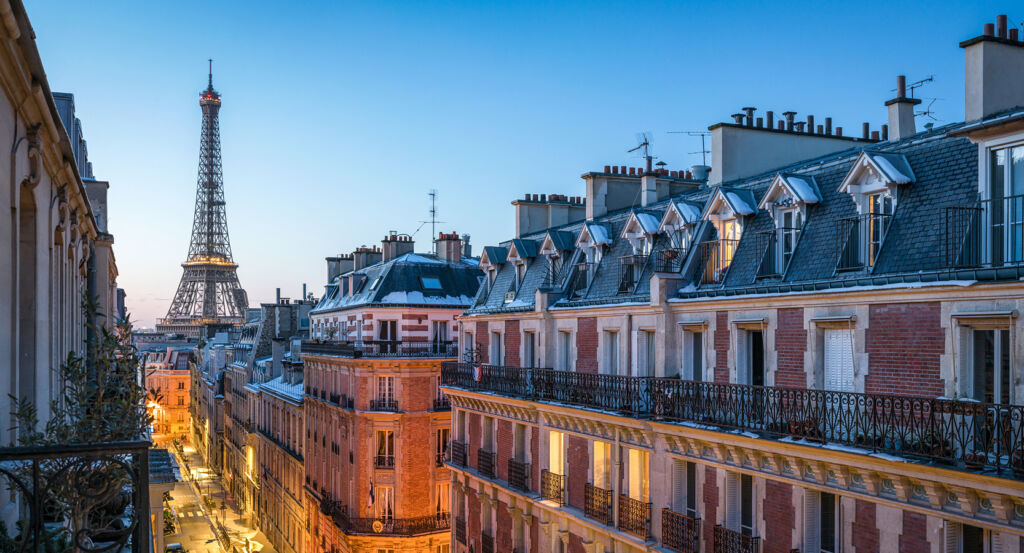
Why you should experience Hôtel le Mathurin in Paris, France.
Hôtel le Mathurin is a sophisticated four-star hotel where Madeleine's theatrical heritage, Belle Époque refinement, commercial prestige and centuries of Parisian cultural reinvention converge within an intimate address on one of the quarter's most historically layered streets.
Set along Rue des Mathurins near Rue de l'Arcade and just steps from Chapelle Expiatoire, the 54-room hotel occupies a building dating to 1820 on a street whose name descends from the Mathurin religious order, which held agricultural land here from the thirteenth century. Rue des Mathurins subsequently became deeply connected with Parisian performance culture, with a public concert salon appearing nearby by 1893 before architects Salvan and Rochet converted it into Salle des Mathurins, inaugurated under performer Marguerite Deval in 1898 and eventually developed into Théâtre des Mathurins. The theater entered another creative chapter when Sacha Guitry reopened and embellished it in 1919 before architect Charles Siclis radically redesigned the property beginning in 1922, concentrating several generations of performance history along the hotel's immediate street. The result is a hotel where the Mathurin order, Marguerite Deval, Sacha Guitry and Charles Siclis give the polished hospitality of Madeleine a direct relationship with centuries of religious, architectural and theatrical history.
What you should know about Hôtel le Mathurin.
Hôtel le Mathurin is best known for occupying 43 Rue des Mathurins, an address dating to 1820 within a street whose history stretches from medieval religious landholding through Revolutionary burial grounds and more than a century of Parisian theater. The oldest portion of Rue des Mathurins developed beside farmland belonging from the thirteenth century to the Mathurin monks, while another section between Rue de l'Arcade and Rue Pasquier opened in 1792 and the street later expanded under an imperial decree of July 16, 1862. Louis XVI and Marie-Antoinette were buried after their executions in the former Madeleine Cemetery near the intersection of Rue Pasquier and Rue des Mathurins, where 500 people guillotined during the Revolution were also interred before Louis XVIII commissioned Pierre Fontaine to create Chapelle Expiatoire on the burial ground. Fontaine began construction in 1816, the chapel was inaugurated on January 21, 1824 and completed under Charles X in 1826, while the remains of the former cemetery were sealed within four ossuaries and the building survived repeated nineteenth and early twentieth-century attempts at demolition before receiving historic protection in 1914. Hôtel le Mathurin occupies an address embedded within an unusually compressed chronology of medieval Paris, Revolutionary memory, Bourbon restoration and Second Empire urban expansion.
The theatrical history of Rue des Mathurins extends that record into the modern cultural life of Paris through a nearby hall documented by 1893, initially accommodating 300 people without a stage, platform or performers' dressing rooms before Salvan modified it in 1897 and Rochet converted it into Salle des Mathurins for its October 10, 1898 inauguration under Marguerite Deval. Théâtre des Mathurins received its enduring name in 1912 before Sacha Guitry drove its 1919 reopening, embellished the auditorium, created a bar beneath the stalls that could function as an exhibition gallery and temporarily renamed the venue Théâtre de Sacha Guitry. Charles Siclis undertook a substantial architectural and decorative redesign beginning in 1922, adding another important designer to a theater subsequently associated with performers including Maria Casarès and Michel Bouquet. Hôtel le Mathurin, Théâtre des Mathurins, Sacha Guitry and Charles Siclis connect contemporary hospitality with a street whose cultural character developed through performance, architecture and repeated reinvention across more than a century.
How to fold Hôtel le Mathurin into your trip.
Hôtel le Mathurin works as the anchor for an afternoon tracing Revolutionary memory, theatrical experimentation and Asian collecting through the cultural institutions surrounding Madeleine.
Begin at Chapelle Expiatoire, where Louis XVIII commissioned Pierre Fontaine to build a memorial over the former Madeleine Cemetery containing the burial sites of Louis XVI, Marie-Antoinette and 500 people guillotined during the Revolution, with construction beginning in 1816 and culminating in a complex containing François Joseph Bosio's Louis XVI and Jean-Pierre Cortot's Marie-Antoinette sculptural groups. Continue to Théâtre des Mathurins, where an 300-person concert salon documented in 1893 evolved through interventions by Salvan and Rochet into the 1898 Salle des Mathurins before Sacha Guitry reshaped the theater after its 1919 reopening and Charles Siclis undertook another extensive redesign beginning in 1922. Conclude at Musée Cernuschi, where Henri Cernuschi's Asian collection made his mansion a center of Japonisme between 1876 and 1896 before the museum opened publicly in 1898 and developed through Chinese and Vietnamese archaeological material, Japanese calligraphy and contemporary Chinese painting into one of Europe's significant collections of Asian art. The progression moves from Pierre Fontaine's architecture of Bourbon remembrance through the theatrical world of Guitry and Siclis into Henri Cernuschi's internationally assembled collection, revealing the political memory, performance culture and collecting traditions surrounding Hôtel le Mathurin.
Where your story begins.
Foresyte Travel reveals places that feel extraordinary long before you arrive.
Experience premium editorial crafted for luxury travelers.














































































































