
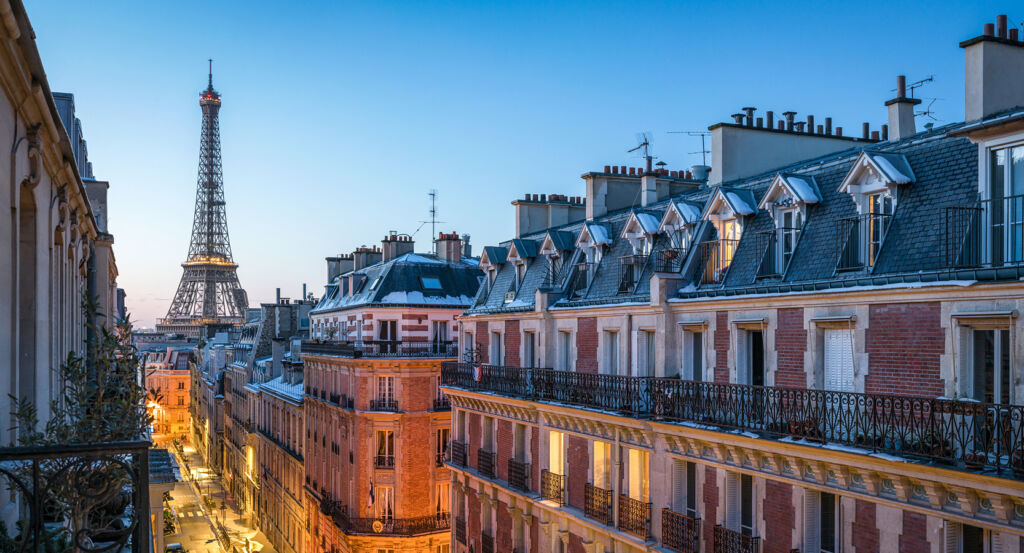
Why you should experience Hôtel Mademoiselle in Paris, France.
Hôtel Mademoiselle is a polished four-star hotel where Saint-Vincent-de-Paul's railway energy, multicultural character, nineteenth-century urban fabric and enduring culture of Parisian movement converge within an intimate house inspired by couture.
Set along Rue des Petits Hôtels near Rue de Chabrol and just steps from Marché Saint-Quentin, the 53-room hotel occupies a quiet pocket between Gare du Nord and Gare de l'Est, translating the surrounding district's constant movement into interiors conceived around the elegance and visual codes of Parisian fashion. Contemporary rooms use restrained whites, grays and blues alongside stylized feminine imagery, decorative objects and books, while four balcony rooms introduce private outdoor space above the surrounding streets. The accommodation program progresses from 14-to-16-square-meter Élégante Classique rooms through 16-to-18-square-meter Allure Deluxe rooms to seven suites reaching 30 square meters, while the planted Gabrielle courtyard creates a secluded setting for breakfast within the compact urban footprint. The result is a hotel where couture-inflected interiors, courtyard intimacy and an unusually substantial wellness program give Saint-Vincent-de-Paul's energetic railway quarter a composed residential counterpoint.
What you should know about Hôtel Mademoiselle.
Hôtel Mademoiselle is best known for taking its contemporary character through a complete renovation associated with Francine and François Dapremont, who acquired the property in 2014 and continue to own the independent 53-room hotel. The accommodation program contains seven suites and four rooms with balconies, with Élégante Classique rooms measuring 14 to 16 square meters, Allure Deluxe rooms spanning 16 to 18 square meters, Junior Suite Couture accommodations ranging from 19 to 26 square meters and Suite Mademoiselle configurations reaching 25 to 30 square meters for as many as four occupants. The renovation developed a fashion-led interior style around stylized Parisian women, pearl necklaces, butterflies, vintage books and references to the années folles, extending the Mademoiselle character through guestrooms and communal spaces rather than limiting it to the hotel name. Francine and François Dapremont maintain the property as an independently owned operation, while Victor Dapremont currently manages a workforce of 20 employees across reception, food service, housekeeping, bar and spa functions. The 2014 acquisition and reconstruction, 53-room scale, seven-suite inventory, four balcony rooms and multigenerational Dapremont involvement establish Hôtel Mademoiselle as a family-run boutique property with unusually coherent ownership, design and operating identities.
Hôtel Mademoiselle develops its strongest contemporary distinction beneath the guestrooms through a private wellness complex documented by the property at 200 square meters, incorporating a sauna, hammam, massage room, hydro-massage mattress, climate-controlled fitness room and a large relaxation area with subdued lighting. Hôtel Mademoiselle structures access around a daily complimentary shared session from 9:00 to 10:30 before converting the facility to reservation-only private use from 10:45, creating a wellness program that shifts from communal access to exclusive occupancy during the same morning. Francine and François Dapremont extend the property's social program above the spa through three salons, the Gabrielle courtyard and a late-opening salon-bar, while Hôtel Mademoiselle's environmental program has earned Green Key certification. Hôtel Mademoiselle's 200-square-meter spa, Gabrielle courtyard, three salons and Dapremont family ownership give a 53-room property an unusually extensive collection of communal environments, allowing wellness, independent hospitality and intimate social space to carry equal weight with its couture-led guestrooms.
How to fold Hôtel Mademoiselle into your trip.
Hôtel Mademoiselle works as the anchor for an afternoon tracing the market architecture, decorative experimentation and multicultural commerce that have shaped the streets surrounding Paris's northern railway terminals.
Begin at Marché Saint-Quentin, where an 1866 covered market combines pink brick, green cast-iron arcades, timber and glass within a Second Empire structure whose continuing food stalls preserve the commercial function for which the building was created. Continue to Église Saint-Vincent-de-Paul, where Jean-Baptiste Lepère began construction in 1824 before Jacques-Ignace Hittorff reshaped the project, delivering the church for worship in 1844 and developing an interior whose decoration includes Hippolyte Flandrin's procession of 200 figures alongside wax painting, enamelled glass, painted and gilded ironwork and enamelled lava. Conclude at Passage Brady, inaugurated in 1828 as a covered commercial passage before the creation of Boulevard de Strasbourg removed its central section and rotunda in 1854, with the surviving glass-roofed arcade evolving during the 1970s and 1980s into a concentration of Indian and Pakistani businesses. The progression moves from Second Empire market architecture through Hittorff's experiments with nineteenth-century decorative techniques into a commercial passage repeatedly reshaped by Parisian urbanism and migration, revealing the architectural and cultural plurality surrounding Hôtel Mademoiselle.
Where your story begins.
Foresyte Travel reveals places that feel extraordinary long before you arrive.
Experience premium editorial crafted for luxury travelers.














































































































