
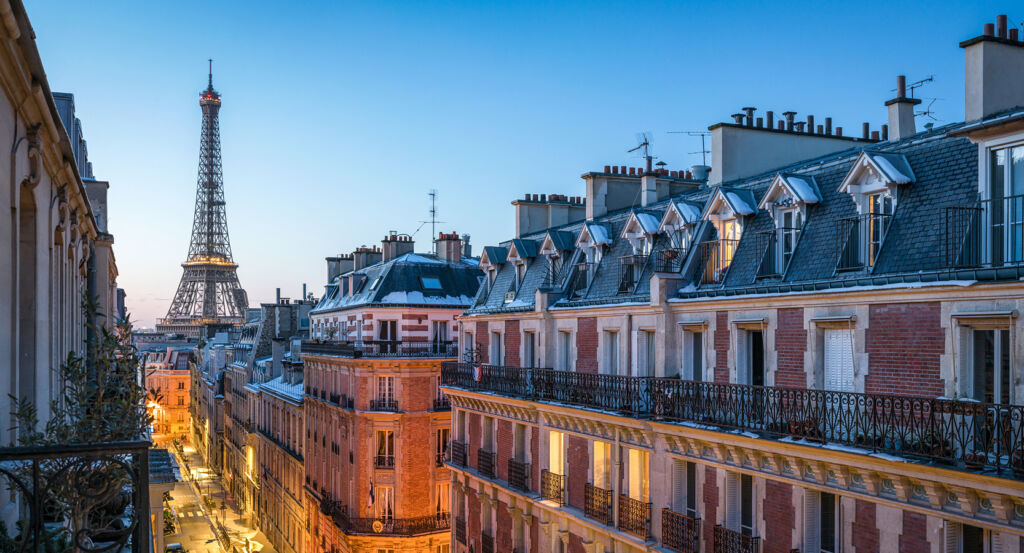
Why you should experience Hôtel Mercure Paris Levallois Perret in Paris, France.
Hôtel Mercure Paris Levallois Perret is an enterprising four-star hotel where Levallois-Perret's inventive spirit, engineering lineage, manufacturing ingenuity and enduring culture of ambitious creation meet within a compact contemporary retreat on the edge of Neuilly-sur-Seine.
Set along Rue Chaptal near Rue Jean Jaurès and just steps from Parc de la Planchette, the hotel occupies a quieter pocket of a commune whose character was forged by Gustave Eiffel, Louis Blériot, Adolphe Clément-Bayard and André Citroën, placing contemporary hospitality inside one of western Paris's richest histories of engineering and production. A partial renovation and extension delivered in June 2012 created the interior courtyard that remains central to the property, giving its compact urban footprint an open-air social core for breakfast and warmer-weather gatherings. Contemporary accommodations range from 14-square-meter single rooms to 15-square-meter doubles and 16-square-meter twins, with configurations facing either the city or patio and Privilege categories extending the room program for couples and small families. The result is a hotel where an intimate courtyard, compact accommodations and Levallois-Perret's culture of invention create a composed base within a district whose workshops helped shape some of France's most consequential feats of engineering.
What you should know about Hôtel Mercure Paris Levallois Perret.
Hôtel Mercure Paris Levallois Perret is best known for taking its current form through an 18-month partial renovation and extension completed in June 2012, when contractor ACT Construction renovated portions of the property and created its interior courtyard as part of a comprehensive building program encompassing structural work, exterior improvements, interior decoration, bathrooms, kitchens and painting. The four-star property currently organizes six accommodation configurations around Classic and Privilege categories, with Accor documenting 14-square-meter single rooms overlooking the patio, 15-square-meter double rooms facing either the city or courtyard and 16-square-meter twin rooms with city views. Privilege inventory expands that compact program through double, twin and three-person configurations, while Accor positions the outdoor patio as one of the defining communal spaces within a hotel situated between Espace Champerret and the Porte Maillot convention district. The property stands at 48 Rue Chaptal on the Neuilly-sur-Seine edge of Levallois-Perret, 500 meters from Anatole France station, within a commune created in 1867 after Nicolas Eugène Levallois transformed earlier development attempts by Jean-Jacques Perret into an intensely planned new settlement. ACT Construction's 2012 intervention, the courtyard it created, six room configurations and a compact accommodation program give Hôtel Mercure Paris Levallois Perret a distinctly small-scale hospitality character within one of the densest communes adjoining Paris.
Gustave Eiffel provides the strongest historical context for the property's surroundings, having established his enterprise in Levallois in 1866, served as a municipal councillor for 12 years and operated workshops where components for the Eiffel Tower and the iron structure of the Statue of Liberty were fabricated. Adolphe Clément-Bayard developed another major manufacturing complex in Levallois beginning in the late nineteenth century, producing bicycles, motorcycles, automobiles, dirigibles and aircraft before André Citroën acquired the works in 1921 and expanded production there. Louis Blériot added aviation to the same local culture of experimentation by establishing a Levallois factory that produced the Blériot XI, the aircraft type with which he completed his 1909 crossing of the English Channel, while Citroën's Levallois works later manufactured the 2CV through 1988. Gustave Eiffel, Adolphe Clément-Bayard, Louis Blériot and André Citroën collectively explain the engineering culture surrounding Hôtel Mercure Paris Levallois Perret, giving an otherwise understated contemporary hotel an unusually deep setting within the history of French metalwork, aviation and automobile production.
How to fold Hôtel Mercure Paris Levallois Perret into your trip.
Hôtel Mercure Paris Levallois Perret works as the anchor for an afternoon tracing the engineering legacy, civic memory and Seine ecology that reveal the successive identities of Levallois-Perret.
Begin at Parc Gustave-Eiffel, whose name recalls the engineer who established his Levallois enterprise in 1866 and whose local workshops fabricated the structural components of the Eiffel Tower and iron structure of the Statue of Liberty, connecting the contemporary cityscape directly to the metalworking expertise that gave the commune international significance. Continue to Parc de la Planchette, where the surviving dependency of an estate acquired by Comte Jean Bérenger in 1806 preserves a fragment of the landscape that preceded modern Levallois, while three hectares purchased by the municipality in 1924 became the present public park. Conclude at Maison de la Pêche et de la Nature, opened in 1993 on Île de la Jatte, where a glass-and-marble building contains a 360-degree aquarama composed of 18 aquariums devoted to fish inhabiting the Seine and extends the afternoon toward the river ecology surrounding the commune. The progression moves from the engineering culture that made Levallois internationally consequential through a surviving fragment of its pre-urban landscape into the Seine ecosystem that shaped its geography, revealing the layers of invention, urban formation and natural history surrounding Hôtel Mercure Paris Levallois Perret.
Where your story begins.
Foresyte Travel reveals places that feel extraordinary long before you arrive.
Experience premium editorial crafted for luxury travelers.














































































































