
Why The Hôtel Salé matters.
The Hôtel Salé is a theatrical private mansion where the Marais's aristocratic character meets seventeenth-century social ambition, sculptural exuberance and one of Paris's most dramatic ceremonial staircases.
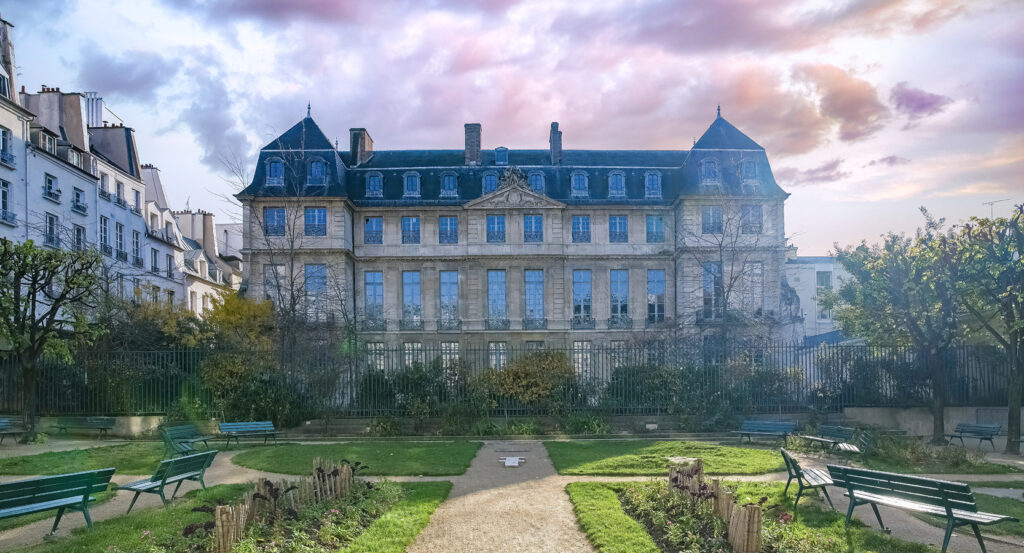
Set along Rue de Thorigny near Rue Vieille du Temple and just steps from Rue de la Perle, the mansion occupies a tightly built Marais block where narrow historic streets, tall stone fronts and enclosed courtyards conceal a residence of exceptional depth between the commercial activity of Rue Vieille du Temple and the quieter hôtels particuliers around Rue de Turenne. A street building and carriage entrance lead into the curved cour d'honneur, where seven bays, a projecting central section and abundant carved ornament transform the compressed approach into a ceremonial architectural sequence. The principal residence extends between courtyard and garden, with a secondary service court tucked beside the main composition and a more restrained garden elevation behind it. Inside, the grand staircase expands upward through two imperial flights, a projecting balcony and an upper gallery, turning circulation into the mansion's strongest spatial event. The result is a secluded Marais residence whose restrained street presence opens into a succession of courtyard, sculpture and interior volume calibrated for seventeenth-century display.
What defines The Hôtel Salé.
The Hôtel Salé is best known for being the lavish Paris residence created for Pierre Aubert de Fontenay, whose ascent through royal finance culminated in the salt-tax position that supplied the mansion's enduring nickname. Aubert purchased 3,700 square meters from the nuns of Saint-Anastase on May 16, 1656 for 40,000 livres, choosing territory within the Marais expansion encouraged after Henri IV established the Place Royale. He commissioned Jean Boullier de Bourges, then a young architect from a local family of masons, to translate his newly acquired status into a residence whose scale exceeded many contemporary houses in the district. Construction concluded in the final days of 1659, only three years after the land purchase. Boullier developed an asymmetrical composition with a double-depth corps de logis, two enfilades of rooms, a curved cour d'honneur and a perpendicular wing separating the ceremonial court from the service court. Gaspard and Balthazar Marsy joined Martin Desjardins on the sculptural program, filling the principal elevations and staircase with sphinxes, cupids, garlands, Corinthian pilasters and mythological figures. The staircase drew upon Michelangelo's Laurentian Library in Florence, expanding two imperial flights beneath a projecting balcony and gallery in an arrangement conceived with unusually strong theatrical depth. Aubert enlarged the property in 1660 by acquiring neighboring parcels toward Rue Vieille du Temple, including ground occupied by the tennis court housing the Théâtre du Marais, whose lease he preserved for the actors. His possession proved brief: the financial crisis surrounding Nicolas Fouquet brought Aubert down in 1663, and creditors fought over the property for decades. The Hôtel Salé emerged from that compressed seven-year sequence as both a product of Aubert's striking social ascent and an architectural demonstration of the new spatial and Baroque ambitions entering Parisian domestic design during the Mazarin period.
The mansion's conversion into the Musée Picasso-Paris created another architectural chapter through the collision of historic fabric and late twentieth-century museum design. The City of Paris acquired the property in the 1960s, and protection as a Monument Historique followed on October 29, 1968 after educational and commercial occupation had heavily altered the interiors. Michel Guy selected the Hôtel Salé in 1974 to receive the Picasso dation, the mechanism developed at the end of the 1960s that enabled the French state to accept major works in payment of inheritance taxes after Pablo Picasso's death in 1973. Historic restoration proceeded from 1974 to 1979 before a design competition selected Roland Simounet to convert the seventeenth-century residence into a museum. Simounet inserted a modernist architectural system inside the protected shell without extending the property, using the restored grand staircase as the pivotal element of a route supplemented by his own ramp and new vertical connections. Diego Giacometti designed furniture specifically for the museum, adding another major twentieth-century artist-designer to the building's adaptation. The Musée Picasso opened in 1985, joining the state collection created through the dation with the City-owned mansion. A later campaign under Jean-François Bodin & Associés and Stéphane Thouin reorganized interiors, technical areas, circulation and the garden before the museum reopened in 2014, preserving Simounet's intervention beside the recovered seventeenth-century enfilades. The Hôtel Salé consequently contains three architectural authorships in direct succession: Boullier's aristocratic residence, Simounet's museum insertion and the twenty-first-century reworking that expanded exhibition use.
How The Hôtel Salé fits.
The Hôtel Salé works as the anchor for a daytime exploration through the Marais using three nearby sites that move from an earlier Renaissance hôtel through a sixteenth-century residence preserved for an eighteenth-century collection into the grand seventeenth-century domestic architecture surrounding the former Place Royale.
Begin at Musée Carnavalet, housed principally within the Hôtel des Ligneris, constructed between 1548 and 1560 for Jacques des Ligneris, president of the Parlement de Paris. The residence ranks among the oldest surviving hôtels particuliers in the Marais, with Renaissance sculpture attributed to Jean Goujon across the courtyard architecture. Françoise de la Baume acquired the house in 1578; her husband, Kernevenoy, carried the nickname that evolved into Carnavalet and remained attached to the building. François Mansart raised the Rue de Sévigné entrance and added two wings beginning in 1660, followed by Madame de Sévigné's residence there from 1677. The City acquired the hôtel in 1866 during Haussmann's reconstruction of Paris and opened its historical museum in 1880, eventually incorporating architectural fragments rescued from demolished buildings into the enlarged complex. Continue to Musée Cognacq-Jay inside the Hôtel Donon, built after Médéric de Donon purchased the site in 1575. Donon, Controller General of the Royal Estates and husband of Jeanne della Robbia, created a residence organized around a rectangular courtyard with a principal house between court and garden, vaulted service spaces below and a high upper roof. Its arrangement belongs to an experimental generation of late Renaissance Marais houses influenced by Philibert de l'Orme and preceding the seventeenth-century designs of Mansart and Le Vau. The City acquired the property in 1974 and restored it between 1986 and 1989 before transferring Ernest Cognacq and Marie-Louise Jaÿ's eighteenth-century collection there in 1990. Conclude at Hôtel de Sully, begun in 1624 for financier Mesme Gallet with a garden and orangerie extending toward the Place Royale. Maximilien de Béthune, first Duke of Sully and former minister to Henri IV, acquired the residence in 1634 and completed its decoration; his grandson added a western garden wing in 1660. Nineteenth-century subdivision introduced shops, workshops and tenants before historic protection in 1862 and state acquisition in 1944 initiated a long restoration campaign completed with the orangerie in 1973. The progression moves from the Renaissance court architecture of Hôtel Carnavalet through Médéric de Donon's late sixteenth-century domestic experiment into the garden, sculpture and ceremonial planning of Hôtel de Sully, placing The Hôtel Salé within the century of architectural development that made the Marais Paris's great concentration of private mansions.
Where your story begins.
Foresyte Travel reveals places that feel extraordinary long before you arrive.
Experience premium editorial crafted for luxury travelers.
Foresyte Travel may earn a commission when you book through the link on this page.














































































































